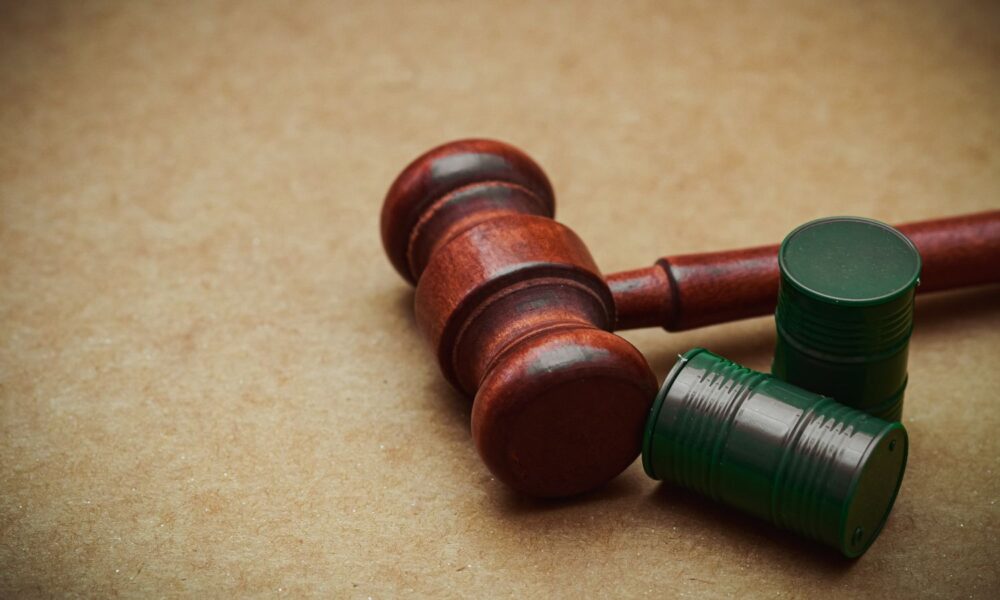

Over the last year, communities, states and advocates have driven some of the most meaningful climate progress by turning to the court. In case after case, communities and states have secured real victories.
That truth has felt especially important to hold onto in a year defined by escalating attacks on science, on democratic norms, and a US government that’s bent of uplifting the needs of fossil fuel industry over community needs. It has been a bruising stretch with programs rolled back, expertise sidelined, industry interests prioritized, and public information erased. I know that we’ve all felt that heaviness more than once.
But as the year comes to an end, I’ve been trying to step back and take in the full picture. Beneath the noise and obstruction we all witnessed in 2025, real progress did happen. Courts stepped in where political systems faltered as judges restored funding, protected rights, and kept the door open for climate accountability.
Litigation wins from around the world
I want to start with the global story. In 2025, courts around the world issued bold decisions that advanced rights, protected ecosystems, and set new expectations for climate accountability.
A healthy climate is a human right
In July 2025, the Inter-American Court of Human Rights issued an advisory opinion declaring climate change a human rights emergency and recognizing a right to a healthy climate. The Court recognized a right of nature, and emphasized states’ obligations to prevent and mitigate climate harms, protect vulnerable groups and environmental defenders, and ensure meaningful public participation. It is hard to overstate how significant it is that a regional human rights court has effectively said that inaction on climate change is incompatible with fundamental rights.
Just a few months later, former youth plaintiffs from the Juliana v. United States case turned to the Inter-American system. Fifteen young Americans filed a petition with the Inter-American Commission on Human Rights, arguing that the US has knowingly endangered their rights to life, health, and dignity for more than five decades and has systematically blocked their access to justice.
This is a clear example of how decisions in international courts are influencing new cases. Youth who spent a decade blocked in domestic litigation are now invoking a regional human rights system that has just recognized climate change as an emergency.
States must act on climate change under international law
Also in 2025, the International Court of Justice (ICJ) echoed this reasoning. In its advisory opinion, the ICJ affirmed that states have legal obligations under international law to protect the climate for present and future generations. It recognized that historical emissions matter, that states must adopt ambitious climate targets, and that failure to act can violate human rights. It also suggested that vulnerable countries and individuals may be able to seek reparations from major polluters for climate damage.
This advisory opinion is already changing the legal landscape. In Germany, for example, an environmental organization expanded a constitutional complaint on biodiversity loss by citing the ICJ advisory opinion and its recognition of a right to a healthy environment and state duties to protect nature. They argue that, since international law acknowledges the right to a safe and sustainable environment, domestic law must be interpreted in a way that makes that right real.
Courts regulate oil and gas projects
In Kenya, courts have upheld the revocation of the environmental license for the Lamu Coal Power Station and blocked large-scale clearance of Nairobi’s Karura Forest, grounding their reasoning in constitutional rights to a clean environment, procedural fairness, and meaningful public participation.
In South Africa, the Western Cape High Court has overturned the South African government’s approval of TotalEnergies’ offshore drilling project due to significant flaws in the environmental review process.
In Europe, courts are increasingly confronting oil and gas expansion. The Scottish Court of Session ruled that approval of the Rosebank oil field was unlawful because regulators failed to consider emissions from burning the extracted oil and gas. A Danish appeals body struck down the permit for the Hejre oil field for similar reasons, aligning Danish law with emerging European case law that demands full lifecycle assessment of climate impacts. In Norway, an appeals court declared three North Sea oil fields illegal because the state failed to properly assess their climate consequences, relying on detailed scientific evidence about health impacts and ice loss.
Courts thwart greenwashing
At the same time, consumer protection and advertising laws are becoming important tools for accountability. A Paris court issued a historic ruling condemning TotalEnergies for greenwashing its carbon neutrality claims. Regulators and courts in Australia, New Zealand, Germany, and the European Union repeatedly sanctioned financial firms, pension funds, tech companies, energy companies, and airlines for overstating their climate credentials or promising “carbon neutral” products without adequate evidence.
Corporate cases and expanding legal theories
A court decision in Italy confirmed that climate lawsuits against a major company like ENI are admissible. Also in Italy, courts jailed eleven executives and imposed over €75 million in civil damages for PFAS contamination. In a landmark decision, the Higher Regional Court in Hamm, Germany, affirmed that major carbon emitters such as RWE can be held legally liable for their proportional contribution to climate-change damages, establishing a powerful precedent that strengthens climate accountability cases worldwide. In Brazil, a Supreme Court justice has ordered that land illegally deforested or burned must be confiscated, cutting off a pathway that allowed land-grabbers to profit from environmental destruction.
These are concrete, enforceable decisions that change behavior on the ground. They reaffirm that the environmental protections embedded in laws and constitutions carry real weight.
US legal wins in 2025
In 2025, the US courts issued a series of decisions that strengthened climate accountability, clarified legal responsibilities, and delivered tangible outcomes for communities.
In Louisiana, a jury ordered Chevron to pay $744.6 million to restore coastal wetlands damaged by decades of oil and gas operations. That case turned on a specific state law requiring companies to remediate environmental damage, but it also shows that courts and juries are prepared to put real numbers on long-term ecological harm.
A federal court blocked a 73-million-acre offshore oil lease sale in the Gulf of Mexico, relying on NEPA and endangered species protections to say that climate impacts and risks to species like the Rice’s whale cannot be brushed aside. Another federal court certified a class of Colorado landowners who allege that oil and gas companies shirked their obligations to plug orphaned wells, leading to methane emissions and other harms. On the West Coast, the Swinomish Indian Tribal Community reached a landmark settlement with BNSF Railway over unauthorized train operations across the reservation, an agreement that affirms tribal sovereignty, protects treaty fishing rights, reduces tanker traffic, and channels settlement funds toward housing, healthcare, education, and environmental stewardship.
The US has also seen some legal wins regarding consumer protection. New York’s Attorney General secured a settlement requiring JBS USA to pay $1.1 million toward climate-smart agriculture and to stop misleading “Net Zero by 2040” claims.
New legal theories expand pathways to accountability
We are also seeing new types of cases. In Washington State, the daughter of Juliana Leon, who died during the record-breaking 2021 Pacific Northwest heat dome, has brought what appears to be the first US lawsuit that links an individual death directly to climate change. Her case argues that major fossil fuel companies should be held responsible for knowingly contributing to the extreme heat that killed her mother. The companies immediately tried to move the case into federal court, a common tactic used to delay or derail state-law climate claims. But a judge rejected that effort and sent it back to Washington state court.
Another emerging case in Washington links Big Oil’s decades of climate deception to the sharp rise in homeowners’ insurance premiums, arguing that fossil fuel companies’ disinformation campaigns helped drive the climate-intensified disasters now burdening families with soaring costs.
What about US climate accountability cases?
Now, I’ve written about this before. In 2025, courts continued to open doors for climate accountability cases. In the United States, courts repeatedly refused to shut down state and local climate accountability cases. Federal courts rejected Big Oil’s procedural arguments nearly 30 timesand every state supreme court to reach the question so far has allowed these cases to move ahead rather than dismiss them. One example from 2025:, when companies attempted to remove Maine’s climate deception case to federal court, the judge sent it back to the state court, echoing decisions across the country that have rejected the same recycled arguments.
On top of that, trial courts in states like Massachusetts, Rhode Island, Vermont, California and Hawaiʻi have denied motions to dismiss and are letting key deception and consumer-protection claims move into discovery and toward trial.
Moving forward, we are working hard to maintain that momentum and stop the Trump administration and the Supreme Court from blocking communities from seeking accountability.
The importance of the courts today
While not traditional climate litigation, I also need to note the important role the courts have played in the United States to defend science, pathways to accountability, and clean energy.
While the Trump administration has increasingly attempted to use the courts to shield fossil fuel companies from scrutiny, its approach became especially clear on May 1, 2025, when it filed lawsuits against New York, Vermont, Hawai’i, and Michigan. The administration sought to block these states’ climate superfund laws and their ability to pursue climate damages cases, an unprecedented effort to prevent states from holding fossil fuel companies accountable for the harms they have caused.
But that same day, Hawai’i told a very different story.
Rather than backing down, Hawai’i filed a major lawsuit against some of the world’s largest fossil fuel companies and the American Petroleum Institute. The complaint details decades of climate deception with deliberate efforts to mislead the public, understate climate risks, and delay the energy transition. It links that deception directly to the lived realities of rising seas, worsening extreme weather, and tragedies like the Maui wildfires. Where the federal government sought to shield polluters, Hawai’i chose to demand accountability.
This pattern repeated throughout the year. The administration worked to roll back or freeze billions of dollars in climate and clean energy funding, to cancel programs like the Solar for All initiative, and to lean on secretive “climate working groups” and skeptic panels to undermine scientific consensus. Farmers saw climate information disappear from USDA websites. Communities that had been promised support for resilience and clean energy saw grants suddenly revoked.
Again and again, people went to court.
Federal judges ordered the release of hundreds of millions of dollars in frozen climate and environmental funds, rejecting the argument that agencies could simply pause or de-obligate lawfully appropriated grants. A judge in Seattle blocked the cancellation of more than $9 million in climate resilience funding for Washington State, including a Tribal Stewards program and a coastal hazards project, warning that allowing administrations to upend multi-year grants at will would create “unnecessary chaos.” Nearly two dozen states sued over the abrupt termination of the $7 billion Solar for All program, arguing that the administration’s actions were legally baseless and politically punitive.
Advocates also challenged the administration’s attempts to manufacture doubt about climate science itself. Environmental Defense Fund and the Union of Concerned Scientists sued over the secret “Climate Working Group,” a panel that produced a report aimed at weakening the EPA’s Endangerment Finding, the scientific determination that climate pollution endangers public health and welfare. Courts have already ruled that this working group is subject to federal transparency laws because it provided policy advice, not neutral technical analysis.
In today’s political climate, the courts have become one of the few places where science, transparency, and public interest still have a real foothold.
Rays of hope in dark times
Litigation is increasingly how societies are defining what climate responsibility means in practice. It is the place where scientific evidence about attribution and impacts is translated into legal standards, where principles like polluter pays, intergenerational equity, and the right to a healthy environment take on enforceable meaning. And it is where communities insist that their rights do not vanish simply because political leaders are unwilling to act.
In the United States, climate litigation has also become a critical counterweight to the Trump administration’s efforts to shield polluters and dismantle climate protections. When federal agencies attempt to block or undermine state-level accountability, the courts can help ensure that those claims are heard on their merits.
Progress is not linear. Some rulings do signal caution or reveal weaknesses in the evidentiary record, and increasingly, industry is filing anti-climate action suits. I’m not trying to pretend like those cases aren’t happening, but I do think it’s important to uplift and celebrate the wins of 2025.
This year climate litigation has evolved into a forward-looking strategy to secure rights, protect communities, and keep science at the center of public decision-making. Courts are not perfect, but they remain one of the few institutions where facts must be weighed and legal obligations can still be enforced. In a moment when democratic norms and scientific truth are under pressure, that role matters. In this moment, it is a bright spot and a reminder that the story of climate accountability is still being written, case by case, and community by community.