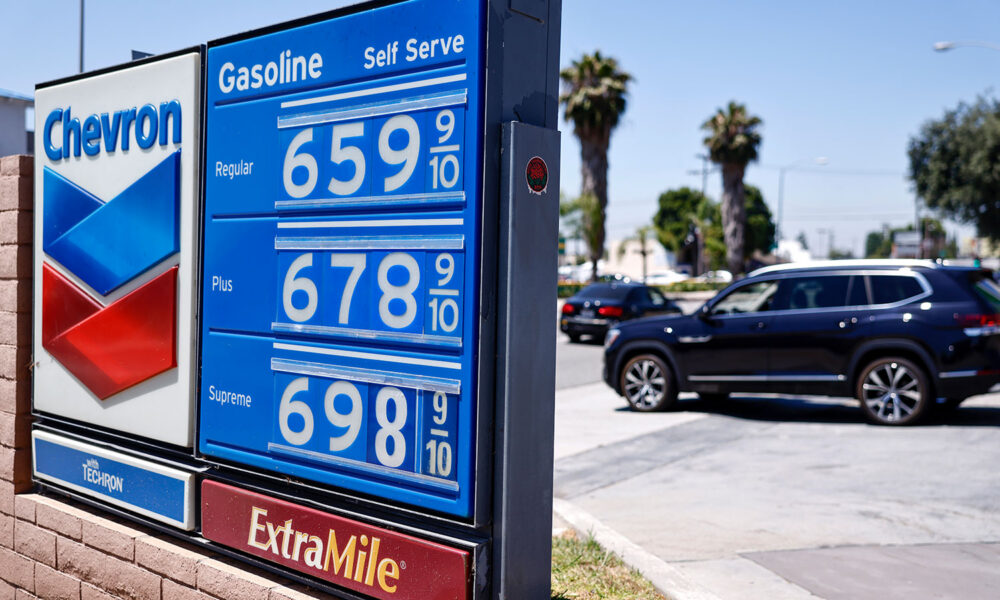

California’s gasoline market has become dangerously uncompetitive. It is increasingly clear that the most egregious reason for high gas prices in California is oil companies taking advantage of supply constraints and market consolidation to charge consumers unfair monopoly prices. Incoming Governor Xavier Becerra should be laser focused on fixing California’s broken market by modernizing regulations, repurposing obsolete infrastructure to meet current and future needs and taking on vertically integrated oil companies to restore fair competition. This will bring down unfair premiums and reduce the leverage oil companies have over California’s economy and democratic decision-making process.
Why is gasoline so expensive in California?
California’s gasoline prices are high for several reasons. Prices are higher in 2026 than they were a year ago because of the war in Iran. There is not much Governor Becerra can do about that. But prices in California are also higher than they are in the rest of the US, and that is certainly something the Governor should pay attention to. There are three broad reasons for California’s higher prices: taxes, environmental programs, and uncompetitive markets. Fuel taxes pay for transportation infrastructure projects including highway maintenance, local road repairs, and transit. Environmental programs are driving down heat-trapping emissions and toxic air pollution. Taxes and environmental programs are determined by elected officials and state agencies on behalf of Californians and are subject to ongoing scrutiny to ensure that taxes are well spent, that the tax burden is equitably distributed and that environmental programs are working well.
But the more insidious and undemocratic reason for high California gas prices is a broken uncompetitive fuel market that allows Chevron and other big oil companies to charge higher markups than they do in the rest of the US. Professor Severin Borenstein at the UC Berkeley Haas School of Business is the leading expert in this area, and has documented that since 2015 California gasoline has been about 40 cents a gallon more expensive than the rest of the US, after accounting for differences in taxes and environmental programs. He dubbed this the “mystery gas surcharge.” Partly as a result of Professor Borenstein’s analysis, the Legislature created the Division of Petroleum market Oversight (DPMO) in 2023 by Senate Bill X1-2, the California Gas Price Gouging and Transparency Law. DPMO has been using their oversight authority to understand the root causes of fuel market disfunction and recommend solutions. DPMO confirmed Professor Borenstein’s findings, concluding that the mystery surcharge cost “California consumers over $59 billion in extra payments for gasoline between 2015 and 2024.”
How monopolies harm people
The competition problems in the California fuel market have been brewing for decades. California’s gasoline market has been getting increasingly concentrated since the 1980s. The trend toward refinery consolidation is global and was facilitated by a permissive approach to monopolies in all sectors of the economy. The resulting concentrated corporate power is a problem that goes beyond gasoline prices. Supreme Court Justice Louis Brandeis argued a century ago, in the last gilded age, that the concentrated power of huge corporations – railroads, banks and oil companies in his day – undermines democracy, an argument that increasingly resonates today. Monopoly control over vital industries harms workers, consumers and communities and undermines the ability of California’s democratically elected leaders to act in the best interests of the people they represent. Oil companies like Chevron have engaged in decades of deceit and disinformation against climate action. They’re now desperately trying to avoid accountability for climate deception and damages — and block lawsuits including from eight California municipalities and the state of California — by lobbying for legal immunity in Congress and state legislatures and appealing to the US Supreme Court. It’s therefore vitally important for Governor Becerra to restore competition to California fuel markets, to protect consumers, reduce the political power of oil companies, and chart a course to a clean energy future that protects the people of California.
To restore competition to California’s gasoline market we need to understand the specific barriers to competition. The details are complex and interconnected, but in the last few years we have developed a much better understanding, thanks to the efforts of the California Energy Commission, the DPMO, Professor Borenstein and many others. Some of the key barriers are listed below.
Barriers to competition in California’s gasoline market
Geography and the Jones Act
California is a long way from the center of the US refining industry in the US Gulf Coast, especially by sea, which is how petroleum products are generally transported in the absence of pipelines. The impact of physical distance is amplified by a US law called the Jones Act, which requires shipments between US ports to move by ships that are US owned, built and crewed. There are very few Jones Act tankers available to move petroleum products between US ports, and even when they are available, they are relatively expensive. As a result, it is generally less expensive to ship fuel to California from Asia than from the US Gulf Coast. 2026 has been an exception, as the Trump administration waived Jones Act requirements from March to November 2026.
A shrinking market
California’s gasoline market peaked in 2005 and is expected to keep declining as more efficient vehicles and electric vehicles increase market share. This is a major accomplishment of California’s policies, and benefits consumers and public health. But it also discourages new investment in oil refineries and related infrastructure.
Unique gasoline regulations
California uses a unique gasoline formulation, called California Reformulated Gasoline for Oxygenate Blending (CARBOB). This is slightly more expensive to produce but more significantly poses a barrier to competition since refiners outside the California market can’t just sell the fuel they already produce but need to make a different formulation specifically for the California market.
Configuration of physical infrastructure
California has an extensive network of marine terminals, pipelines, and storage for crude oil and refined products. However, the configuration of that network is not keeping up with changes in the market. The infrastructure was built when California was a net exporter of refined fuels and is not optimized to import and distribute the refined fuels California increasingly needs.
Market consolidation and vertical integration
The number of oil refineries operating in California and the number of companies operating them have fallen steadily since 1980, paralleling trends across the US and around the world. With the most recent closures, just three companies, Chevron, Marathon Petroleum and PBF Energy, control 90 percent of California’s gasoline refining capacity. But the barriers to competition are not limited to refineries. The distribution system that delivers fuel to gas stations is also highly concentrated. Compared to other US markets, a larger share of the infrastructure required to import, store and distribute gasoline is under the control of the major vertically integrated oil companies rather than merchant or independent operators that serve multiple third-party fuel marketers and wholesalers.
Uncompetitive retail gasoline markets
Comparing California’s average gasoline prices to the rest of the US obscures important problems in the retail gasoline market. Branded gasoline stations, especially Chevron stations, charge vastly higher premiums compared to unbranded stations than they do in the rest of the US. Analysis from DPMO and other agencies here, here and here reveals that, in 2025, branded gasoline was $0.31 per gallon more expensive than unbranded gasoline in California versus $0.07 per gallon more expensive in the rest of the US, and points to several contributing factors: only 32 percent of gas stations in California sell unbranded fuel, compared to 50 percent nationwide; half of California gasoline sales are through vertically integrated channels, versus 9 percent in the rest of the US; California has a third fewer gas stations per resident than the rest of the US; and a recent lawsuit highlighted the alleged use of AI-based pricing services to raise prices through tacit collusion.
The solutions: removing the barriers to competition one Jenga brick at a time
Given the interconnected barriers to competition that have built up over decades, it will take more than one step to fully restore competition and fair prices to California’s gasoline market. The barriers to competition are like a stack of Jenga bricks, and when enough brinks are removed, monopoly pricing power will collapse restoring fair competition. It’s hard to know in advance exactly which brick will bring down the pile, and some of the barriers to competition, like geography and federal law, are outside of the Governor’s power. But Governor Becerra has the power to remove barriers to competition. Three priorities deserve special focus:
- Update or eliminate outdated gasoline regulations
- Repurpose and modernize California’s fuel infrastructure
- Restructure fuel markets to restore fair competition
Update or eliminate outdated gasoline regulations
A quick search on why California gasoline is expensive will turn up its special gasoline blend, CARBOB. Starting in the 1990s, California introduced pioneering gasoline regulations, which were phased in over the next decade. They were much stricter than federal regulations, which was vital for cleaning up California’s very bad air pollution. Over time, federal regulations followed California’s lead, and by 2020 they had largely caught up on the most important properties (sulfur and benzene). At the same time, cars got much cleaner thanks to stronger pollution regulations, and modern cars became much less sensitive to small changes in fuel properties. As a result, CARBOB matters much less for clean air than it did 25 years ago. Today, the biggest source of pollution is the oldest cars on the road, especially those sold before 2004, which lack modern pollution controls.
But while the benefits of CARBOB have been declining, the costs are rising. CARBOB increases costs in two ways. First, it is slightly more expensive to produce, although this difference has probably declined as federal standards have gotten closer to California’s. But beyond manufacturing costs, using a unique fuel makes the California market less competitive, since refiners who produce fuel for other markets can’t readily ship some to California to take advantage of high prices. This combines with other barriers to competition to sustain the monopoly powered mystery gas surcharge.
The solution is to modernize California’s fuel regulations to support competition. The state should immediately implement short-term flexibility provisions we’ve described before, allowing the sale of US spec gasoline to speed up resupply during supply disruptions. And over the next two years it should modernize its gasoline regulations to align with federal regulations. California’s Air Resources Board is currently testing vehicles with different fuels to understand what difference, if any, changes in fuel make to tailpipe pollution. Based on their findings they should start the process of updating their fuel regulations.
Our earlier analysis suggested that there is a small air quality benefit to CARBOB over federal fuel, but these modeled findings need to be validated by experimental data. Our conclusion was that the best way to protect air quality and public health is not to make everyone use more expensive fuel, but to focus state support on older cars, where the pollution is concentrated. The smarter and more equitable path to clean air is to increase support for programs that get the oldest, most polluting cars off the road. State and regional air districts already run programs, called Clean Cars for All, that help low-income drivers replace older vehicles with new or used EVs. These programs remove highly polluting vehicles from overburdened communities, ease the burden of high fuel prices on low-income drivers, and support California’s public health and climate goals. Making fuel regulations more flexible while accelerating the retirement of old cars is a win-win-win.
There are two paths forward. The state could match federal gasoline regulations exactly and increase its investment in Clean Cars for All to mitigate any increased pollution. Or it could adopt a hybrid regulation that allows the sale of federal fuel with a small mitigation fee but maintains a preference for cleaner fuel when it is available. Either way, the state should not allow its pollution regulations to be a barrier to a competitive fuel market when it has better options to achieve the same public health and pollution outcomes.
Repurpose and modernize California’s fuel infrastructure
California’s fuel infrastructure, its pipelines, terminals, and fuel storage, is increasingly unsuitable for its current needs. It was built to move crude oil from California oilfields and marine terminals to refineries that would be refine it to gasoline, diesel and jet fuel for use in California and for export to Arizona and Nevada. However, refinery closures mean California no longer has excess refined fuel for export. Instead, it now relies on international imports for about 20 percent of its gasoline and a substantial amount of its jet fuel. The result is that California’s fuel market is increasingly dependent on imports by ship, and when the Jones Act is being enforced, these imports are generally from Asia rather than US refiners in the Gulf Coast.
Now that California is a persistent importer of gasoline and other liquid fuels, Kinder Morgan, Phillips 66 and HF Sinclair are building the Western Gateway Pipeline. This pipeline will connect California and Arizona to fuel markets in the US Midwest and Gulf Coast. The California portion of the project involves reversing the flow of the existing pipeline that is currently used to export fuel from California to Arizona. The capacity of this pipeline is roughly equivalent to one refinery, and when it begins operation it will reduce the need for international imports by ship.
It might seem counterproductive to build new fossil fuel infrastructure when the California market is shifting to electrification. But it’s important to examine the specifics, and in this case connecting California and its neighbors to broader US fuel markets has important advantages. Pipeline connections between the west coast and inland refining centers will reduce the need to import fuel by ship from overseas. This will not increase overall fuel consumption but replace international imports with domestic fuels and move those fuels by pipeline rather than ship, which will reduce the pollution burden of shipments at overburdened port communities.
Another important advantage of increased pipeline connections is that pipelines can deliver whatever mix of products the market needs. In-state refiners are not set up to supply the mix of fuels California needs now and in the future. Fossil diesel has been rapidly replaced by renewable diesel, gasoline is declining gradually, and jet fuel demand is expected to remain strong for decades to come. A small number of in-state refineries can’t readily adjust their output to match these changes in demand, but the pipeline can deliver whatever fuels are required to complement the fuels produced in California. Pipeline connections between California and the broader US fuel market can supply not only fossil fuels, but bio-based diesel and jet fuel, as fuel market demand evolves.
California regulators are currently studying the adequacy of its fuel infrastructure. The state should support strategic infrastructure modernization to meet current and future needs, which can largely be met by repurposing existing infrastructure. There is underutilized infrastructure designed to move and store crude oil that could be converted to use for refined products. For example, a 2022 analysis conducted for the California Contra Costa Refinery Transition Partnership suggested reconfiguring excess capacity in crude oil pipelines to move refined products between Northern and Southern California. Such a pipeline conversion, if it proved practical, could improve the connections between Northern California and Southern California, and though it to the rest of the US, and reduce the need to move fuel between these markets by ship.
Restructure markets to restore fair competition
The most important problem in California’s broken gasoline market is the market structure itself. A few companies, led by Chevron, control a large share of California’s gasoline market, not just in-state refining capacity, but marine terminals, pipelines, fuel storage, the distribution system needed to get fuel to gas stations, and contractual relationships between fuel suppliers and retail outlets.
DPMO analysis has provided clear evidence that California’s market structure is far more concentrated both horizontally and vertically than in the rest of the US. This market structure and technologies like pricing algorithms limit competition and allow uncompetitive prices to persist even without explicit collusion.
Governor Becerra should take a multi-pronged approach to fixing the market structure problems in four ways.
- Aggressively enforce anti-trust laws. Some of these laws have been on the books for decades, others have been recently strengthened, but these laws are only effective if they are aggressively enforced.
- Empower DPMO and other state agencies to study and correct market structure problems where they have authority and seek additional authority as needed.
- Strengthen anti-trust laws, including laws to break up vertical integration such as open supply and divorcement.
- Facilitate private sector competition. The state has identified the need for more fuel storage and is studying the adequacy of marine terminals and other potential infrastructure bottlenecks. The state can encourage private sector investment to address these needs, but as it does it should prioritize infrastructure run by independent operators and open to all potential market participants, to support competition.
Breaking up and restructuring an industry as large as California’s fuel market is no small task, and it will take some time. California’s transition from fossil fuels to clean energy over the coming decades will deliver many benefits, but it will also amplify many of the structural problems in the legacy fossil fuel system. It’s vital for Governor Becerra to establish and maintain flexible and competitive markets for both clean energy and legacy fuels that can meet the daily needs of California consumers until the transition away from fossil fuels is complete.