
Industry backed groups are once again shaping public narratives in ways that favor the status quo. If the opposition to offshore wind feels eerily familiar, that’s because it is. What we’re watching along the US East Coast is a well-worn disinformation playbook, one the fossil fuel industry has refined over decades, being redeployed to slow the clean energy transition at precisely the moment it threatens entrenched power.
Research from Brown University’s Climate and Development Lab, in striking detail, maps a network showing how fossil fuel interests and climate denial groups fund, staff, and strategically guide “grassroots” opposition to offshore wind projects from Massachusetts to Virginia. The result is a facade of local resistance that obscures a coordinated, well-resourced campaign to preserve fossil fuel dependence. (And the threat to fossil fuels is real: a new UCS analysis shows that if a larger offshore wind fleet had been operating, New England’s local renewable resources would have delivered more than double the amount of energy delivered by costly, polluting LNG imports.)
Understanding the battle that’s been brewing off the East Coast is important because, at its heart, it is a battle over who gets to decide our energy future and how disinformation is being used to preserve fossil fuel dominance. Here are some key tactics being used to obscure the discussion around offshore wind.
Manufactured grassroots opposition
Across coastal communities, new organizations have emerged claiming to speak for local residents, fishermen, or wildlife advocates. They show up at town council meetings, flood social media, and file lawsuits with unproven warnings about the “harms” offshore wind could cause.
But when you trace these claims back to their sources, a different picture emerges. The Brown University report Against the Wind documents just how many of these groups are embedded in a dense national network of fossil fuel aligned think tanks, dark money donors, and political advocacy organizations. You can see the full map of these organizations here.
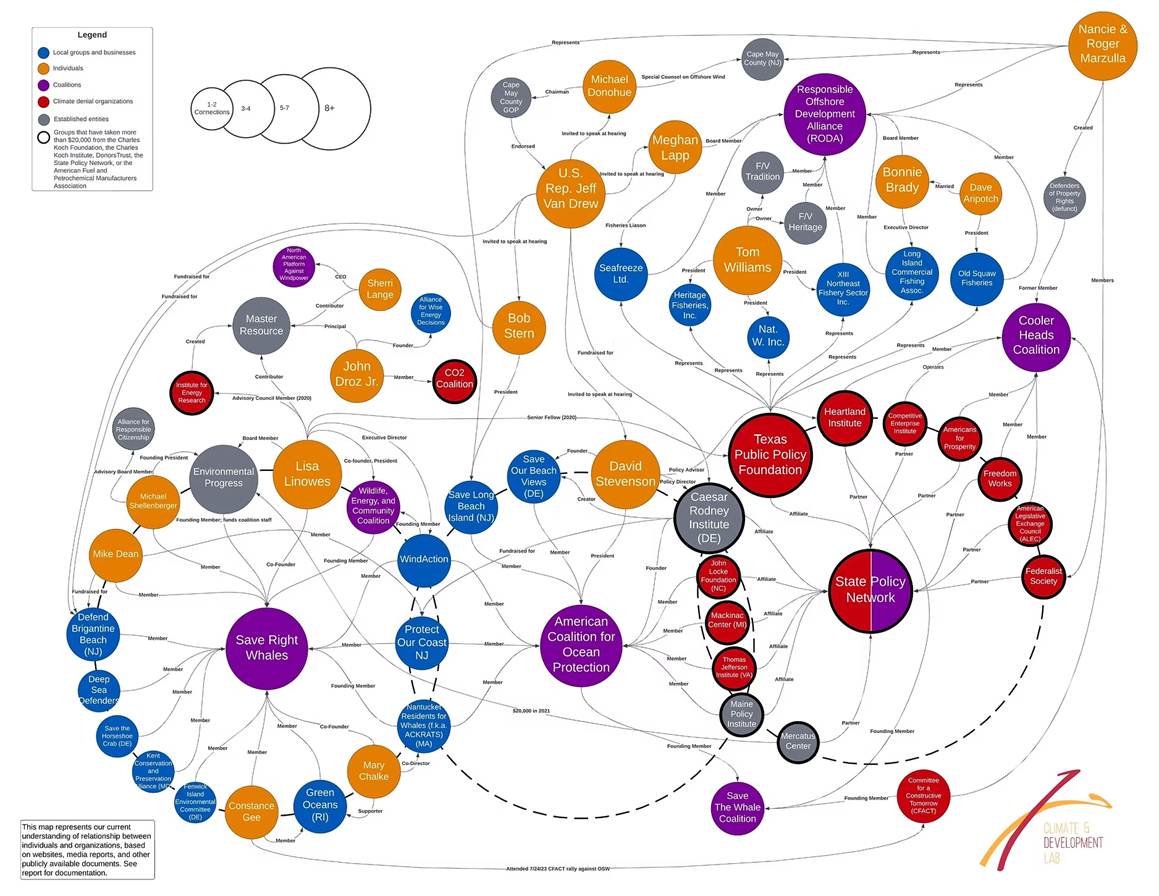
Brown University’s mapped understanding of the connections between individuals and organizations, and the fossil fuel industry, in the offshore wind arena. Source: Against the Wind
These groups share leadership, legal counsel, messaging, and funding streams. What appears to be grassroots activism is, in many cases, astroturf—campaigns that are designed to look like local, community-driven opposition but are actually funded, coordinated, or guided by powerful outside interests.
This is not accidental. As early as 2012, internal strategy documents from anti-wind operatives explicitly called for campaigns that “must appear as a ‘groundswell’ among grass roots.” That guidance has been followed to the letter. Local groups are provided with talking points, media training, legal infrastructure, and scientific-sounding claims that lend an air of legitimacy to opposition efforts.
Fake science as a weapon
Central to this playbook is the strategic misuse of science. Rather than engaging with the substantial scientific record, opponents of offshore wind often lean on unsubstantiated environmental concerns, particularly around whales, to argue against its development. These claims are repeated endlessly despite overwhelming scientific evidence to the contrary.
Federal agencies, independent scientists, and peer-reviewed research have found no causal link between offshore wind development and recent whale mortalities. In fact, the primary documented threats to North Atlantic right whales remain vessel strikes (and 40% of ships on the oceans globally are actually transporting fossil fuels) and fishing gear entanglement, both long-standing consequences of existing industrial activity in the marine environment.
The persistence of these claims is not about scientific uncertainty. It is about narrative saturation. By flooding local discourse with misleading or outright false assertions, opponents create confusion, delay permitting, and undermine public trust in scientific institutions. This tactic mirrors earlier fossil fuel strategies to cast doubt on climate science itself: if people are confused enough, action stalls.
Intimidating scientists, chilling speech
The consequences extend beyond intentionally creating public confusion and misunderstanding. Scientists working on offshore wind, marine ecology, or climate impacts increasingly face harassment, legal threats, and coordinated attacks on their credibility. Public meetings devolve into hostile interrogations filled with disinformation. Researchers are accused of significant harm, cover-ups, or ideological bias simply for presenting established science.
This intimidation is another well-known tactic in the disinformation playbook. When scientists are harassed or discouraged from participating in public processes, industry-aligned narratives face less resistance. The chilling effect narrows the range of voices shaping public understanding and policy decisions, further tilting the field toward delay.
From tobacco to pharmaceuticals to climate change, industries facing regulation have repeatedly targeted scientists as obstacles to profit. Offshore wind is simply the latest arena.
Bad faith lawsuits as delay
Disinformation alone is rarely enough, so it is often reinforced through litigation designed to slow or derail action.
The same network mapped by the Brown University researchers shows how fossil fuel–aligned organizations provide legal support to local opposition groups to challenge offshore wind projects in federal court. These lawsuits frequently recycle the same debunked claims, but their purpose is not necessarily to win on the merits: it is to delay.
Every lawsuit buys time. Every injunction request stalls construction. Every procedural challenge drains public resources and investor confidence. Meanwhile, while our green energy infrastructure is being delayed, fossil fuel infrastructure, already permitted, already polluting, continues operating without interruption.
This strategy exploits the legal system’s good-faith openness to challenge by weaponizing process against progress at a hefty cost.
Attacking state authority
There is another layer to this strategy that deserves attention. Offshore wind opposition is increasingly tied to broader political efforts to strip states of their authority to regulate energy systems and protect public interests.
Many of the same organizations opposing offshore wind are also involved in campaigns to preempt local climate policies, block building electrification, or weaken environmental review processes.
These efforts are often framed as defenses of property rights or economic freedom, but their effect is to centralize power in ways that favor incumbent fossil fuel industries.
If states cannot set renewable energy targets, enforce environmental safeguards, or pursue climate solutions tailored to their communities, the status quo prevails. Offshore wind, one of the most scalable, near-term tools for decarbonizing the power sector in some parts of the country, becomes collateral damage in a much larger fight over democratic control of energy systems.
The hidden infrastructure behind offshore wind opposition
What makes this all possible is something we don’t talk about nearly enough: disinformation subsidies.
Fossil fuel interests don’t just spread misleading claims: they subsidize the entire ecosystem that allows those claims to circulate, gain unearned credibility, and take root locally. The network mapping that I shared above shows that that local groups opposing offshore wind have received massive and varied information subsidies from national think tanks and industry-aligned organizations including funding, legal support, media content, research reports, expert talking points, and strategic guidance backed by more than $72 million in contributions from just six major donors between 2017 and 2021. These resources allow local groups to project influence far beyond what their size, capacity, or expertise would otherwise permit.
Crucially, this system does not fit neatly into established categories of either purely grassroots opposition or top-down astroturf campaigns. Instead, it operates through dense networks in which local actors remain visibly present and active, while national fossil fuel–aligned organizations shape the narratives, claims, and strategies that local groups deploy. The result is a steady stream of misleading or distorted arguments often framed in the language of environmental concern that are amplified through lawsuits, op-eds, social media, and public testimony.
Scientists, regulators, and communities are facing off with a professionally produced alternative reality backed by coordinated messaging, litigation capacity, and tax-deductible support structures.
A subsidized disinformation system is not a single lie, but a sustained infrastructure designed to delay accountability, demobilize political support, and lock in fossil fuel dependence.
Seeing the disinformation clearly
Offshore wind is a powerful tool for meeting climate targets, improving air quality, reducing reliance on fossil fuels, and a host of other benefits. Delaying it has real costs that are borne disproportionately by low-income communities and communities of color already overexposed to pollution and climate risk, while disinformation exploits and amplifies genuine concerns someone might have about offshore wind.
The opposition movement mapped by Brown University makes clear that these delays are not accidental but a product of deliberate investment, coordination, and narrative manipulation by actors with a vested interest in maintaining fossil fuel dominance. Recognizing disinformation is the first step toward countering it.
Disinformation thrives in the shadows when funding sources are obscured, networks remain invisible, and fake grassroots campaigns go unexamined. Research like Against the Wind helps pull back that curtain, showing how opposition to offshore wind is manufactured, financed, and deployed.
The lesson here extends far beyond wind turbines. As climate solutions scale up, we should expect this industry playbook to be reused again and again. This means that we need to all learn the playbook and confront the systemic disinformation infrastructure designed to keep fossil fuels in power.
The real threat isn’t offshore wind, but a subsidized system of delay that we can no longer afford to ignore.