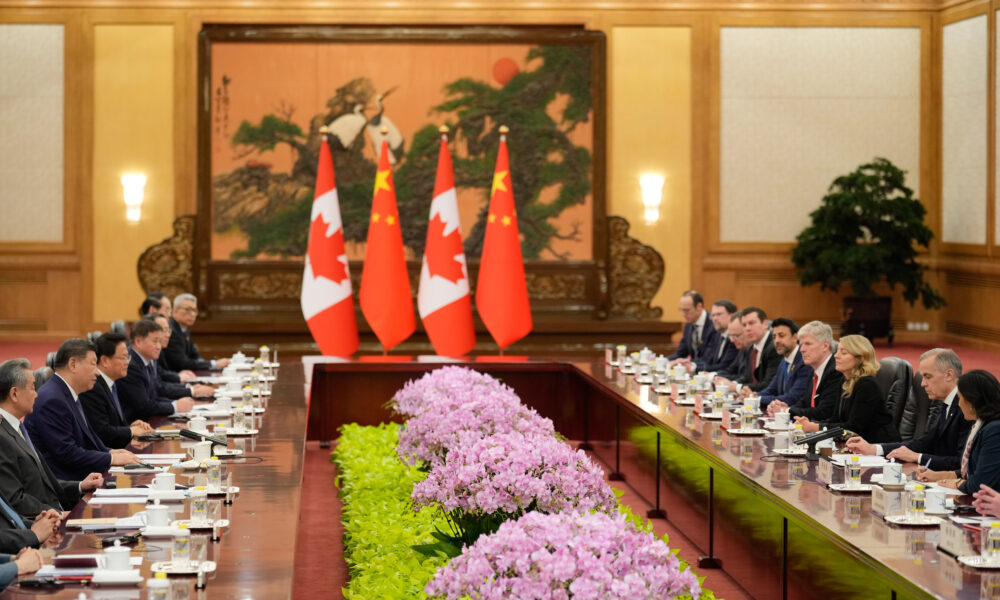

During his well-received speech in Davos, Canadian Prime Minister Mark Carney made two noteworthy observations about current events that could alter the trajectory of contemporary China. The first is that we are experiencing “a rupture in the world order” that marks “the end of a nice story,” which is that the world order the United States organized in 1945 was based on rules that applied equally to everyone. The second is that the “American hegemony” that sustained allied governments’ faith in that story “no longer works.” He delivered the same message in Beijing two days earlier, just after signing a strategic partnership agreement with Chinese President Xi Jinping.
Except for a brief rapprochement in the mid-1980s, the foreign and defense policies of the Chinese Communist Party have been consistently focused on combating US hegemony. The Chinese definition of the term is hard to pin down, but at the heart of it is the shared belief among the United States and its allies that the “rules-based world order” the United States has led since the end of World War II is legitimate, and the Chinese Communist Party is not. Carney, invoking Vaclav Havel’s characterization of the old Soviet system, described the post-war US-led system as “a lie.” If more US allies come to the same conclusion, a significant change in Chinese foreign and defense priorities could follow.
Meeting in the Middle
Chinese officials began to question the longevity of US hegemony more than a decade ago. In 2013, during a conference on space and cyber security at China’s National University of Defense Technology, I listened to a Chinese general describe, with genuine incredulity and anger, what he learned about the 2008 financial crisis from the US documentary film Inside Job. He told his fellow officers there was nothing to admire in a US system that corrupt and incompetent. He warned that the only things China had to fear were the consequences of remaining dependent upon it.
Carney seems to have come to the same conclusion. If other “middle powers” like Canada seek their own strategic partnerships with China, US hegemony may collapse just as quickly as the old Soviet bloc. Carney said there is no going back. He was less certain about what’s ahead. His stated aim is to create “a dense web of connections across trade, investment, culture” supported by “institutions and agreements” based on “the power of legitimacy, integrity and rules.”
That sounds a lot like China’s standard talking points. During their meeting in Beijing, Xi reportedly told Carney, “There is no way a splintered world can meet the common challenges humanity is facing. The way forward is to uphold and practice genuine multilateralism.” Chinese official statements consistently disparage hegemony and repeatedly promise China will never become a hegemon. What happens if they’re telling the truth?
Europe May Decide
An important test of Chinese veracity could emerge in Europe. China’s unwillingness to be a more proactive participant in multinational efforts to end the fighting in Ukraine is rooted in its sympathy for Russia’s contention that it was forced to respond to aggressive US efforts to use NATO as an instrument of US hegemony. When questioned about this by a member of the Japanese Diet during the East Asia Quadrilateral Dialogue in Tokyo last fall, a Chinese participant responded by saying China’s leadership felt “trapped” by those sympathies and that its relationship with Russia was “more complicated” than outsiders imagine.
If enough members of the European Union decide to join Carney in making an equally clear and irreversible break with the US government, Chinese leaders could feel less constrained by their relationship with Russia and become more willing to work with European governments to end the fighting in Ukraine.
An EU-China brokered settlement of the Ukraine crisis could change the course of global affairs. European skepticism of Chinese intentions, along with European anxieties about access to Chinese supply chains, would diminish. The atavistic rhetoric and behavior of the two old Cold War superpowers would become a less significant obstacle to the emergence of a European coalition of middle powers that works with China to create the economic predictability and geopolitical stability they both seem to desire. And countries around the world would benefit because European economies would be better positioned to participate constructively in the sustainable development of emerging markets in the Global South.
Prescription, Not Prediction
Chinese leaders may not be telling the truth. But policymakers need to imagine a better future before they can attempt to create one. Too often, these acts of imagination are repressed by the ubiquitous acolytes of antiquated theories of international relations who claim to know for certain that China will seek hegemony, like all “great powers” supposedly do.
Carney took a cautious step away from those theories in Beijing. Instead of trying to predict the future, he used his speech in Davos to offer a prescription for change that his counterparts in China can be encouraged to follow.