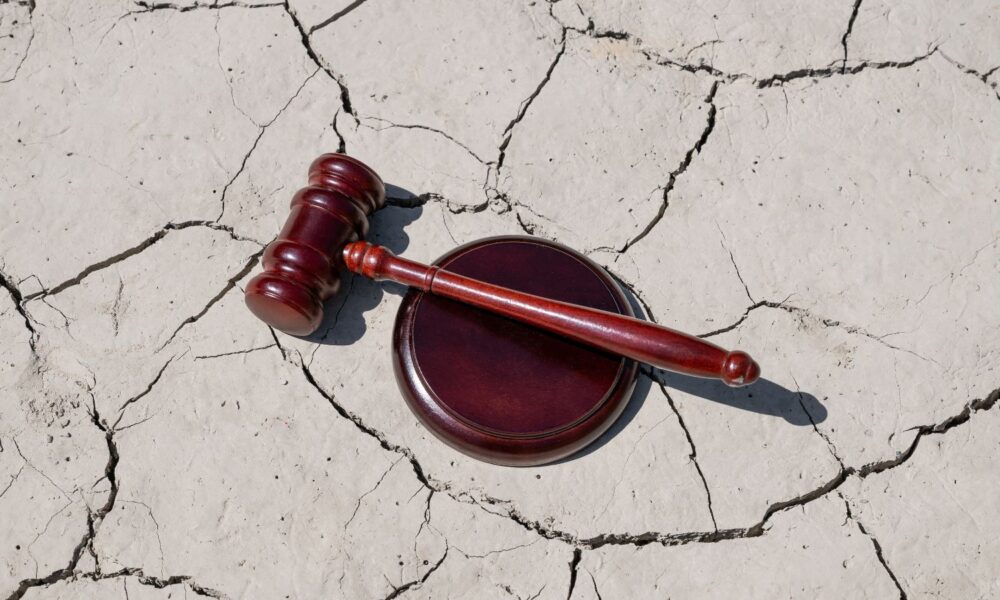

Climate change litigation must climb many mountains to advance justice and reshape human behaviors for the well-being of people and our planet. On this long, arduous journey, litigants, lawyers, scientific witnesses, and judges face challenges of communicating across disciplines. UCS’s new resource Climate Science in Legal Contexts: A Glossary of Key Terms for Lawyers makes this journey more feasible.
In many trials and appeals related to climate change, lawyers must effectively present factual evidence and analyses through climate scientists, ecosystem scientists, physicians, engineers, and other experts. For example, in Held vs. Montana, in which youth sued their state government for violating their constitutional rights, the plaintiffs’ lawyers presented testimony of two climate scientists, two ecologists, two environmental policy leaders, one pediatrician, one psychiatrist, one energy engineer, and one tribal leader. Aside from standard witness training on courtroom procedures and cross-examination, this litigation required effective lawyer-scientist communication and coordination on highly technical concepts like scientific consensus, anthropogenic climate change, and greenhouse gas emissions and atmospheric carbon dioxide, to name a few.
What a downpour of new, nuanced vocabulary for participants in climate change litigation! Enter: this timely, much needed UCS glossary.
Vocabulary challenges in two prominent court proceedings
This UCS glossary can help people in multiple disciplines communicate for stronger outcomes in climate change litigation. Consider some definitional issues which arose in two recent, prominent court proceedings.
1. The 2025 ICJ Opinion: The International Court of Justice (ICJ) in the 2025 Advisory Opinion on climate change interpreted the “1.5°C above pre-industrial levels” provision in Article 2 of the Paris Agreement adopted under the United Nations Framework Convention on Climate Change. The ICJ sought to apply the “best available science” as directed in the Paris Agreement.
For a leading international organization with members including scientists and other experts, I served on a team of environmental lawyers drafting one of the many briefs filed with the ICJ. Several lawyers proposed to characterize this provision as a “threshold” and “tipping point” for the global climate system. Recognizing that the ICJ would apply science and that the brief should reflect the organization’s scientific expertise, I asked these lawyers to consider that atmospheric scientists model the impacts of average global warming at a range of temperatures; these scientists view the effects of any such temperature increase as a continuum of harmful effects extending below and above 1.5°C. Furthermore, climate and ecosystem scientists analyze the occurrence of physical, biological, and geological thresholds or tipping points for various natural systems at various temperatures.
The legal team revised the brief to make the terms and arguments more aligned with climate science. This UCS glossary’s information on “best available science,” “1.5° Celsius,” “threshold,” and “tipping point” would have facilitated the lawyers’ work.
The UCS glossary would have also served as a valuable reference for the judges and their clerks. The ICJ’s interpretation drew on climate science and employed the terms of “scientific consensus,” “target,” “threshold,” and “goal.” The ICJ concluded: “1.5°C has become the scientifically based consensus target under the Paris Agreement…. Accordingly, the Court considers the 1.5°C threshold to be the parties’ agreed primary temperature goal for limiting the global average temperature increase under the Paris Agreement.”
2. Held v. Montana Case: Sixteen plaintiffs between the ages of 2 and 18 called on Montana courts to determine whether a statute limiting the scope of an agency’s environmental reviews for permits violated residents’ state constitutional right to a “clean and healthful environment.” The plaintiffs’ witnesses and lawyers drew on a large literature of scientific analyses of climate systems applying various methodologies. The UCS glossary, including sections on climate models, public health, and cultural heritage, would have been helpful throughout the litigation for the expert witnesses, litigators, and judges.
The judge’s findings included:
- “There is overwhelming scientific consensus that Earth is warming as a direct result of human GHG emissions, primarily from the burning of fossil fuels,” and
- “Children are uniquely vulnerable to the consequences of climate change, which harms their physical and psychological health and safety, interferes with family and cultural foundations and integrity, and causes economic deprivations.”
In 2024, the Montana Supreme Court affirmed the trial court’s findings. “Overwhelming scientific consensus” was not a standard for constitutional interpretation in the relevant laws and judicial decisions. The Court’s conclusion on what environmental conditions and causal linkages are protected by the right to a “clean and healthful environment” used different, non-scientific vocabulary and analysis: “Montana’s right to a clean and healthful environment and environmental life support system includes a stable climate system, which is clearly within the object and true principles of the Framers[‘] inclusion of the right to a clean and healthful environment.” The Court crossed scientific and legal disciplines with the terms “environmental life support system,” “stable climate system,” and “within the object and true principles of the Framers.”
The courts’ opinions reflected the judges’ strong understanding of the climate science vocabulary and analysis, which was aided by the scientific experts’ strong understanding of the legal terms and issues. Multidisciplinary decisions can be achieved, and the UCS glossary makes this feat more obtainable.
From glossary to actions
By helping lawyers navigate scientific concepts that frequently arise in climate litigation, UCS intends that the glossary will aid litigators in assessing expert evidence and avoiding misinterpretations of science in the courtroom. Let’s also use this glossary to talk about the bigger picture for climate change litigation.
For example, the glossary defines “attribution science” and addresses why it matters. No doubt, lawyers should gain a better understanding of these tools that have been developed and are being advanced by scientists through complex climate models and statistical analyses. But what will lawyers’ understanding of this topic mean for the effectiveness of climate change litigation in promoting justice and reshaping human behaviors?
Legislators may try to shield polluters from liability for causing harms identified through attribution science. This depends in part on the public’s understanding of this topic and campaigns to turn this science into votes and policies. Additionally, will judges find standing in cases brought against polluters, allow in and give substantial weight to experts’ evidence based on attribution science, and order remedies commensurate with the scientific evidence? This depends in part on the training courses and materials offered for judges, similar to resources in forensics, artificial intelligence, and genomics, as well as reports by expert bodies such as the current National Academies of Sciences, Engineering, and Medicine Consensus/Advisory Activity on Attribution of Extreme Weather and Climate Events and their Impacts. Despite this need, the Federal Judicial Center in 2026 removed a draft chapter on climate change from the fourth edition of its reference manual on scientific evidence.
As another illustration, the glossary defines “vulnerability,” a key concept in the successful climate change litigation brought by Montanan youths and by Swiss elderly women before the European Court of Human Rights (ECHR). Lawyers for these plaintiffs, through testimony from physicians and other experts, showed that these groups are particularly vulnerable to adverse physical and mental health impacts from higher heat and other climatic changes. In response, however, Montana promptly enacted a law that excludes certain fossil fuel projects from environmental reviews. Similarly, the Swiss parliament rejected the ECHR’s ruling that the nation should take stronger actions on climate change, and the Council of Europe’s committee of ministers issued a weak review of Switzerland’s compliance with the court order. Again, facilitating greater understanding by lawyers in climate change litigation is important but implementing changes that protect the health of Montanan youth, Swiss elderly women, and all people remain critical for the pursuit of climate justice.
Multidisciplinary thinking in education and litigation
I welcome the UCS glossary as a tool for furthering my interdisciplinary approach in teaching environmental law, policies, and impacts as well as in environmental litigation, legislation and regulations.
As an adjunct professor at the University of Illinois (holding graduate degrees in law, applied mathematics and economics), I teach students in law, environmental sciences, medicine, public health, molecular and cellular biology, and European studies. These students come to see sustainability as dependent on a core of interrelated social, economic, and environmental systems surrounded by science and law. They regularly draw on unfamiliar fields of evidence, analysis and recommendations, often with new vocabulary or different definitions for terms. They are asked to engage in collective action by contributing their own expertise and interests in developing and implementing multidisciplinary sustainability solutions.
There should be more education for multidisciplinary actions on climate change and sustainability, which requires spanning multiple vocabularies and better understanding of terms. Universities must develop graduates in all fields of study who not only understand and want to act on sustainability challenges, but also apply their expertise collaboratively and contribute meaningfully to multidisciplinary solutions.
Collaborating and communicating across disciplines is also essential for climate change and other environmental lawyering. I worked with scientists, engineers, physicians, economists, and local organizers on litigation and regulatory proceedings for UCS and other US organizations, the World Commission on Environmental Law, and community groups in Spain and Portugal before the Aarhus Convention Compliance Committee.
Although the glossary will be helpful in education and legal work for me and many others, there are deeper challenges. These include intense political attacks on science (particularly climate change) and the rule of law, along with disinformation efforts that mischaracterize or ignore scientific findings and methods. The federal EPA’s February 2026 recission of the endangerment finding illustrates the need for effective climate litigation. These cases range from appellate review of agency actions, to state cases based on public nuisance and consumer fraud, to human rights and constitutional claims, and more. While many lawyers shy away from science and quantitative analysis, and many scientists and physicians may view policies and advocacy as outside their lane, climate litigation like the Montana decisions show that science-informed actions are achievable. More work for UCS and others.
UCS’s glossary is needed, timely, and helpful. This good work is one step on a long, arduous journey to greater multidisciplinary understanding, addressing climate change, and sustainability.