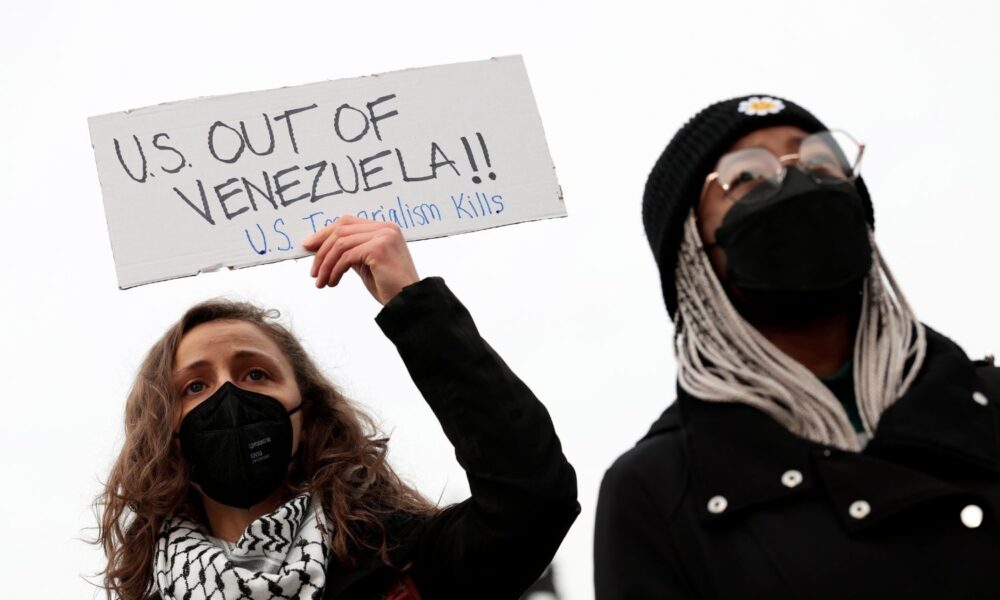

The illegality of the Trump administration’s actions earlier this month in Venezuela under domestic and international law has grave, long-term consequences for international peace and security beyond this immediate crisis and its costs to the Venezuelan people.
The administration’s actions and their explanations for them are well beyond contraventions of domestic and international law—they take aim at the very notion that the United States or its administration should be constrained by law or notions of state sovereignty.
The bombing of locations around Caracas and capture and rendition of Venezuela’s president and the president’s wife to the United States are widely understood to be illegal acts of aggression against a sovereign nation under international law. This followed on weeks of other escalatory and illegal actions, including the killing of civilians at sea and the seizure of oil tankers. This, and President Trump’s statement that the United States will be in Venezuela and controlling its oil “for years” belie the administration’s claims that the extraction was an execution of a “surgical” law enforcement action, which was its explanation at the United Nations General Assembly last week.
The use of force against the territorial integrity and political independence of a state is prohibited under the United Nations’ Charter except in cases of self-defense or authorization by the UN Security Council, neither of which are the case. The actions also are in violation of the core principles of the Organization of American States, including respect for sovereignty and international law and the rejection of acts of aggression.
The President’s actions also indicate a disregard for domestic law. His use of force was not authorized by Congress, which is statutorily required by the War Powers resolution. The Gang of Eight (key congressional leaders on security issues) were not consulted, which is longstanding practice for sensitive operations. They were only notified after the intervention had begun. This brings the number of countries the United States bombed in 2025 to seven: Iraq, Somalia, Syria, and Yemen which are continuations of action by previous administrations, and new targets Iran, Nigeria, and Venezuela. There seems to be no one in the administration or Congress who can meaningfully constrain the President and his staff’s decisions to use such force nor require that any action be consistent with law or be strategically wise.
International cooperation gives way to unilateral aggression
From his very first press conference following the military action in Venezuela, the President has made clear that giving US companies greater access to the nation’s oil reserves is a primary reason for the United States being there. President Trump’s assertion that the United States will “run” Venezuela is also a violation of sovereignty and opens the door to corporate control and resource extraction. It invokes the US history of imperialism in the Western Hemisphere as desirable. And indeed, the recently released National Security Strategy reasserts US “preeminence” in the Western Hemisphere as a key objective.
After two destructive world wars, the world drafted a set of international laws, including the United Nations Charter, that sought to establish principles that would safeguard sovereignty and justice and could advance the causes of peace and security through diplomacy without resorting to aggression. The United States, as a superpower, benefitted from this arrangement and the trust, influence, and legitimacy it conferred, even as it did not always abide by its principles.
However, the President and his advisors, including Homeland Security Advisor Stephen Miller, have been clear that the current administration’s actions are not exceptions to the rules-based order, but that the rules-based order no longer suits them, and that their goal is to organize the world under a doctrine of might is right.
Miller stated that the “iron laws of the world” demand a world “that is governed by strength, that is governed by force, that is governed by power.” When asked directly last week in an interview with the New York Times about whether he needed to respect international law, the President equivocated, and noted that the only guide he has for exercise of power is “My own morality. My own mind. It’s the only thing that can stop me.”
This short-term view of prioritizing unilateral advantage impairs the world’s ability to survive its existential, long-term challenges. For decades, the rule of international law has permitted nations to avoid, if imperfectly, large-scale wars of aggression by providing a framework for a higher authority than “might makes right.” Critically, a baseline of trust and stability allows countries to work together to address issues that cannot be solved alone, including climate change, nuclear nonproliferation and disarmament, pandemics, and economic and social well-being.
And while the 2025 US National Security Strategy acknowledges that “alliances, with treaty allies and partners in the world’s most strategically important regions” are a core “asset” for security, the United States’ withdrawal last week from 66 international organizations is another indication that the administration sees little value in this type of cooperation. The listed organizations include a wide range of cooperative efforts, including on climate, law and society, security, and nonproliferation.
Doing away with the international legal and normative structures provides cover to other states to pursue wars of aggression and undermines standing of the US to make objections to Russia’s war on Ukraine and other wars of aggression. And a lack of meaningful international and domestic pushback emboldens this administration to accept no limits on its grab for more.
In remarks after the Venezuela invasion, the President also threatened regime change to Cuba, Mexico, and Colombia. Given the long and destructive history of US intervention in Latin America, this did not land as an idle threat. And not days later, the president is threatening to claim Greenland, a territory of one of the United States’ historically staunchest allies, Denmark, and a member of NATO, and has reportedly ordered the US special forces commander to draw up invasion plans. The President rejected the idea that the existing generous terms providing US access to Greenland for military bases was enough, stating that “ownership” was necessary for “psychological” comfort. Seizure of Greenland would likely be the end of the NATO alliance and open the door to direct conflict between the United States and Europe, including NATO’s other two nuclear-armed countries.
Even absent direct military attack, such threatening neighbors and dismantling longstanding alliances will have important consequences for regional and international security, creating an environment likely to be less predictable and more confrontational.
Rising risks in a power-hungry age
Leaders will need to be more concerned that such behavior is now more permissible and with fewer avenues for accountability. Analysts suggest that North Korea, which already fears a decapitating strike from the United States, may assess this risk as higher than before, now that the Trump administration has operationalized it, leading to greater chance of miscalculation and greater entrenchment of its commitment to nuclear weapons as guarantor of security. Cooperation between adversaries as well as allies has been key to nuclear nonproliferation, disarmament, and risk reduction efforts which recognize that full-scale conflict in the nuclear age could be cataclysmic. Keeping these efforts moving forward under these conditions is likely to be even more challenging.
Despite the ominous trends, there are still some meaningful ways to create limits. Congress should assert its constitutional authority for authorizing military force through the war powers resolution; the Senate’s vote last Thursday to advance to a floor vote is positive but merely the first hurdle among many. Congress must hold the administration accountable for its illegal use of US military and law enforcement forces in Venezuela and the US must reassert its commitment to international and domestic law and the pursuit of common security based on sovereignty and respect for justice and human rights.