

Across the state, Wisconsinites are seeing their electricity bills rise, adding to existing economic anxiety over how to meet basic needs. This year, rate increases were approved for three major utilities, raising average bills as much as $13 per month.
At the heart of many energy cost discussions are data centers, which are being approved for development across the state. While there are many factors that can cause bills to go up, we already know that data center costs are being passed on to consumers in many parts of the United States. Furthermore, data center developers are manufacturing a false urgency to meet their steep electricity demands, but current policies and regulations in Wisconsin don’t protect ratepayers from cost increases or the potential adverse environmental, health and reliability impacts. Advocates on the ground are fighting for transparency and protections for their communities, but decision-makers need to both listen and take action by implementing comprehensive policy to protect their customers.
How utilities are responding to data center growth
Developers are seeking rushed approval of data center projects, and utilities in turn are seeking approval for billions of dollars of infrastructure to power them. Wisconsin doesn’t require Integrated Resource Planning (IRP), meaning each proposal to the Public Service Commission of Wisconsin (PSCW) is a one-off request for a new project. This requires significant vetting time for PSCW staff and advocates to comb through all the paperwork, and makes it challenging to review proposals in a holistic framework.
Residents of Wisconsin may already be familiar with many of these projects…but more likely not, since proposals and approval processes have been mostly hidden from the public by use of confidentiality agreements between tech companies and decision-makers.
Notably, are the projects in We Energies’ territory. Microsoft’s data center plans include a suite of projects in Racine (yes, the one in Mount Pleasant that was supposed to be host to the now defunct Foxconn project years ago) and Kenosha counties with an initial plan of around 450 Megawatts (MW) with continued growth in the future. There’s also the data center planned in Port Washington hosted by Vantage (to be utilized by OpenAI and Oracle), estimated to need anywhere from 1 to 3.5 Gigawatts (GW) of electric generating capacity. According to Clean Wisconsin, 3.9 GW is enough to power 4.3 million homes in Wisconsin (currently, there are only 2.8 million housing units in the whole state).
To power these behemoths, We Energies is seeking approval for nearly 3 GW of generation capacity, including 1.4 GW of fossil gas. Last year, the PSCW approved We Energies application for $1.5 billion of gas plants to accommodate data centers’ energy demand. Around $1.4 billion dollars in transmission infrastructure is also being proposed in Port Washington to connect the data centers to the grid.
Another large utility, Alliant, is planning on being home to Meta’s billion-dollar data center in Beaver Dam; however, the company has not been forthcoming on the details of the data center’s planned energy demand.
This is not a comprehensive list and it’s worrying for various reasons. Instead of using less gas and coal, utilities are building more, pushing back coal plant retirements, setting the stage for increased pollution and health impacts and delaying a transition to clean energy. Tech companies have been notorious in keeping information from the public about their true plans, proposing duplicative and speculative projects, therefore creating a risk that utilities may overbuild generation capacity that ratepayers get stuck paying for.
A look at how regulatory cases raise energy bills
When it comes to the “large customer” terms and conditions—or “large load tariffs” in regulatory terms—the PSCW is also responsible for approving, modifying, or rejecting utility proposals brought forth by utilities. We Energies, for example, has proposed a Very Large Customer tariff which would require customers with huge electricity loads (aka data centers) to pay for their electricity needs differently than what residential and other commercial users are subject to. There’s no question that this is an important and necessary step in addressing potential unfair costs to ratepayers. Every utility should implement a fair cost rate for data centers, but the devil is in the details here, so we need to scrutinize the utilities too.
While the utility insists their proposal requires data centers to pay their fair share of energy costs, there are serious reasons to doubt these claims. We Energies’ proposal falls short of actually holding data centers responsible for their impacts, and if approved, ratepayers are at risk of seeing higher electricity bills. Let’s examine some of these issues.
- The 500 MW qualifier: First, there’s the size threshold requirement. We Energies believes this special rate should only apply to customers requiring at least 500 MW of electricity. For reference, below is a snapshot from Halycon’s Large Load Tariff tracker, which accounts for the various applications being submitted and processed across the country for large users like data centers. That lone point in the top right corner with the big red arrow? That’s We Energies’ plan–the qualifying energy threshold is waaay bigger than what’s being proposed in other jurisdictions. This 500 MW threshold would exclude many data centers and other large users that should still be responsible for paying for their own energy needs.
Figure 1: Data plot of proposed sizing requirements for large load tariffs
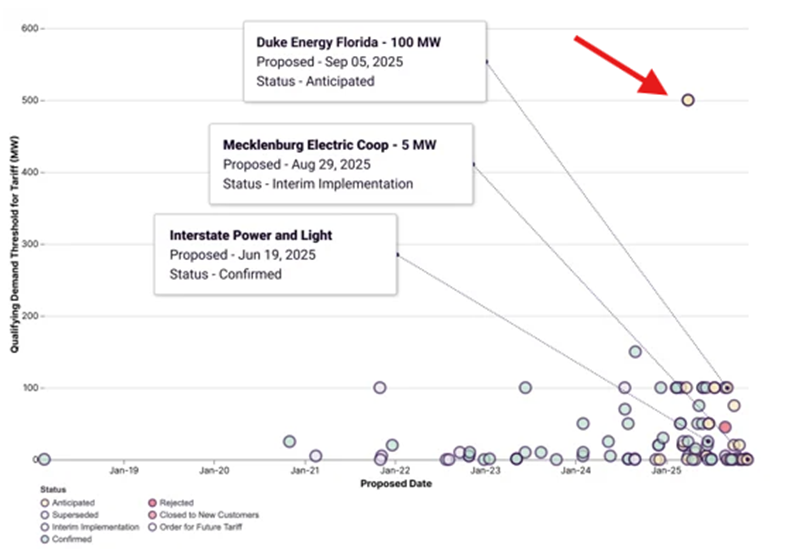
We Energies does not explain why their criteria is so large beyond stating that the proposed structure wouldn’t be suitable for smaller customers. Source: Halycon
- 75% is not 100%: Under We Energies’ proposal, data centers may choose a specific capacity-only service from the utility which would only make them responsible for 75% of costs out of the portion of resource they want to use. Despite entire gas plants being built for the purpose of accommodating a data center, other ratepayers would still be on the hook for a significant portion of these ownership costs…plus 100% of the associated fuel costs. The utility claims their proposal creates a fair plan to make data centers responsible for their electricity needs, but their own application proves otherwise.
- Transmission costs are not accounted for: The utility claims that data centers would also be responsible for paying the costs of transmission and distribution investments made to serve their electricity load, but then admits that there are hidden costs that they wouldn’t be able to trace back to the data center customer. My colleague, Mike Jacobs, broke this issue down in his recent analysis, showing that utilities in seven states in PJM (the regional transmission organization in the mid-Atlantic) passed more than $4.3 billion in local transmission upgrade costs on to other customers in 2024, and at least another $3 billion last year. Because of how costs are socialized in the MISO approval process, the true costs of transmission investments cannot be comprehensively traced back to the individual customer in order to assign responsibility. The result? Ratepayers are on the hook once again. Don’t be fooled – utilities have a lot of control over how much of those transmission costs are allocated (take a look at recent testimony analyzing the utility’s proposals for doing this). We Energies can’t continue to pass the buck on its responsibility to ratepayers.
- Mismatched lifetime of assets: We Energies is proposing that data centers enter into a 10-year contract for which they’d be responsible for covering energy infrastructure costs. Simply put, this is not enough time to recover the costs of all the investments that will be made, including distribution, transmission, and generation. One example of how the risk of unrecovered investments may impact ratepayers in the long-run is the cost of stranded assets, which is already estimated to be around $1 billion dollars for Wisconsin energy customers.
The details of We Energies’ application matter because they are trying to claim that everything is fine, so there’s no need to scrutinize the details! They’d prefer regulators and the public to think that they’ve come up with the perfect solution, but their track record and the fine print tells us otherwise.
When we don’t scrutinize the validity of these applications by applying scientific and economic realities to profit-motivated claims, we lose the opportunity to fight for fair outcomes. We cannot and should not cede this ground. Communities become exposed to higher costs and environmental harms and the cycle continues. When left unchecked, decisions are made based on what’s negotiated between utilities and big tech companies, rather than what’s best for Wisconsin ratepayers. Hopes for future climate goals also become harder to achieve when new gas is built and coal plants don’t retire.
We don’t have to accept the backroom deals and attempts at distraction. Wisconsin can achieve clean and healthy energy systems that provide communities with affordable power.
What does data center accountability look like?
UCS has been studying the impact of data centers’ electricity demand in Wisconsin, and our forthcoming analysis will take a deeper dive into how different policy pathways may affect our energy future. The bottom line is that comprehensive policy must be enacted to ensure a healthier, less costly, and reliable future for communities. Below is a sneak peek at some of the recommendations from our analysis:
- Data centers should bring their own clean energy: Data centers must not be a barrier to achieving clean energy goals in Wisconsin. With proper legislation to plan long-term, like an IRP, regulators and the public can hold utilities accountable for meeting the state’s energy needs and prioritizing clean, reliable energy infrastructure for the public rather than a few large customers.
To ensure the state’s long-term roadmap provides a path to clean and healthy energy, lawmakers must also commit to clean electricity legislation and guardrails for large users like data centers to bring their own new clean energy (BYONCE). Utilities must invest and offer comprehensive demand response and energy efficiency programs to help lower costs and conserve energy where possible.
Wisconsin state legislators recently introduced a bill, known as the Data Center Accountability Bill, to address some concerns about data center development. The bill aims to apply more stringent reporting requirements about data centers’ water and energy use, directs the PSCW to define a classification for large customers like data centers, creates renewable energy requirements for data centers, and provides guidance on how laborers constructing data centers should be fairly compensated. Rather than counting on data centers or investor-owned utilities to do the right thing, decision-makers must bake these principles into law. - Data centers must pay their fair share: Ratepayers in Wisconsin should not be on the hook for the costs that data centers incur. New policy is needed to require data centers to pay their fair share, while also helping to fund community energy efficiency programs and low-income communities, to ensure that the economic growth promised by developers actually flows to Wisconsin families. Utilities need to properly classify data center customers and make them responsible for 100% of their energy and infrastructure costs.
In addition to the Data Center Accountability bill, consumer advocates and energy experts from around the state are fighting to protect ratepayers from even higher electricity prices. By scrutinizing We Energies’ inadequate proposal that we discussed earlier, advocates are making it clear to regulators that corporate interests of power-hungry data centers cannot come before the needs of Wisconsin residents. Take a look at the details of case here. - Information Transparency: We can’t achieve any of the above goals if the public isn’t equipped with information. Data centers must disclose data regarding their intended energy, water, and other resource uses which would impact the communities surrounding them and the state as a whole. The public needs ample time to participate in the decision-making process; large corporations can’t be allowed to rush through approvals. A single user like a data center having the power to disrupt the livelihoods of so many with their energy use is unprecedented. State regulators must adapt accordingly by setting the expectation that thorough review from experts and the affected communities is a requirement when approvals by data centers are sought.
Wisconsin communities continue to show up in numbers to make their voices heard. Towns impacted by proposed data centers are sending a clear message to their elected officials that a lack of transparency over data center impacts will not be tolerated. Questions on the environmental impact of data centers and how they will impact the health and future of communities are still going unanswered, but the call for accountability is only growing stronger.
If there’s a single takeaway from this discussion, it’s that the future of Wisconsin’s energy and environment shouldn’t be decided by a select wealthy tech companies. Let’s not leave it up to data centers and utilities to decide whether or not to do the right thing. A just energy future means fair costs, clean air, and an informed public.
Wisconsinites, make your voice heard—demand data center developers pay their fare share by submitting a public comment on this regulatory case here by February 17, 2026.
Editor’s Note: An earlier version of this blog specified contract term length language tied to the utility’s bespoke resource agreement. It has been corrected to reflect the terms covered under the utility’s Very Large Customer (VLC) agreement.