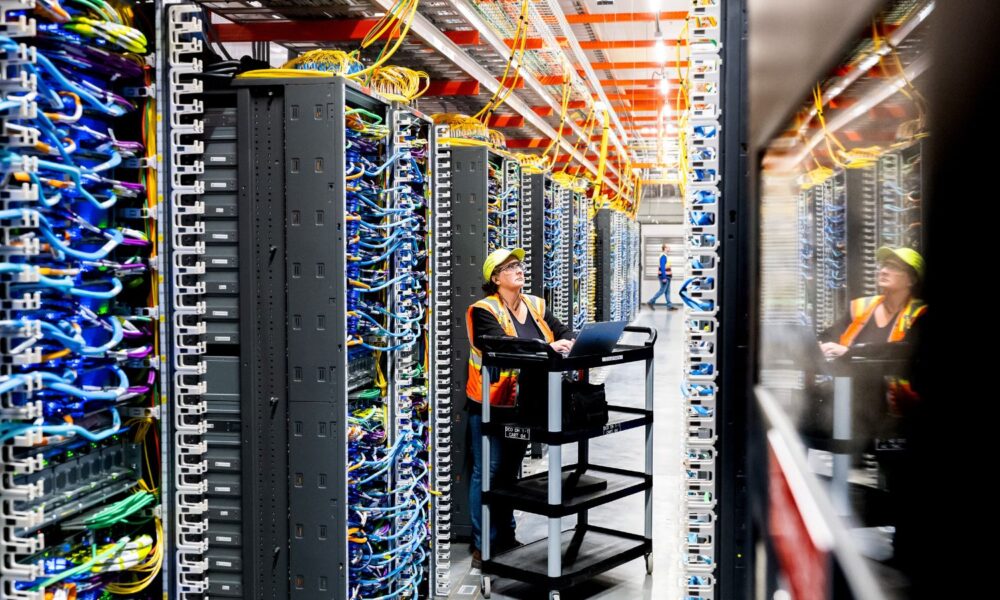

It’s no secret that Big Tech and AI companies are rushing to build new power-hungry data centers as quickly as they can. In Michigan, for example, a massive new 1.4 gigawatt data center received conditional approval to draw enough electricity from the grid to power a million homes and increase the local utility’s entire demand by a whopping 25%.
To examine the effects the AI boom is bringing to the power grid, the Union of Concerned Scientists conducted an analysis published today entitled Data Center Power Play: How Clean Energy Can Meet Rising Electricity Demand While Delivering Climate and Health Benefits. In addition to a national report, the project also includes state-specific analyses for Illinois, Michigan, and Wisconsin.
We examined how different levels of electricity demand growth, driven largely by new data centers, affect the power system in the coming years—and how improved policies can respond to these changes with clean energy instead of fossil fuels and protect people from higher utility bills and public health costs.
UCS’ director of energy research and analysis, Steve Clemmer, writes about our national findings and recommendations here. In this blog post, we’ll zoom in on our trio of state analyses in the Midwest to compare what we found, where similarities and difference arise, and what conclusions we can draw.
Illinois: Avoiding increased fossil emissions and spikes in power imports
Our look at Illinois demonstrates the urgent need for action by state policymakers to ensure that rising data center electricity demand is met with clean energy. Illinois does have existing, strong power sector decarbonization policies, most recently enacted through the 2026 Clean and Reliable Grid Affordability Act which built upon 2021’s Climate and Equitable Jobs Act. Yet, our results show the shifting landscape caused by power-hungry data centers requires further action from policymakers.
Using a projection of future data center additions based on various industry sources, we found that data centers will account for up to 72 percent of Illinois’ electricity demand growth by 2030 and up to 65 percent by 2035. Without additional policy protections, over the next 25 years, this type of data center-driven load increase could put Illinoisans at financial risk for up to $37 billion in additional electricity system costs.
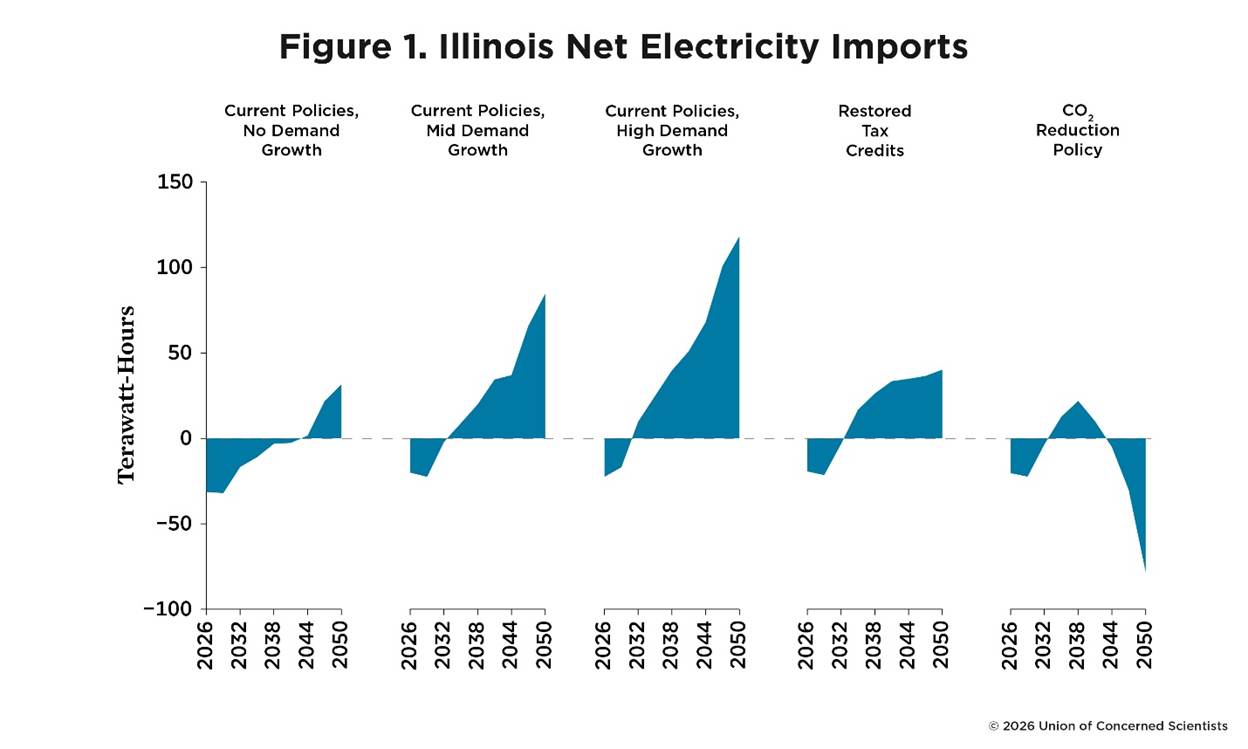
Moreover, absent stronger policies such as clean energy requirements for data centers, the load growth will also lead to increased pollution from Illinois’ fossil fuel power plants and rapidly escalate the state’s reliance on out-of-state electricity supply (see figure 1). Both trends are at odds with the state’s policy vision of phasing out gas and coal plant emissions and replacing fossil power primarily with wind, solar, and battery storage that directly benefit Illinoisans.
Conversely, our Illinois analysis shows that more robust policy scenarios at the state and federal levels could address data center-driven demand growth, resulting in savings of up to $2.8 billion in health costs and $112 billion in climate damages globally between 2026 and 2050.
Stronger policies stimulate more clean energy development in Illinois, which means less reliance on fossil plants and less need to import power from elsewhere. It also means keeping more jobs, tax revenue, and economic activity that comes from building wind, solar, and energy storage in the state.
Illinois does not have to accept more pollution and less clean energy development from data center demand growth. To mitigate the worst impacts of data centers shown in the UCS analysis—and to pursue a future more like our improved policies scenarios—we provide a series of recommendations focused on data centers. Most notably, legislators should mandate that they secure new sources of carbon-free electricity and should protect other customers by requiring data centers to pay for additional grid infrastructure and operating costs they cause.
Michigan: Closing the fossil power export loophole
Like Illinois, Michigan has also enacted significant clean energy legislation through a series of bills in 2023. But, just like in Illinois, further policy action is needed to protect Michiganders from the risks that data centers derail progress on climate goals, raise costs, and weaken the grid.
Based on our assumption of the size of data center build-out, our Michigan analysis found that data centers will account for up to 57 percent of demand growth by 2030 in the state, resulting in cost increases up to $51 billion and up to 25 million tons of increased heat-trapping emissions (nearly equivalent to emissions from Michigan’s entire industrial sector in 2021).
A key consequence of the increased demand is that combustion of fossil fuels to generate power that is sold outside of Michigan will increase. As enacted, Michigan’s clean energy laws only apply to electricity sales within the state, and Michigan typically exports only minimal energy. However, our analysis shows that with the growth in demand from data centers, this will change; Michigan utilities will export more than 56 gigawatt-hours of electric energy to other states annually by 2050, causing CO2 emissions to increase despite the clean energy laws.
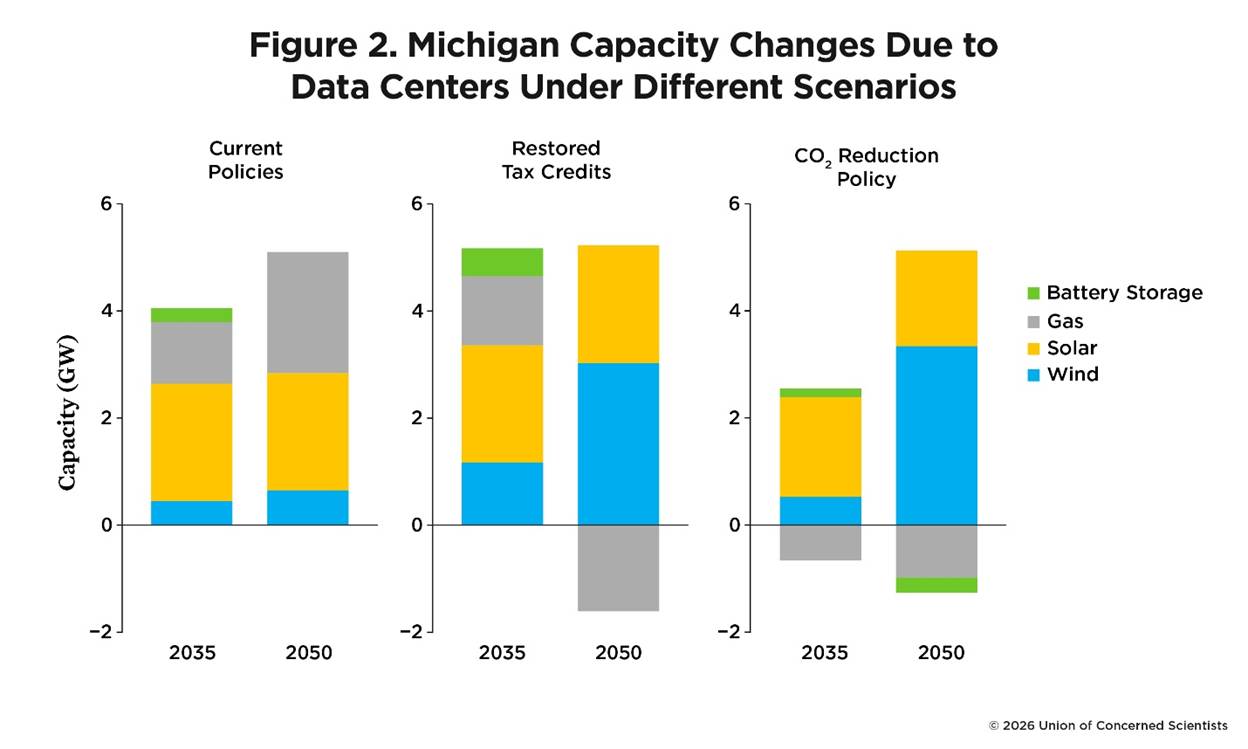
To address this, we recommend a CO2 reduction policy that would apply to all electricity generation produced in or imported to Michigan, closing the loophole that allows utilities to keep burning fossil fuels. This policy would drive Michigan’s electric sector to net zero emissions by 2050 with an energy mix dominated by wind and solar (see Figure 2). This in turn results in $3.5 billion in reduced health costs locally and $408 billion in reduced climate damages globally by 2050.
In concert with clean energy policies, we recommend measures similar to our Illinois recommendations to require transparency from utilities and their data center customers, create incentives for continued clean energy development, and prioritize the needs of Michiganders by ensuring data centers pay their fair share while also boosting funding of consumer energy programs such as bill assistance and energy efficiency.
Wisconsin: Forging a healthier future through net-zero emissions
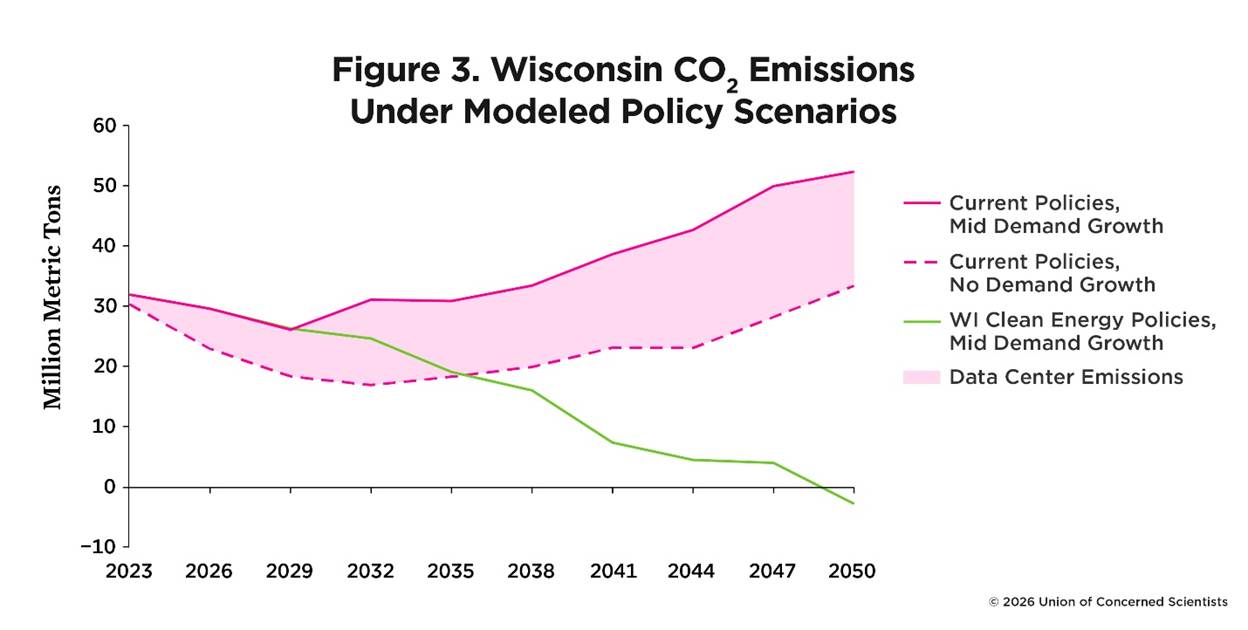
The third state featured in our Data Center Power Play analyses, Wisconsin, does not yet have comprehensive clean energy policies in place. To explore the benefits of doing so, we modeled a scenario where the state adopts a Clean Energy Standard and CO2 reduction policy. Together, these policies set Wisconsin on a path to net zero power sector emissions by 2050, a goal already in place in numerous states.
The data center development boom in Wisconsin further complicates the state’s ability to plan for long-term affordable energy or move away from costly fossil fuel overreliance. Our analysis found that data centers could be responsible for 26% to 36% of the total electricity system costs through 2050. To add to that, under current policies, data center load prompts large additions of fossil gas capacity, while decreasing wind capacity. This results in 31 million metric tons of carbon emissions accumulating by 2035 and 140 million by 2050 as a result of new data center load (see Figure 3).
Implementing and committing to clean energy policies now could drive the state toward a more sustainable alternative while avoiding $8.7 billion in health costs, preventing $428.2 in climate damages, and saving lives in the process. Data centers must bring their own clean energy to power their facilities. To further ensure that these benefits are realized for the communities in Wisconsin that need them most, UCS also recommends that—regardless of the energy policy pathways taken—the state adopt strong ratepayer protections. Consumers must not be left on the hook for the costs that data centers incur. Like in Illinois and Michigan, transparency over data center impacts is key to the plans enumerated above. Decision-making with respect to data center development can’t take place without equipping the public with information and meaningful engagement with communities.
Importantly, Wisconsin must introduce Integrated Resource Planning (IRP) requirements that provide a long-term energy resource roadmap. This keeps utilities accountable for their grid investments, empowering Wisconsin to look ahead towards a cleaner and healthier future in the direction of its state motto: Forward.
There is a better path forward
Looking collectively at our findings for Illinois, Michigan, and Wisconsin, it’s clear that strong, foundational state clean energy policies are helpful for confronting the large—yet highly uncertain—data center-driven growth in electricity demand. But without careful, specific attention by state policymakers and regulators to data centers, the rapid rise in the need for power leads to increased costs and pollution.
The good news from our Data Center Power Play analysis is that there is a better path forward. Improved policies at the state and federal levels can help meet data center load growth with clean energy while protecting ratepayers, reducing health costs, and cutting climate damages.
While no one knows how the data center story will ultimately play out, the call to action is clear. You can join us by clicking here and asking your state policymakers to ensure data centers are powered by new clean energy and do not burden other ratepayers with unfair costs.
Special thanks to UCS analysts Lee Shaver and Maria Chavez for their contributions to this blog post.