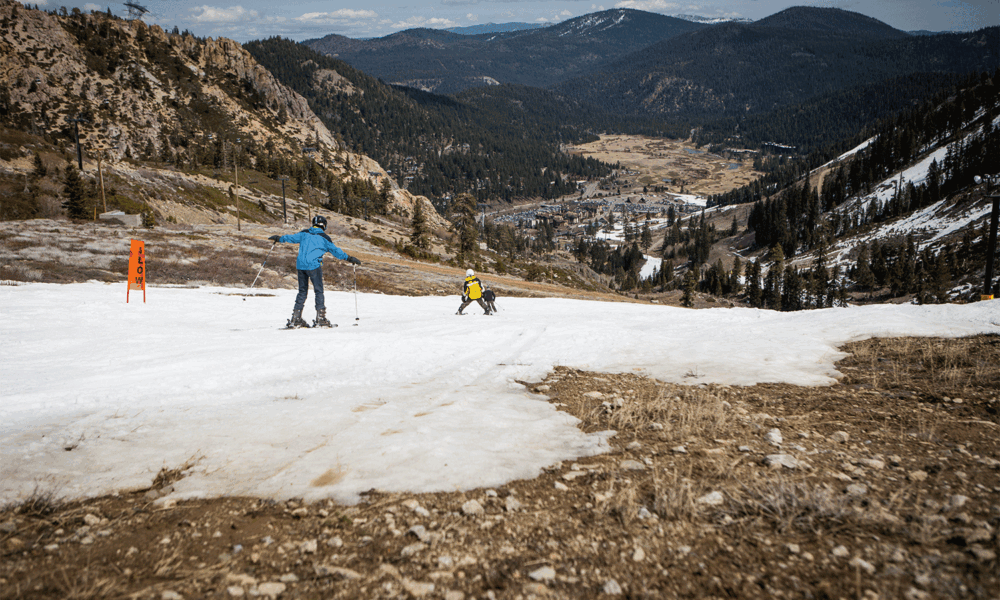

Across the western United States, the climate crisis is on full display with record-low snow and an early-season heatwave shrinking critical snowpack that many Western states rely on for their water supplies over summer. Our changing climate, rapidly heating due to the burning of fossil fuels, is shifting the winter water cycle with more precipitation falling as rain than snow and warmer-than-normal temperatures causing premature runoff of what remains of the snowpack.
With climate change, the potential for winters with low- to no-snow is substantial. These profound shifts jeopardize water supply reliability across the West and are forcing us to adapt our water infrastructure to prepare for a future that doesn’t look like the past.
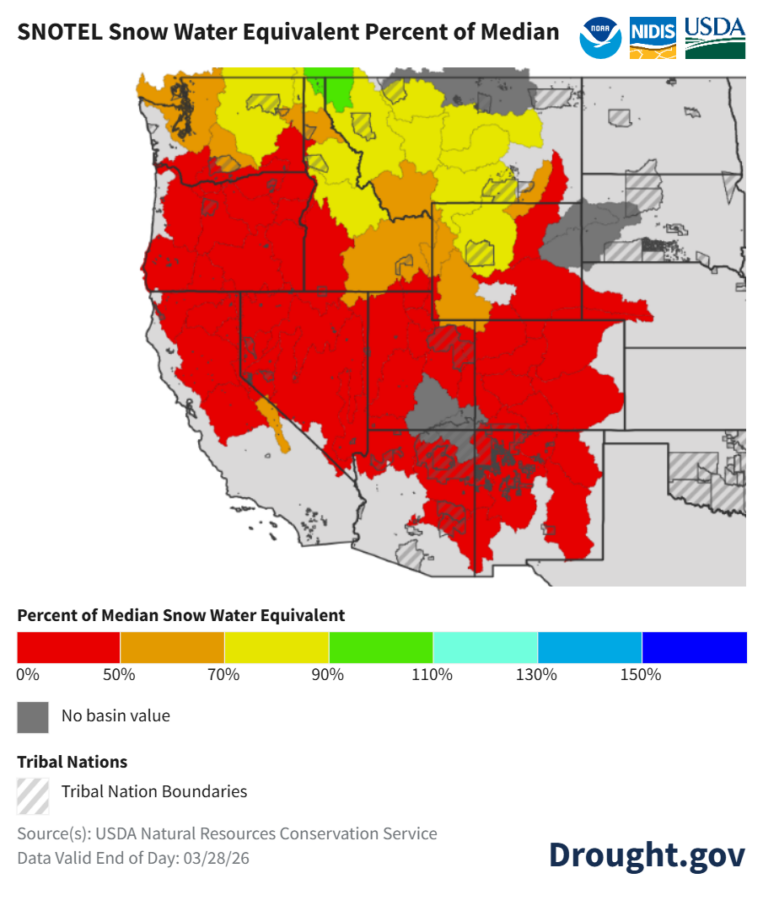
Western states are entering Spring 2026 in a snow drought, with near-record low to record-low snowpack amid unprecedented heat, scarily setting the stage for the possibilities of drought, water shortages and heightened wildfire risk in the coming months.
In California, where I live, the Sierra Nevada snowpack provides nearly a third of the state’s annual water supply. Following an unusually warm winter and an extreme March heatwave, water managers will likely find very little snow remaining when they conduct this week’s April 1 snow survey—the historic peak of our snowpack. I expect we’ll be left with significantly below-average snowpack—consistent with what climate science has been warning us for years will happen with higher global temperatures. What little is left of the snow is disappearing quickly.
What is a snow drought?
While early winter storms brought more than 90 inches of snow to parts of the Sierra over the holiday, that was short lived. The unusually warm winter left many states with serious snow deficits even before the unprecedented, early-season heatwave in March that brought temperatures 20⁰F to 40⁰F above normal. This abnormally low snowpack is what’s called a warm snow drought—meaning that, even with a normal or average amount of precipitation as we’ve had this year, more rain falls than snow. Recent research shows that the Western US has emerged as a global snow drought “hotspot,” with snow droughts more prevalent, intense and longer in the last two decades, compared with 1980-2000.
By early January, one indicator of snowpack—the snow water equivalent (SWE, or amount of water stored in the snowpack) was below the 20th percentile across the western US. This was the lowest recorded level in 25 years (since 2001, when the MODIS satellite record starts). Not much has improved by late March 2026. For example, in Colorado, the SWE across 115 stations was 38% of average, the lowest in more than four decades.
In a semi-arid state like California, a robust Sierra Nevada snowpack is essential for sustaining the state through the dry and hot summer season, which is why it’s often referred to as the state’s “frozen reservoir.” Cities, farmers and ecosystems historically rely on predictable mountain snowmelt in late spring, running off into rivers and streams to be stored in network of surface water reservoirs—essential for balancing availability of summer water supply with mitigating spring flood risk. Historically, the largest snow-producing months in Sierra Nevada are December through March. That’s why April 1 is typically the peak of snow accumulation. That window is narrowing with climate change.
Unrivaled: Snow is no match for winter heat
An extreme, early-season heatwave like the one experienced across the Western North America in March was “virtually impossible without human-induced climate change” according to a World Weather Attribution study. The record-breaking heat came on the heels of an unusually warm winter across the West, with temperatures breaking records in Arizona, Colorado, New Mexico, Oregon, Utah, and Wyoming. That warmth caused more rain than snow to fall, even at some high elevations, with dire consequences for communities reliant on winter tourism dollars. While a hotter than usual winter gifted us with one form of Heated Rivalry—the type that kept many of us indoors and glue to our TVs—outside, ski resorts across the region ended their seasons early.
In other regions, record breaking winter warming threatens outdoor hockey and skating culture, with groups like Save Pond Hockey rallying around climate change. A recent World Economic Forum report warned that just 10 countries will have the winter weather suitable to host the Winter Olympics by 2040, with billions in anticipated losses to the sports economy.
Who’s the game changer? Climate change
My colleague Dr. Pablo Ortiz previously wrote about the many reasons that snow matters in California, noting that it is an “indicator of climate change” and calling the state’s winter snow surveys “a health check-up for our water system.”
Since California started its snow survey at Phillips Station in 1942, the lowest measured value was in 2015, when statewide snowpack was 5% of the historic average. That remarkably warm winter, attributed in part to anthropogenic warming, prevented snow accumulation and contributed to the broader context for one of the worst droughts on record.
That’s why I am closely tracking the 2026 levels. The year began on a promising note with the California snowpack measuring 89% of average statewide in early January after a series of atmospheric rivers. Following a dry January, which is historically the wettest month of the year in California, that statewide average dropped to 59% of average by late January.
In the Northern Sierra, where several of the state’s largest major water supply reservoirs are located, water managers measured the snowpack at a dismal 46% of normal in late February. In the weeks that followed, and before temperatures started shattering records, dry and warm conditions were melting the California snowpack an average of 1% per day, according to data from a network of sensors that weigh overlying snow. The heatwave further accelerated that premature melting, further eroding the snowpack, with estimates that nearly 20% of peak snowpack melted between late Feb and early March.
The rapidly melting snowpack presents a problem in California where winter precipitation filled major reservoirs that are now 122% of average statewide. That means they have limited space to accommodate the additional early runoff from melting mountain snowpack and any additional precipitation from a late-season storms e.g. from this week’s expected weather.
Smaller snowpack may mean bigger wildfire risks
The record-high temperatures are drying out vegetation while reduced snowpack and early-season melt in the Western US deprives the soil of prolonged moisture, posing a heightened risk for wildfires. New research warns that declining snowpack and earlier snowmelt may “prime forested watersheds to dry, burn, and experience high severity fire,” particularly concerning where snowpack “historically buffered fire risk,” and instead may result in more areas burned by severe fires. Earlier snowmelt can also lengthen the fire season by allowing a longer period for vegetation to dry out and become more flammable.
Changes to snowpack and timing of melt are just some of the many ways that climate change is supercharging wildfire activity in the West, driving a near doubling of forest burned area between 1984 and 2015.
Contagious dry spells: Snow to hydrologic droughts
Parts of the Western US have been navigating through the driest two-plus decades in the last 1200 years. The region expects a not-infrequent amount of drought years, but this particular mega-drought is exacerbated by and attributable to anthropogenic warming. Winter snow droughts can progress into a hydrologic drought characterized by observed deficits in water supply (stream flow, reservoir levels, and ground water table declines); or a agricultural or ecological drought where crops and/or ecosystems are impacted by a drought, respectively.
The Colorado River Basin, where snow cover is the lowest level on record, is the water supply for 40 million people. Concerns are growing beyond water supply availability to hydro electricity generation. The Glen Canyon Dam, which sits above Lake Powell and provides electricity to more than 5 million people in six different states, may become inoperable by December 2026 if the minimum water level for power generation is breached, as government projections suggest. In states like Colorado, this winter’s snow drought led water users to pursue water-use restrictions earlier than usual: Denver Water asked its residents to help meet a 20% conservation target with other towns declaring water shortage emergencies—a “harbinger of what’s to come.”
The consequences of the snow drought go beyond hydrologic droughts to water rights as well. The Colorado River basin is already over-allocated (to put it mildly), and this winter’s snowpack will likely only exacerbate the ongoing water rights tensions, especially for Tribal Nations with uncertain access and unresolved water rights claims.
A common goal: Drought resilience is a long game
While California managed to be briefly “100% drought free” for the first time in 25 years after an exceptionally wet start to the winter, the National Weather Service’s Climate Prediction Center is forecasting that drought will expand to the US West this spring with worsening drought conditions for both the Western US and the South-Central Plains, according to NOAA.
To meet the challenge of a hotter and drier climate, we need to more quickly learn from recent dry periods about how and where our adaptive approaches remain insufficient. For example, after the dry period in 2021-2022, the state had to fundamentally overhaul the way they consider the relationship between snowpack, spring runoff and reservoir storage to better account for how climate driven warming altered runoff regimes. At that time, failure to adequately account for climate change led to overestimating runoff by 68% for the Sacramento River watersheds and by 45%+ for southern watersheds.
Since then, California has made forecasting improvements that could better position the state to adapt to this year’s snow drought, but it doesn’t change the physical limitations and challenges of balancing summer supply and spring flooding.
Whether it’s deciding who gets rights to limited water or what we do with irrigated agricultural land when water runs out, results from this week’s snow survey can inform how California rethinks how it manages water in the face of climate change.
In our Western States program, we are committed to a just land transition in California which may facilitate long-term drought and climate resilience. Just land transition solutions are informed by, and responsive to, the realities of our changing climate.
What can we do?
Until your community is “officially” in a drought and you’re asked to pay close attention to your household water use—like folks are in Denver—at minimum, all of us can work to hold our elected officials accountable for 1) protecting and preserving the critical climate services provided by U.S. government from institutions like the National Center for Atmospheric Research and 2) protecting democracy. As outlined by my colleague Dr. Jennifer Jones in her recent blog post, “A shared commitment to knowledge and facts, produced independently from political interference, is critical to maintain democratic decisionmaking, sustain public trust in institutions, and enable society to make progress on the world’s biggest challenges, including climate change and public health.” Democracy depends on science, and and UCS has outlined five ways that scientists can stand up to authoritarianism.