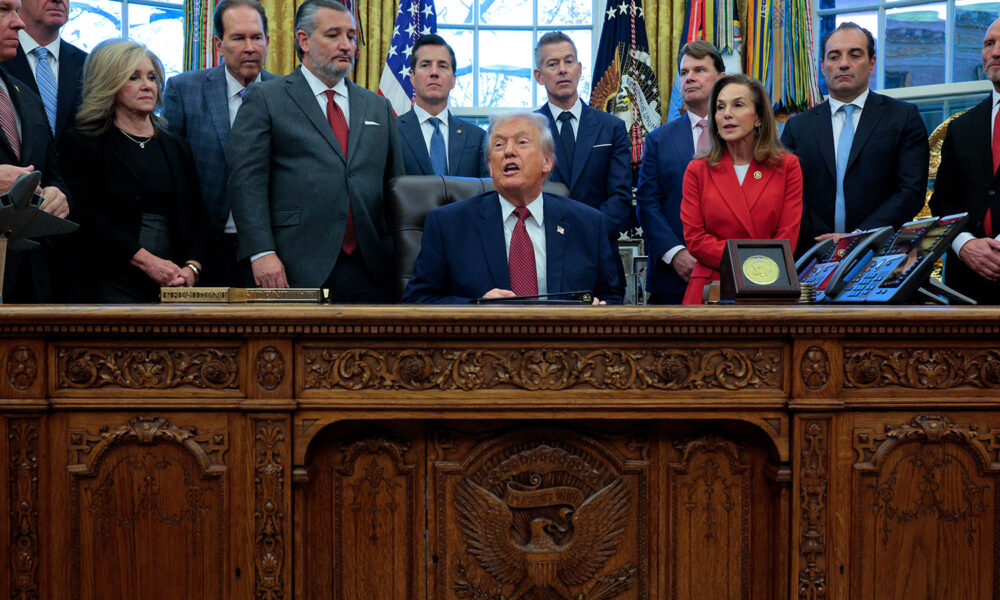

The Trump administration proposed last week to effectively eliminate fuel economy standards for passenger cars and trucks, setting them to a level already exceeded by last year’s new vehicle fleet. The President did so flanked by representatives from Ford, General Motors, Stellantis (fka Chrysler), and the National Automobile Dealers Association, who each claimed that this was to “better align fuel economy standards with market realities,” but the reality of the proposal is that rather than encouraging more efficient vehicles as intended by Congress, these standards will simply do nothing but line automaker and oil company pockets.
This holiday season, you may have found yourself in a “white elephant” gift exchange, where inevitably there is that one gift someone is stuck with. Unfortunately, this year that “gift” is this proposal, which will stick the public with cars that cost more money. The car industry and this administration are giving this to you because they want you to pay more at the pump by jettisoning the fuel economy standards that, to date, have saved consumers literally TRILLIONS of dollars in fuel.
Below are five reasons we need to give this “gift” back.
#1: The administration’s own analysis says that consumers will be worse off
Like the gift of a white elephant, the costs of keeping this proposal outweigh the benefits. And perhaps no single thing embodies that more clearly than the administration’s own analysis showing that consumers will be worse off.
The main purported benefit to consumers according to the administration is that these rules would save buyers $900 up front on vehicles, a claim that rests upon an assumption that manufacturers pass all technology costs directly onto consumers and that, with less technology, prices will go down. However, it turns out this number comes from a constrained analysis that ignored all of the electric vehicles already being sold. And they also ignore the increased fuel costs resulting from those “savings”.
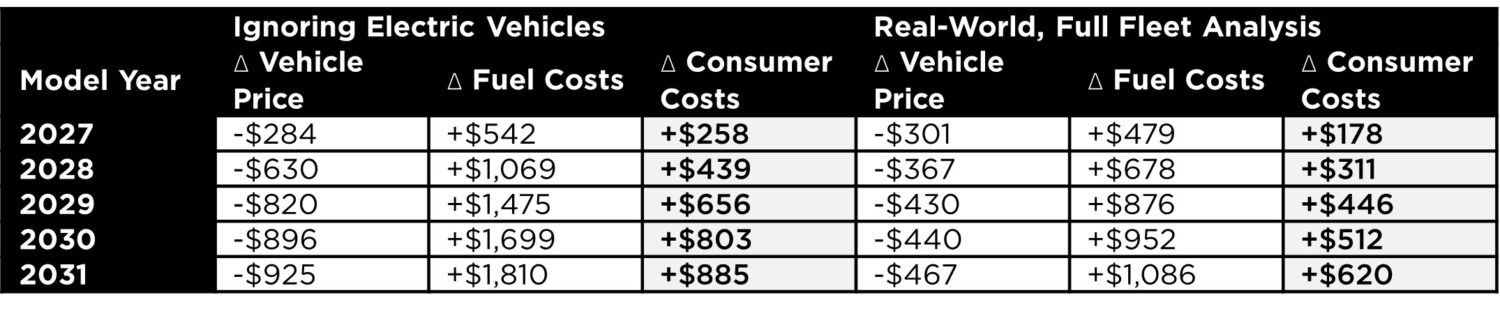
When you look at the agency’s real-world analysis of the purported cost savings on vehicle prices, it turns out that completely rolling back vehicle standards as they propose will knock less than $500 off the average sticker price for new vehicle purchases (note: auto experts doubt whether these “savings” will actually trickle down to consumers). And the result? Nearly $1,100 in additional fuel costs over the life of the vehicle. That’s not great for consumers.
This is a proposal looking to bilk American consumers out of their hard-earned money, first by restricting consumer choice to whatever makes automakers the most profit, and then by the extra money families spend on gas resulting from those far less efficient “choices”.
I guess we know why this administration seems to think “affordability” is a hoax—because policies like this ridiculous CAFE proposal are jacking up prices on American families all so that auto companies and fossil fuel companies can boost their profit margins.
#2: The administration is propagating bad science yet again
Under the first Trump administration, NHTSA put out a ridiculously bad proposal that failed peer review. This time around, they’re repeating a number of the same mistakes.
While not every error has a large impact on their benefits calculation, one that completely shifts the sign of their analysis is their unfounded assumption that manufacturers will significantly overcomply with their much lower CAFE regulations, adding lots of technology to increase fuel economy even though this has never once happened in the history of the program absent strong standards.
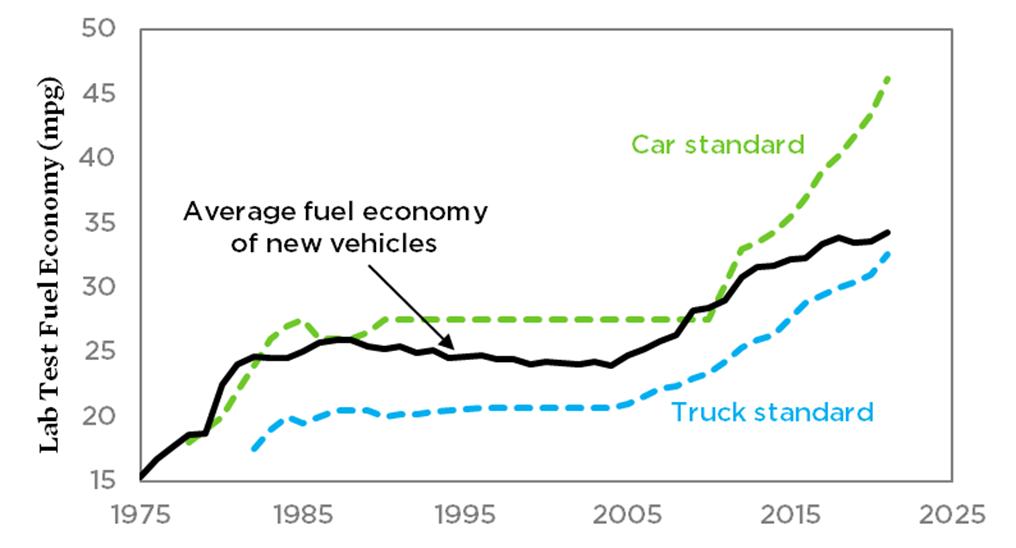
How do I know that this has never happened? Well, the administration themselves even point it out in their supporting documents: “During periods when CAFE standards have remained unchanged over successive model years, manufacturers have offered improvements in [performance] attributes…for example, from 1986 to 2004 when standards remained constant, average horsepower improved from 114 to 210, while real-world fuel economy actually dropped slightly.”
It’s clear that this is an example of the administration trying to use bad science to put a thumb on the scale against improving efficiency.
Obviously their projection that manufacturers can and would add significantly more technology than required indicates that the agency is not setting “maximum feasible standards.” But even more than that, when you get rid of this erroneous assumption that manufacturers would voluntarily overcomply with these standards, the rational, real-world impact of their preferred alternative shows itself as net detrimental to society, even with all the other bad science they’ve baked in to put their thumb on the scale. Our analysis estimates that rather than resulting in $17.8 billion in net social benefits as the administration claims, their proposal generates at least $9.7 billion in net social harms (based on a 3 percent discount rate for future benefits, and looking at vehicles sold through the 2031 model year).
This harm of $9.7 billion is a floor, correcting for just one of their errors. Correcting for further mistakes related to undercounting impacts of smog-forming and global warming pollution, manufacturing consumer benefits out of thinly grounded economic hocus pocus, and more will only increase the calculable harm from this proposal.
#3: Donald Trump is “fixing” rules set by…Donald Trump…because they worked?
One of the ironies of this proposal is that the current Trump administration is proposing to weaken standards set by the previous Trump administration. Way back in 2020, then-President Trump finalized weak CAFE standards for model years 2021-2026 as a parting gift to oil companies. Now, apparently the Trump administration thinks requiring a mere 1.5 percent per year improvement in fuel efficiency is too ambitious, even though they acknowledge that automakers themselves said “‘[b]etween 2012 and 2022, the average 2-cycle fuel consumption (gal/mile) of non-EVs improved at an average annual rate of 1.3 [percent] (passenger cars) and 2.0 [percent] (light trucks).”
And why is the current administration undoing what the previous Trump administration did? Because those rules worked: “the higher rates of increase were driven by standards set by NHTSA.” How dare automakers comply with finalized standards that save fuel for consumers!
It’s also absolutely absurd to set new rules for vehicles that are already sold when those standards are proven feasible and effective. In the 50-year history of the fuel economy program, regulators have never retroactively weakened past years’ standards for the entire fleet. Manufacturers are complying with the fleetwide standards for model years 2022-2026 that the administration is proposing to weaken—lowering the bar after these vehicles are already on the road just makes it easier to comply with future standards by granting them a windfall of credits, reducing consumers’ availability of efficient choices. We estimate that these credits will result in 150 billion gallons of additional gasoline usage, resulting from foregone improvements.
#4: Future rules ignore cars that already exist
They’re not just trying to rewrite history—they’re also trying to ignore it.
The weirdest part of the administration’s proposal is that it claims Congress only meant for fuel economy standards to be based on gasoline and diesel vehicles, ignoring the more than 10 percent of new vehicles being sold today that are electric. Not only does this ignore the most effective technology at reducing fuel use today, but it means that the administration is setting rules based on an incomplete picture of how manufacturers are choosing to cut fuel use.
For each of the past six previous CAFE rulemakings in the modern, footprint-based era for cars and trucks since 2008, each administration (including the previous Trump administration) has considered Congress’s limitation on the consideration of alternative fueled vehicles when setting standards, including EVs, to apply only to vehicles that are not yet electric. Instead, this proposal just excludes a whole portion of the fleet. Not only are the resulting costs and benefits of a rule ignoring such a large part of the fleet completely out of whack and unrealistic, but they yield a rule that no longer abides by Congressional intent to “provide for improved energy efficiency of motor vehicles,” since they ignore extremely efficient vehicles already produced for sale.
#5: The proposed CAFE rule is even weaker than doing nothing
at all
Perhaps the most galling aspect of the CAFE proposal is that the final standard in 2031 is actually at a level WORSE than what was achieved by 2024 vehicles. This was not hidden deep in their analysis, either but in the very first data table in the rulemaking.

At no point in time do the newly proposed CAFE standards exceed what has already occurred. Despite a requirement that the administration set “maximum feasible” standards, it has decided the best it can do is worse than what consumers already have. Drivers will be forced to pay the price, to the tune of nearly $150 billion more at the pump under this proposal. The vast majority of US drivers want to see fuel economy standards continue to improve, and very few of them think automakers will do so without government pressure.
Setting strong fuel economy standards is the gift that keeps on giving
Fuel economy standards were first introduced in response to an energy crisis, but their importance has not diminished over time. Our oil-fueled transportation sector continues to be at the mercy of globally determined oil prices and greedy fossil fuel companies that have long denied the drawbacks of their industry. Today we see the growing harm of climate change and need to drive down energy usage and find alternative ways to get around, whether that be cleaner, electric vehicles or cleaner modes like transit, walking, and cycling. And instead of embracing a cleaner transportation future, the Trump administration is rolling back global warming pollution standards, revoking grants for bike lanes and pedestrian safety, and preparing proposals to defund mass transit.
While fuel economy standards are critical to transitioning to a more sustainable transportation future, they are also important in driving down costs for families still dealing with the economic realities of the status quo. Fuel economy standards have saved families about $5 trillion at the pump since their inception—they continue to be a necessary policy to help cut costs for families facing continued concerns about affordability and the costs of basic needs like housing and mobility.
This is a policy that works—the administration is using bad math to try to shovel money from hardworking families into the hands of the oil and automotive industries, and we need to stop this rollback dead in its tracks.