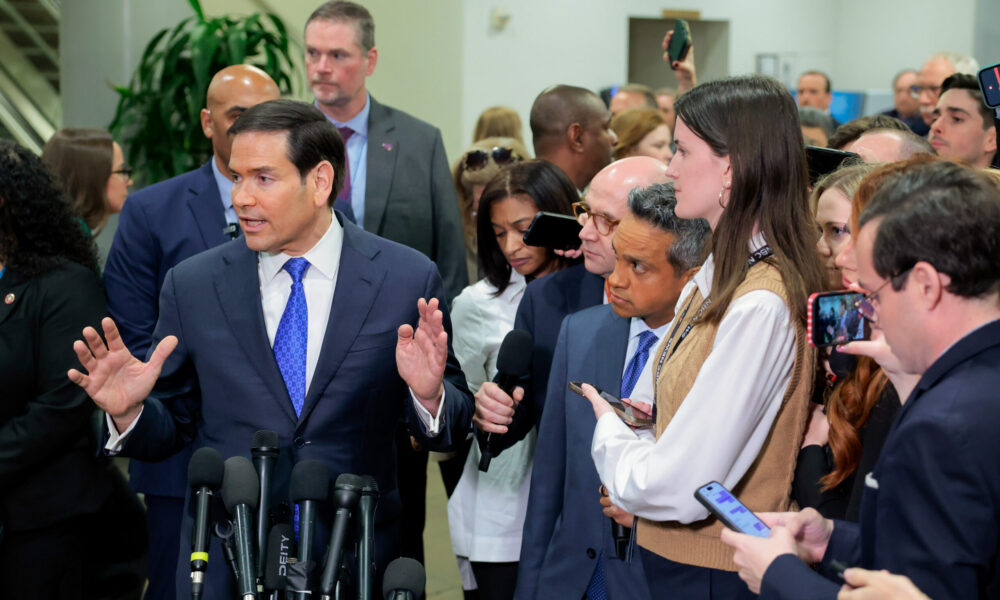

In public remarks about the United States’ strategy in Iran, US Secretary of State Marco Rubio said the Trump administration was going to “unleash Chiang.” I’d bet my house there’s a memo about it on Chinese President Xi Jinping’s desk. That same language was used back in the 1950s by US ultra-conservatives who pressured President Eisenhower to support Chiang Kai-shek’s efforts to overthrow China’s communist government.
The history is complicated, but Eisenhower’s capitulation to these elements in the Republican Party created misunderstandings that almost started a nuclear war. Rubio may be unaware of the origins of the phrase. To him, it seems to be a euphemism for getting tough. That’s not how it is going to be interpreted by the senior leadership in China.
Regime change
Ever since the People’s Republic of China was established in 1949, its leaders have been on guard against US government efforts to depose it. The United States did not officially recognize the communist government in Beijing until 1979. Ten years later, Chinese leaders ordered their military to massacre an untold number of protesters in Tiananmen Square, and all across China, because they feared the protests were being manipulated by US authorities who were trying to weaken and eventually overturn their government. Xi Jinping’s sympathy for Russia’s invasion of Ukraine is a product of his belief that the overthrow of Ukraine’s pro-Russian leadership in 2014 was precipitated by US government meddling in Ukraine’s internal affairs.
It’s not difficult to imagine that Xi and other Chinese leaders could interpret Rubio’s public call to “unleash Chiang” as a warning of what is waiting for them if they don’t play ball with the Trump administration. No amount of US denials is likely to erase that possibility from their minds. President Trump’s statement suggesting one of his war aims in Iran was to kill its leaders and encourage the Iranian people to overthrow their government fits a perceived decades-old pattern in US behavior that would be difficult for China’s leaders to discount as a slip of the tongue from a bungling secretary of state.
A hopeless summit
The Trump administration announced that the president will be visiting China from March 31 to April 2. Authorities in China have not confirmed those dates, but even if they do, a visit now has no hope of producing any meaningful improvement in US-China relations. After watching Trump use negotiations with Iran as a pretext for a military attack—twice—it will be challenging for an inherently skeptical Chinese leadership to believe anything he tells them. Having your secretary of state revive rhetoric about regime change in China, just as planning for a summit with China is set to begin, could make that impossible.
If that were not enough, the Iran war and its consequences for China, especially the restriction of oil imports from the Persian Gulf, is likely to dominate the summit agenda. China may be well-positioned to manage the disruption, at least for a while, but its trading partners in the rest of Asia are not. The entire region could experience a significant economic downturn that disrupts China’s economy.
Back in the 1950s, Eisenhower “unleashed” Chiang to harass shipping along China’s southern coast, believing it would pressure the Chinese leadership into negotiating an end to the fighting in Korea. Rubio’s callous reminder of that experience is as likely now as it was then to stiffen the resolve of a Chinese leadership that does not respond well to what it may perceive as another US attempt at intimidation.
Long-term consequences
Holding a summit under these circumstances is unfortunate, especially given the stakes of an accelerating US-China nuclear arms race. Towards the end of his first term, Trump directed his administration to pursue three-party nuclear arms control negotiations with Russia and China. There was some hope he would make the case for these negotiations during the upcoming meetings with Xi in Beijing.
China’s decision to significantly expand the size of its nuclear arsenal, and its refusal to discuss it, are a primary driver of current US nuclear war planning. Xi appears to have made that decision during the first Trump administration, when Chinese leaders apparently became so concerned Trump would launch a military attack that the chairman of the US Joint Chiefs of Staff felt compelled to call a Chinese general twice to “prevent war between great powers armed with nuclear weapons.”
The calls were prompted by US intelligence sources that indicated Chinese leaders were preparing for the possibility that Trump would start a war with China to prevent Joe Biden from becoming president. Given that history, it’s possible that as Xi prepares for the upcoming summit, his intelligence officers will raise the possibility that Trump attacked Iran to deflect attention from domestic political trouble. If Xi seriously entertains these kinds of doubts about the character of the current US president, it is hard to imagine he’d enter into a discussion about nuclear arms control with an aggressive and unpredictable US leader he cannot trust.