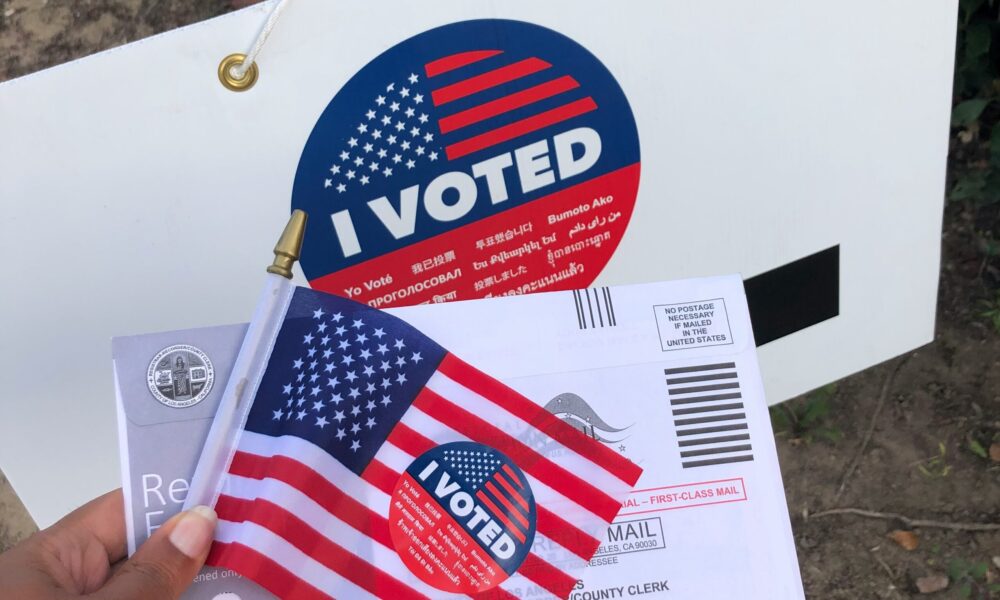

In the United States, our system of government is premised on the idea that voters pick their leaders. However, the second Trump administration and its allies are implementing a multi-pronged attack on this premise. Among the administration’s many harmful attacks on science and democracy, they’re targeting voting rights and elections.
Under President Trump and Attorney General Pam Bondi, the administration is deploying the Department of Justice (DOJ) to demand voter data, propagate the myth of noncitizen voting and ratchet up investigations into the 2020 election. At the same time, a newly proposed House bill would profoundly alter how elections are administered in this country. President Trump has suggested nationalizing elections, removing state authority in violation of the Constitution. Trump allies made even more elaborate threats, suggesting the federal government will have ICE officers patrol polling locations. Together, these actions are all part of a brewing authoritarian crisis.
DOJ’s demands for voter data
For months, the DOJ has been demanding and even suing states (including my home state of Pennsylvania) for access to their voter data. Many states have rebuffed these demands, and federal judges recently dismissed the DOJ’s cases against Oregon and California for their voter data. The Brennan Center is tracking DOJ requests for voter information, which includes requests to nearly every state and active suits in 20 states and DC for noncompliance. So far, 11 states have agreed to hand over, or have already provided, their state voter registration lists, which include personal information such as driver licenses, Social Security numbers, dates of birth, and addresses.
On top of illustrating the Trump administration’s systematic incompetence and inexperience, these demands for voter data are supremely dangerous. Trump administration officials assert they require the information in voter data in order to assure state compliance to two federal laws, the Help America Vote Act (HAVA) and the National Voter Registration Act (NVRA), which both include provisions on accurate voter file maintenance. However, both these laws place the authority to direct voter file maintenance practices in the hands of the states. The DOJ has requested that states agree to a confidential memorandum of understanding that states that the federal government will conduct its own independent review of voter rolls and tell states what voters to remove—something that is under the legal authority of the states and something that “would turn the American system of election administration upside down” according to the Brennan Center. The agreement further stipulates that voters identified for removal by the federal government must be removed from rolls by states within 45 days, which may also violate federal law. While dangerously unprecedented, this is likely just part of the reason for the data requests.
Many elections administrators and observers fear that the federal government could use these data to further spread false information about elections and voting and to contest the results of future elections, including the upcoming 2026 midterm elections (which Trump has already suggested shouldn’t even happen). Including sensitive personal information such as driver license and Social Security numbers also raises concerns that the federal government can target individual voters in their crusade to steal elections, under the cover of false claims of non-citizen voting.
Some concerns run even deeper. Maine’s Secretary of State, Shenna Bellows, worries that the federal government is interested in aggregating state-level data to create a national voter registration file that can be used to identify an individual voter’s party identification and investigate and target political rivals. Unfortunately, this isn’t outside the realm of possibility, especially in light of the Trump administration’s deployment of the Justice Department to investigate his political enemies.
The battle over voter data between states and the federal government attracted even more public attention after Attorney General Pam Bondi demanded that Minnesota Governor Tim Walz turn over the state’s voter roll data as a condition of rolling back ICE operations in the state. This demand feels extortionary in light of the widespread resistance to ICE in Minnesota and the killings of Renee Good and Alex Pretti. In fact, Attorney General Bondi’s demands caused the federal judge who dismissed the DOJ’s lawsuit in Oregon to reconvene the case’s parties. “I have great concerns given what I have seen now both in this letter from U.S. Attorney General and those motives and purposes. It does clearly focus and relate to motives that would very well undermine the basis and purpose provisions of the Civil Rights Act of 1960,” said Judge Kasubhai.
An illegal raid on Fulton County
In addition to trying to intervene in future elections, the Trump administration is also using the power of the federal government to support the lie that the 2020 election was stolen. This is a threat to free and fair elections. Last week, FBI agents raided and seized 700 boxes of original election materials in Fulton County, Georgia. This came after the Justice Department sued the county for access to these records. Director of National Intelligence Tulsi Gabbard was present at the raid by order of President Trump, suggesting that the administration may use conspiracy theories of foreign interference in the 2020 elections, which have been repeatedly discredited, as justification for their investigation.
Senator Mark Warner (D-Va.), who sits on the Senate Intelligence Committee, argued that if Gabbard had unearthed evidence of such interference in the 2020 election, she is required by federal law to inform the committee, which she has not done. Democrats on the Senate Intelligence Committee have called for Gabbard to appear at an emergency hearing to learn more about her involvement in the raid. Allegedly, Gabbard connected FBI agents involved in the raid with President Trump via telephone call after the fact wherein he asked several questions and thanked the agents. The political motivation behind this groundless investigation is evident.
“Every audit, every recount, every court ruling has confirmed what we the people of Fulton County already knew: Our elections were fair and accurate and every legal vote was counted,” said Rob Pitts, the chairman of Fulton County Board of Commissioners, in response to the raid. said “These ongoing efforts are about intimidation and distraction, not facts,” he added. At the same time, the DOJ has refiled its suit for Georgia’s voter rolls after a federal judge originally dismissed the case for being filed in the wrong district. Fulton County has filed a motion demanding the return of all seized materials.
Legal experts like those at Democracy Docket are questioning the legality of the FBI raid. According to these observers, warrants are supposed to be issued when there is probable cause that the location searched or the items to be searched and collected will reveal evidence of a crime but, in this case, there was no evidence of any crime or wrongdoing. Moreover, certain records that were seized by the FBI are under seal by order of a Fulton County judge as they are involved in an ongoing lawsuit for the same election materials. Finally, the warrant cites NVRA provisions on voter intimidation, election interference and voter fraud but the law has a five-year statute of limitations. All of this information points in the same direction: this warrant likely should never have been approved and signed by a judge. Legal experts are also wondering what the sealed FBI affidavit that accompanied the warrant said that might have effectively convinced the judge in question to sign the warrant. Prior DOJ practice would have put the US attorney in Atlanta in charge of the investigation. It remains unclear as to why the US attorney from Missouri is doing so.
Some election officials warn this isn’t just about 2020 but rather a dry run for interference into the 2026 midterms. At a national meeting of the National Association of Secretaries of State, Nevada Secretary of State Cisco Aguilar responded to the raid, saying he believed the action was intended to “intimidate us” ahead of upcoming elections. Similarly, Steve Simon, the Secretary of State of Minnesota, said he and his staff are “imagining ways in which the federal government might explicitly or implicitly interfere with the administration of elections, and we’re planning out what our response would be.”
Attorney General Bondi, Homeland Security Secretary Kristi Noem, and Director of National Intelligence Tulsi Gabbard were last minute additions to the list of speakers at the National Association of Secretaries of State convening, but cancelled just before they were set to appear on Friday. Many Secretaries of State were hoping to use their appearance for the opportunity to probe them for more information about the administration’s quest for voter data and the Fulton raid.
Congressional attacks on elections
The potential for meddling in the 2026 elections doesn’t stop there. A new piece of legislation proposed in the House by Representative Bryan Steil (R-Wisc.) would institute new, restrictive requirements that would harm voting rights and direct state-level election administration. Among its provisions, the misleadingly named Make Elections Great Again (MEGA) Act would implement a strict photo identification requirement for federal elections, necessitate proof of citizenship to register to vote, prohibit counting mail ballots that arrive after Election Day, ban universal mail voting in federal elections, make it easier to sue election officials by expanding who can sue states, impose nearly continuous voter purges, mandates a centralized voter surveillance system in every state, and bars rank choice voting in federal elections. In sum, the bill would disenfranchise millions of eligible voters and put elections under tighter control by the federal government.
According to Democracy Docket, “the MEGA Act is a catastrophic proposal for democracy in the United States. Where voting would move from a fundamental right to a permission-based system—one where voters must repeatedly prove their eligibility, navigate bureaucratic obstacles and hope they are not wrongly flagged by a single database.”
The MEGA Act goes against several of our election science recommendations for both improved election data transparency and more equitable ballot design. For example, evidence suggests that a variety of absentee voting options make elections more accessible for voters with disabilities.
If this legislation is adopted into law, our recommendations concerning voter file maintenance become more important than ever. Even without these harmful policies, states should, among other things, use multiple methods to contact voters about their possible removal from voter files; institute methods to track additions, deletions, and changes made to voter files; and work with community organizations to update information and conduct voter outreach. At present, it looks unlikely that MEGA will become law, though these kinds of restrictions have been proposed by Trump administration allies in some states.
This House bill isn’t the only looming legislative threat—House Republicans have also introduced an even more restrictive version of the deceptively-titled Safeguards American Voter Eligibility (SAVE) Act.
Stop the creep of authoritarianism
What can we do about creeping authoritarianism that is happening all around us? The good news is that despite democratic backsliding, there are still significant ways people can have their voices heard:
- Call or write your congressional representatives and urge them to vote against and be vocal in their opposition to the MEGA and SAVE Acts. (If you aren’t sure who your representatives are, you can use this Ballotpedia tool to find out.)
- Voice your own opposition within your social circles and community by speaking up and maybe even write an op-ed.
- Know how to identify mis- and disinformation and learn what to do about it. Practice nonviolent resistance by attending rallies, meetings, and marches in your area.
- Help those in your community who are the most impacted by President Trump’s actions by finding and supporting mutual aid networks and other community efforts.
- Fight against apathy in the face of struggle. I know it can be exhausting, but our never-ceasing opposition in the face of these attacks on our liberties are vital to protecting them for ourselves and future generations.
Most importantly, vote in upcoming elections. In the United States, voters still choose their leaders, they don’t get to choose their voters. They wouldn’t be trying so desperately to take away your right to vote if your vote didn’t matter.