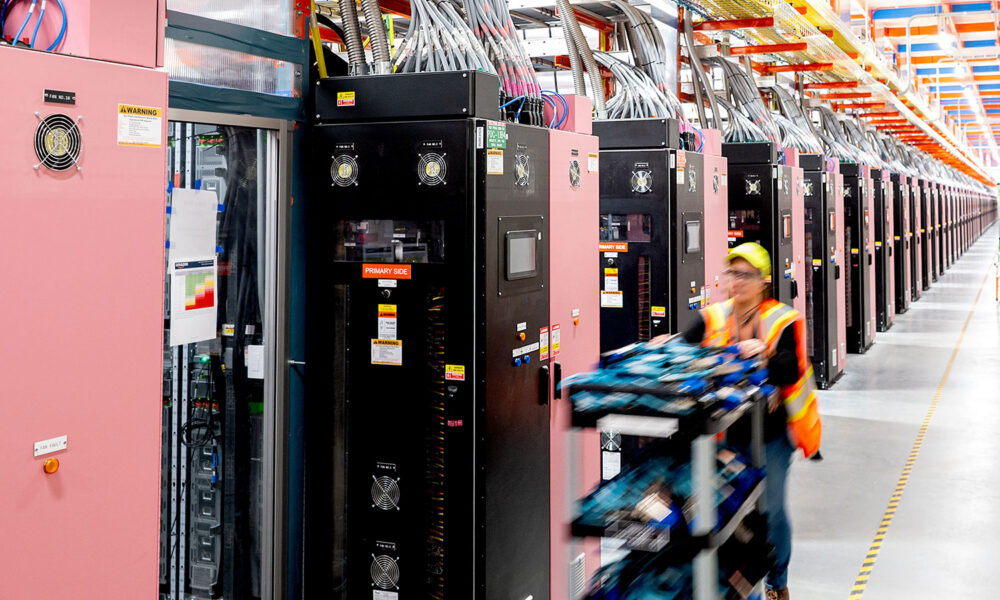

The race to build AI is stressful for electricity suppliers and users. A look at the whole picture shows strains on assumptions and even basic principles. We can see things bending in the electric utility system, both retail and wholesale under the avalanche of new demand from data centers supporting AI. You may have heard what’s happening with data centers creating demand for electricity on the scale of new cities. Amongst many reports, this was featured in recent State of the Union address in Congress and numerous proposed state and federal laws. That’s because the rising demand from data centers is greater than the utility industry has seen in anyone’s careers. Utility companies find themselves competing with data center companies when buying equipment to build needed supply and are often losing.
So what’s coming apart under the stress of all this?
As the information network and data center industry, known for the slogan “move fast and break things” collides with the electric utility world which has slogans 180 degrees opposite, a raft of conventional wisdom is failing. Both the economics and the industry ways of doing things are getting turned upside down. Note at the outset: the idea from State of the Union of customers building electric supply is not new. This was common first with paper and lumber mills burning wood for steam, then in a broad expansion of cogeneration of steam and power at industrials during the 1980s and 1990s, and now with rooftop solar boom of past decade.
Push to increase supply with increased costs
The utility industry originally expanded without raising costs through economies of scale, then with consumer energy efficiency, and most recently with renewable energy. The rush to build supply has scrambled economics with differing emphasis on basic priorities of speed, reliability and cost accountability.
Amongst the data center companies, powerplant economics are a mess. The rush to build supply has bid up the cost of conventional gas-fired plants (and deliveries are back-ordered for 5+ years). To work around that, big tech companies are bringing small truck-mounted turbines designed for short-term or peak use by the dozens. This is the opposite of economies of scale. These generators have roughly 50% higher fuel costs than a utility-grade combined cycle gas-burning plant, and the maintenance of a field of engines is multiples more expensive. That also means 50% more emissions pushed onto the local community, and tempting opportunities for developers to play fast and loose with air permitting rules. This is just a boom-town mentality that jeopardizes everything in the name of speed.
The two dominant existing economic structures for paying for plants reveal serious issues when seen in perspective. Where the old utility structure is still in place and costs are passed on to consumers, utilities are building expensive gas-fired generation and spreading the costs to all consumers. That is, when cost accountability is lost, the costs to consumers aren’t controlled.
In Texas competition is the governing principle. Texas (ERCOT region) does not have protected monopolies in the powerplant business and a costly decision is borne by the owner of that decision. In Texas, wind, solar and batteries are the dominant new supply additions from 2021-2025, and also winning in 2026 on both price and speed to market. This competitive structure recognizes the falling costs of solar panels and battery storage, and gets new supplies added quickly.
Utilities’ costs claims
Utilities like to say they lower costs by adding more customers, but this old logic worked either when incremental supply was a lower price than previous supply, or there is existing unused capacity to serve new customers—neither are true today. Another utility favorite, making the data centers pay their fare share, breaks down when the data centers evade the basic principle of rates that those who cause the costs must pay the costs. This is most clear with transmission connections, but also with the spreading of costs of new, higher cost power supplies. Much of the proposed legislation seeks to sort this, as business-as-usual policies were established under assumptions that each customer was small and spreading costs was fair and reasonable.
Basic policies upended in current rush
Monopolies
So what’s on the policy-making agenda to allow data centers to transform the electricity industry? The biggie—utilities’ monopoly to connect and sell to new customers is threatened by the most dramatic schemes of data center plans to build off-the-grid, and generate all their own power. This expansion of the concept of a micro-grid has been enabled by legislation in a few states, as it revises the idea of a service territory franchise for the regulated monopoly with an obligation to serve. This scenario requires connections to a gas pipeline, a fiber communications network and probably a water source, but no electric utility connection. The data center developer brings their own electric supply attached to their new demand for that electricity. Utility companies hated this idea when US military bases tried to strengthen their resilience (and war-fighting ability) with power plants on-base. The Defense Department lost that fight in the US but use the on-base, mobile generator-approach when operating off the grid in hostile locations.
Planning
In normal times, utilities’ planning aimed to maintain reliability with gradual change and some direction from state clean energy laws. The data centers’ drive for speed is overwhelming all that. In simple terms, a data center can be built much faster than a new utility power plant. New transmission needs more time too. The largest utility planning organization, PJM, with an area of 13 states, the District of Columbia and the greatest concentration of data centers in the world began changing its transmission planning calculus in 2023 but hasn’t started to use that new approach. In the meantime, PJM has been unable to get new supplies connected to the transmission system fast enough. Late last year, after a few years of record high prices for new supplies, PJM conceded that the supply committed for summer of 2027 is not enough to be reliable as PJM normally defines adequate supply. This is a bad situation.
Expect more wonk in a utility discussion
To fill out this landscape survey, we need a few fundamental assumptions about how the rules work for electric utilities, public health and safety, and competition.
Fed-State jurisdictional boundaries
States have a range of authority related to heath, safety and consumer protection under the US constitution. At the start of his current term, President Trump declared an energy emergency and began down a path of scrambling assumptions and authorities. One extraordinary move has been issuing orders under Federal Power Act Section 202 (c) to keep fossil fuel plants from retiring, regardless of the owners’ economic decisions. These orders also override state air pollution limits, and a lot of other state protections. To speed data center expansion, the US DOE seeks proposed rule changes to widen Federal electric utility regulation with 14 proposed reforms that get into costs, planning, monopolies, obligation to serve described above as largely in the states’ authority. So far, states and utilities have opposed much of this. In a flip-the-script move, Utah requested that the Nuclear Regulatory Commission expand the state’s authority on microreactor licensing, fuel storage and reprocessing.
What new supplies to connect and how
Central to the idea of competition in the US electric power industry is open access to the transmission grid. New plants have been allowed to compete since the 1980’s with the assumption that they would have equal access to getting connected to the grid. After gridlock in that process that’s plagued new competitors, primarily wind, solar and batteries, this assumption is being swept aside. Policy changes, some subtle and others less so, are creating fast lanes and set-asides for new gas generators. Totally lost in all this are the quickest new sources available from virtual power plants linking existing distributed resources and procurements of energy efficiency and capacity. This makes a bad situation worse.
Another key rule for the energy supply broken by the current administration is the validity of permits and leasing processes that have been completed. Offshore wind projects with have been most reported, but federal lease agreements with renewable energy and their permits have been decimated by the Department of Interior. The impact on consumers in the Northeast is clear from this interference, as offshore wind contracted to the states make a significant contribution when gas supplies are exhausted and energy prices are high. In the midst of a bad situation, this is unconscionable.
Looking forward to a new change
In any crisis, new opportunities can arise. At the moment, the assumptions about energy storage (mostly batteries) are evolving quickly. Texas has met considerable demand growth with 2-hour batteries. California has adopted 4-hour batteries. In the data center world, some are saying storage is non-optional. Where utilities and data center companies have seen the future, significant new energy storage is in the plans.
The stress of so many data centers, often incredibly large, pushing demand for electricity is reshaping the electric power industry. The reforms proposed and already made to aid the data centers will have implications for the health and safety, as well as economic well-being of citizens in every state. Both state and federal policymakers have a role. Take this up with them.