
The ongoing blockade of ships crossing the Strait of Hormuz has affected the passage of oil, finished fertilizer products, and the raw materials used to synthesize fertilizer. Exacerbated by limited supply, the price of fertilizer has steadily increased since the beginning of the war. On April 27, the price of urea was at $692 per metric ton, a 47 percent increase since the war began. The price of other fertilizers like diammonium phosphate was at $725 per metric ton. Retail prices of all major fertilizer products have been trending rapidly upwards.
Following President’s Trump’s announcement assuring safe passage of ships in the strait, urea prices have fallen to $585 per metric ton, but fertilizer prices remain volatile and somewhat hard to predict due to the ongoing uncertainties of the standoff between the United States and Iran.
How much fertilizer is applied in the United States?
This crisis serves as a stark reminder of how important fertilizer is as an agricultural input and the widespread nature of its use in US farming systems. Data show that in 2022, approximately 236 million cropland acres in the country, constituting roughly 78 percent of the total 301 million acres, were treated with synthetic commercial fertilizers of some kind. Farmers apply a majority of fertilizer, especially nitrogen fertilizer, in the spring months to major row crops like corn.
In a recently released report authored by my colleague Dr. Precious Tshabalala and me, we found that in 2023, farmers in the United States used about 11.62 million metric tons (MMT) of nitrogen fertilizer on all crops. Beyond national data, this report also focused on fertilizer use in three major commodity-crop farming states: Illinois, Iowa, and Minnesota, which contain some of the highest fertilizer-treated cropland acreage. The report estimated that in Illinois, Iowa, and Minnesota, nitrogen fertilizer application on corn and soybean ranged between 565,856 and 883,462 metric tons.
Farmers face compounding crises at the beginning of spring planting
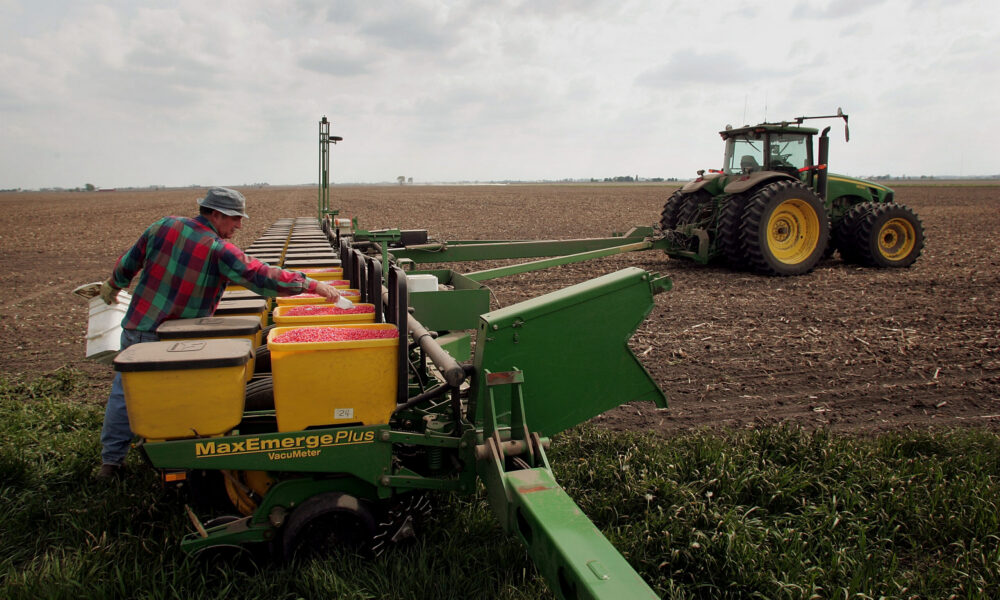
Spring is the time when farmers begin their planting schedules, timing fertilizer application prior to planting to maximize plant growth and yield. Despite signing contracts and locking their price months in advance, reports suggest that there has not been enough fertilizer delivered at ports to fulfil those contracts. Some farmers are now left without the fertilizer they expected just before planting the spring cycle of major row crops.
In a survey conducted in early April by the American Farm Bureau Federation, a majority of farmers indicated they were unable to afford the fertilizer they planned on using for spring planting. Results from the same survey show that farmers were already adjusting their fertilizer purchase and application decisions in response to this crisis. The ongoing supply chain disruption is also likely to affect the planting of major crops like corn, cotton, soybean, and wheat, with the US Department of Agriculture (USDA) predicting a reduction in the acreage of nitrogen-hungry corn in favor of soybeans across the country. With higher fertilizer and fuel costs ahead of spring planting, predictions estimate farmers would plant about 94 million acres of corn and 85 million acres of soybeans, representing a reduction of more than 4 million corn acres and an increase of more than 4 million soybean acres when compared with 2025.
This supply chain shock is likely to reverberate for several months, as fertilizer and fuel prices are expected to remain elevated well into next year, eating into already‑thin farm margins and forcing farmers to make tough choices like planting less crop, switching crops, or absorbing sustained losses. Economists warn that the pressure will fall disproportionately on small and midsize farmers who lack the cash to pre‑purchase farm inputs, and significantly raises the risk of farm bankruptcies since costs are predicted to stay high while commodity prices lag behind.
Farmers actually apply far more fertilizer than required
Because many farmers lean on fertilizer as an insurance policy of sorts for future yields, too much nitrogen fertilizer is applied in our agricultural systems. The majority of nitrogen fertilizer applications occur on commodity crops like corn, which has a high demand for nitrogen and is usually grown in rotation with soybean. Ideally the amount of nitrogen applied would be optimized by balancing how much crops require to maximize crop production while minimizing the loss of unused fertilizer, but the truth is that rates of fertilizer application far exceed the rate of plant absorption, leaving unused fertilizer behind in the soil.
Evidence from peer-reviewed scientific literature shows that farmers apply between 30 to 50 percent more synthetic fertilizer than their crops can actually absorb. Using this range of values in our report, we estimated that US farmers apply about 3.5 to 5.8 MMT more nitrogen fertilizer than plants can absorb.
What does all that excess nitrogen do in the environment?
Excess nitrogen that is not absorbed by crops remains behind in the soil and escapes into the surrounding environment, including bodies of water, and has deleterious impacts on the health of the environment and the health of people living downstream. Unabsorbed nitrogen fertilizer also transforms into powerful heat-trapping gases like nitrous oxide (N2O) and carbon dioxide (CO2) that contribute to climate change. N2O is 273 times more powerful than CO2 in capturing heat.
Our report shows that in 2023, nitrogen fertilizer overapplication was responsible for an estimated 36 to 60 MMT of heat-trapping gas, equal to the emissions from up to 14 million gasoline-powered cars driven for a year. In Illinois, Iowa, and Minnesota, heat-trapping gas emissions from the overapplication of fertilizer on corn and soybeans ranged between 1.7 and 4.6 MMT.
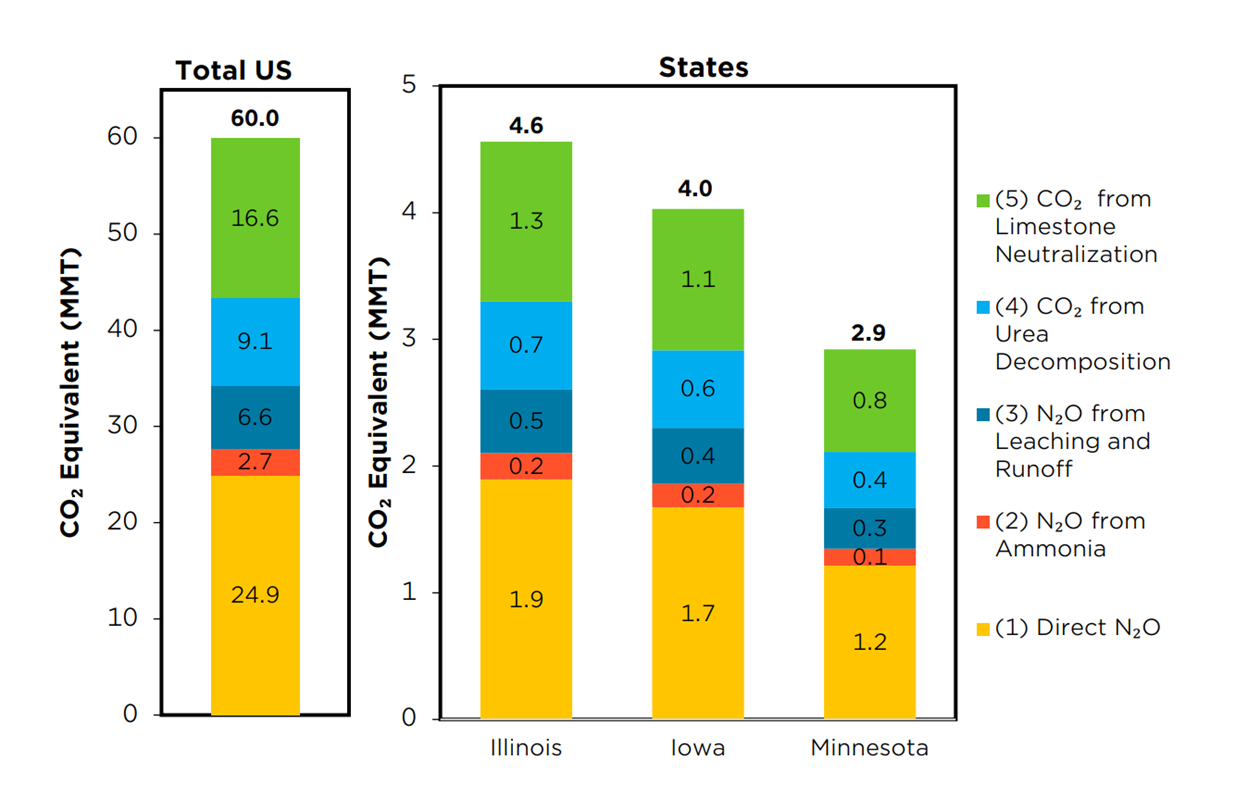
Heat-trapping gas emissions from the overapplication of nitrogen fertilizer (assuming 50 percent of applied fertilizer occurs in excess)
Farmers, communities, and taxpayers end up paying a high cost for the pollution caused by nitrogen runoff. As my colleague Dr. Tshababala wrote in a recent blog, the true cost of nitrogen pollution is much higher than the price farmers pay for purchasing and applying fertilizer. Adding up all the costs from fertilizer damage to the environment and human health, she notes that, according to data from the Environmental Protection Agency, “total annual impact of agricultural nitrogen pollution on health, drinking water, and recreation and fisheries is a staggering $157 billion.”
Farmers face direct impacts due to the Iran war
In a previous blog post I explored the impact of increased fertilizer prices on farm input expenditures and the cost of production. With no end to the war in sight, and the tense standoff in the Strait of Hormuz, farmers remain uncertain how long they will continue facing shortages for shipments booked far in advance and ultimately how much they will end up paying.
This situation shows how vulnerable and exposed farmers are to global shocks. We need to transition away from this input-dependent, monopolistic model of agriculture and provide farmers with off-ramps. One way for farmers to reduce their fertilizer consumption is by integrating farming practices like crop rotations and diversified farming systems that build soil health and resilience. Another way is by using the “4R’s of nutrient management,” which stands for right source, right rate, right time, and right place of application. It isn’t by any means a perfect solution.
A broader pathway would be to increase investments in USDA conservation programs that offer farmers financial and technical support for enrolling their land. The expansion and purse strings of USDA conservation programs are controlled by policy vehicles like the farm bill, which is supposed to be passed by Congress every five years.
We need public policies and incentives that help farmers reduce fertilizer overuse in an intentional and predictable way. Reducing overdependence on, and overuse of, costly fertilizer would be good for our environment and farmers’ bottom lines—and it would protect them from sudden shocks like the current one.
The recent farm bill falls short on helping farmers
Despite some uncertainty and last-minute changes, the House passed its version of the farm bill on April 30, marking some progress on this long-stalled piece of legislation. However, the House version failed to make critical investments in conservation policy and fell short in making changes that would allow farmers to transition away from an input-dependent, industrial model of agriculture. The fate of the farm bill still remains uncertain as it heads to the Senate, where it will need to be debated and passed before heading to the president.
Farm policy continues to favor farmers who engage in industrial agriculture, which focuses on the monoculture of commodity crops like corn and soybean. Incentives like subsidized crop insurance and bailouts during crop failures and disasters keep farmers running on this input-dependent treadmill. There is pretty compelling scientific evidence that US agriculture needs to shift towards a model of agroecology for a resilient farming system that can keep nutrients in place and build long-term soil health. At UCS, we focus on supporting farmers by helping transform the system so they can be both financially successful and environmentally responsible.