

The fight over Meta Platforms’ costly expansion of its data center project in northern Louisiana is heating up, with stakeholders just recently weighing in on the substance of the plan for powering the massive facility. Plus, Meta is fighting—and losing thus far—a subpoena that would require more transparency about its plans for this data center, and state regulators are set to vote on that specific issue this Wednesday, August 12th, 2026 at 9 AM in Baton Rouge. Here’s what you need to know.
Some quick context
In April 2026, Louisiana’s largest utility company, Entergy Louisiana, filed an application with state regulators to build seven additional gas-fired power plants to serve an expansion of the AI data center being built by Meta in Richland Parish, Louisiana. These new plants, along with new transmission and other proposed infrastructure, would be in addition to three gas plants approved by regulators last year for Meta’s data center. Entergy and Meta are claiming that a single data center needs a total of 10 new gas plants, each of them rated at 754 megawatts (MW) of power. For perspective, 7,540 MW is enough to power the entire city of New Orleans’ annual peak demand — six times over.
Now, the regulatory proceeding at the Louisiana Public Service Commission (LPSC) is well underway, where stakeholders are weighing in on Entergy’s proposal to build the seven additional plants and other associated infrastructure. Because Entergy must make its case to the LPSC that this new proposal is in “the public interest” in order to get approval, the company is claiming that the data center will actually benefit its existing customers instead of triggering rate hikes, which has already happened in other parts of the country and is set to take place in Louisiana as well.
This claim of ratepayer “benefit” does not stand up to scrutiny when you actually dig into the details of the proposal. It shouldn’t come as a total shock that Meta is opposing efforts for improved transparency into the data center project.
Meta is fighting transparency, but Louisianans can make their voices heard
On August 4th, 2026, an administrative law judge at the LPSC rejected Meta’s motion to cancel a subpoena that was requested by Earthjustice on behalf of the Union of Concerned Scientists (UCS) and the Alliance for Affordable Energy (AAE), a Louisiana-based consumer advocacy group. The subpoena ordered Meta to substantiate:
- Meta’s level of investment and permanent job creation; and
- The amount of electricity the data center will demand.
Because Meta isn’t a party to this proceeding, UCS, AAE, and other stakeholders in the proceeding haven’t been able to ask the tech company these types of questions in any formal, legal manner. Stakeholders can ask Entergy these questions formally, because that’s the company that filed the application for all the power infrastructure. But when asked to back up the claim that the data center will create new permanent jobs and will require seven additional gas plants, the utility company points only to Meta’s claims, without any other data.
So, the judge ruled last week that Meta must back up these claims in a formal and rigorous manner, but has also granted the tech company’s request to have the full Commission review the issue.
The bottom line: Louisiana’s five elected Commissioners are set to take a vote to ultimately decide whether Meta has to answer these key questions at the Commission’s Wednesday, August 12th public meeting, starting at 9 AM at 602 North 5th Street, Baton Rouge, LA in the 1st Floor Natchez Room.
If you live in Louisiana outside of New Orleans (where the city council regulates utility rates), you can make your voice heard either by contacting your Commissioner or showing up physically to the meeting in Baton Rouge. If you show up, you’ll have an opportunity to make a public comment to the Commissioners, and this blog may give you some ideas if you’re unsure where to start with your remarks But even if you don’t want to speak, your presence in the room makes clear to the Commissioners that people are paying attention to the decisions they’re making.
Now, let’s get into more of the substance of this proposal and why it’s such a risky proposition for Louisiana ratepayers.
Ratepayers still on the hook
Starting with the basics: Meta has not agreed to cover all of the costs of powering this data center project. That means Louisianians could get stuck footing the bill for their ten new polluting, expensive gas plants, including the seven at issue in this proceeding.
This is partially because Meta and Entergy structured their deal with flexibility to allow Meta to walk away from the data center before all the infrastructure is paid for, leaving ratepayers to pay for remaining costs. But even if Meta is truly in it for the long haul, ratepayers are still set to subsidize the operating costs at the new plants.
Expert testimony filed by Current Energy Group (CEG) on behalf of UCS and AAE shows that Entergy’s claimed “benefits” are premised on an unreasonably optimistic set of assumptions and quickly turn into higher ratepayer costs—potentially billions of dollars—once key uncertainties, such as data center demand and fuel costs, are examined. Further, Entergy’s analysis of power grid reliability was wholly inadequate for a project of this scale, failing to consider solutions that could have reduced both costs and emissions.
To be specific about the scale, Meta wants the data center’s peak computing electricity demand to grow to about 5,000 MW, roughly the average load of New York City. Yet, just like last year’s case, the tech company is refusing to come to the table and answer any questions that would shed some much-needed light on this proposal. Let’s recap what’s actually being proposed.
Large construction costs go untested
Investor-owned utilities like Entergy profit off construction projects, generally referred to as “capital costs.” The more they build, the more they profit. Entergy is currently seeking to build more than $15 billion in new capital infrastructure, summarized by the table below:
| Generation Resource | Capacity | Estimated Capital Cost (millions) |
| Richland gas units 1-4 | 3,016 MW | $7,109 |
| Point Coupee gas units 1-3 | 2,262 MW | $5,802 |
| Bogalusa West lithium-ion battery | 200 MW / 800 MWh | $367 |
| Cypress Harvest lithium-ion battery | 200 MW / 800 MWh | $367 |
| Transmission | ||
| WFC-St. Landry 500-kV line (~150 miles) | $1,395 | |
| St. Landry Switching Station | $67 | |
Entergy is proposing four gas plants in Richland Parish, and three gas plants in Point Coupee Parish, totaling 5,278 MW. The company is also proposing some additional battery storage capacity, plus transmission infrastructure.
If the construction projects were approved as proposed, Entergy’s shareholders would stand to make an estimated $8 billion in additional profits over a 20-year period.
Also, because Entergy is proposing this project be rushed through the regulatory process under the LPSC’s new “Lightning Amendment”, the utility company won’t be required to prove that its proposal is the least-cost option for meeting Meta’s needs – a process typically required before new infrastructure projects are approved by the LPSC. With that process being pushed aside, the project costs could very well likely be inflated.
20-year contract, but…
Under the proposal, Meta would get electricity service from Entergy through a 20-year contract that includes “minimum charges” the tech company must pay in order to offset the costs to other ratepayers. Included in these minimum charges is the annual capital cost, the rate of return to Entergy’s shareholders and debtholders, fixed operating and maintenance costs, as well as taxes and insurance. However, while Meta will be paying its own share of Entergy’s “fuel adjustment clause” (FAC) charge, that charge isn’t included in Meta’s minimum charge; these are operating costs that will be spread to all customers. More on that a little further down.
It’s important to keep in mind that even if Meta sticks around for the entirety of its 20-year contract, ratepayers aren’t in the clear on the capital costs. Three out of the seven gas plants being proposed, which would be in Point Coupee parish, would not be fully depreciated (in other words, paid off) until 32 years after being in service, so ratepayers would be on the hook for more than a decade’s worth of capital costs if Meta doesn’t renew its contract. The other four proposed plants, which would be in Richland Parish near the data center, would depreciate over just 20 years, but will still only be about 90% paid down by the end of the contract term, due to the contract coming into effect in 2028 before all the plants are finished being constructed.
Entergy estimates that the gas plants, and the much smaller battery storage projects, will be about 75% depreciated by the end of the 20-year contract term. The utility company’s method of allocating these costs over time isn’t clear from its public filings, which include many redactions, but 25% of those total costs is $3.4 billion. The receipt ratepayers are left holding after the contract expires could be in that ballpark, and that wouldn’t include other costs, such as the operating costs I’ve alluded to, as well as the ~9.7% profit margin Entergy’s shareholders are authorized to make on their construction projects.
But Meta could terminate this contract much earlier than 20 years. If Meta decides to do this, there is a loophole that allows Entergy to seek so-called “retained generator” status, which would allow the utility to charge ratepayers for any remaining costs. This caveat is particularly concerning because Entergy has a financial incentive to retain the plants in order to continue earning its 9.7% profit margin on those billions of dollars in capital infrastructure. Plus, with overall future demand for AI services remaining uncertain, Meta backing out is a possibility that regulators must rigorously take into account.
CEG’s testimony finds that ratepayers seem to bear 100% of the financial risk of these Meta-triggered plants if Entergy retains them. Ratepayers didn’t prompt these huge expenses, so at a bare minimum, Entergy’s shareholders should have to share this risk, and the LPSC should make that expectation clear at the outset (especially given the $8 billion in profits shareholders are estimated to make). This would incentivize the utility to instead pursue any unrecovered funds from Meta, which is the company causing the additional costs. If Entergy is making a huge bet that all these costs will be worth it, the company should be betting with its own money, not ratepayer money.
“Benefits” quickly turn into costs
Even assuming Meta stays at the data center for 20 years, Entergy’s claims that this proposal will benefit other ratepayers doesn’t stand up to scrutiny. The utility calculates $28.5 billion in total costs over the next 20 years, compared with $30.4 billion in total revenue. That’s how the company derives a “benefit” of about $1.9 billion (roughly 6.5% – shown in the table below), in the event that Meta renews its contract. If Meta walks away after 20 years, that decreases to $991 million, or about 3.5%. This means that just a 3.5% increase in costs or decrease in revenues could wipe out any benefit and result in a ratepayer subsidy for Meta. To compare this to a recent example, the projected capital costs of Entergy’s already-approved project to power the first phase of Meta’s data center increased in May from $3.9 billion to $4.4 billion, or about 11.7%.
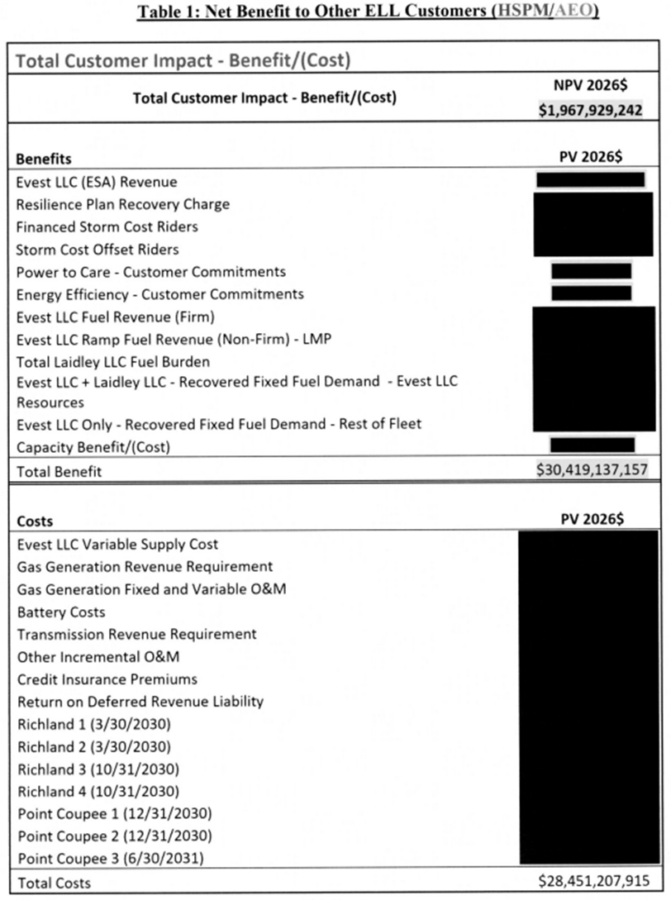
There are several key uncertainties with this massive new proposal that could result in higher costs or lower revenues, but Entergy didn’t adjust any of those variables to see how they’d change the results compared to their overly optimistic assumptions. One of those uncertainties is: how much energy will Meta’s data center actually demand? We are trying to get an answer to this question via the subpoena mentioned above, but Entergy just used the Meta-provided number and didn’t test any other possibilities.
The expected “load factor” of the data center—which is the average percentage of time it will run at its own peak load—is kept confidential. But the CEG testimony notes that the assumed load factor is “very high for any load, leaving no room for upside in the analysis but resulting in significant downside exposure if actual operations fall short of that level.”
We are not the first to point out utilities using very high data center load factors in their projections. With all the uncertainty around the future AI landscape, and with Meta clearly still hedging its bets on what to actually use its data centers for, Entergy should be testing for lower levels of demand to see how it affects its cost-benefit analysis. In fact, Entergy does seem to be expecting possibly lower demand as outside of that analysis; the companies’ contract allows Meta to reduce its average contracted demand in order to avoid a “windfall” benefit to other ratepayers at Meta’s expense.
However, windfalls appear to be going the other direction under this current proposal. The testimony points out that another key variable that Entergy failed to thoroughly examine is fuel and other operating costs at the plants. The utility’s fuel adjustment clause (FAC) charge includes not just fuel costs for the gas plants, but also major maintenance costs—about $10.3 million per year at each of the seven plants—as well as gas transportation costs. The utility company would spread the FAC costs to all customers right away, and most of the estimates for these costs are redacted from public view.
The proposed gas plants would have “firm”, or uninterruptible, gas transportation service via pipeline, which means Entergy would pay a gas pipeline operator to reserve capacity on the line. That is a fixed cost Entergy will recover through the FAC, but again, Meta could use less electricity than expected and then the tech company’s revenue contributions to the FAC therefore wouldn’t be commensurate with the costs. Ratepayers could therefore subsidize Meta’s fuel costs.
Entergy also acknowledged that three of the plants in Point Coupee parish will likely need new pipeline infrastructure. Those additional costs will be caused by this Meta-driven project, but Entergy will spread the costs to all of its customers through the FAC. This is yet another subsidy of Meta’s fuel needs by ratepayers.
Power-grid reliability solutions go unexplored
The second piece of testimony, submitted by engineering consultancy HickoryLedge on behalf of AAE and UCS, highlights a number of grid solutions that Entergy ignored or only studied at a very surface level. These solutions could have the potential to reduce the number of gas plants and project costs, and improve the reliability of the grid. But the company instead is primarily seeking to throw more fossil fuels at the problem.
For example, for the proposed transmission aspects of this project, Entergy is seeking to use transmission line designs that are 20 years old. Newer, more advanced lines would be able to carry up to about 30% more power and could potentially allow better access to renewables at a minimal impact on capital cost.
Another solution is data center load flexibility: essentially, reducing demand during peak hours a handful of hours per year so that the overall infrastructure buildout can be reduced. This strategy has potential to reduce overall costs, mitigate the risk that these assets become stranded (essentially worthless), and improve grid reliability. But Entergy wrote off data center load flexibility because Meta said it wasn’t interested in it. The companies seem to have given up quickly for such a massive project.
LPSC must prioritize ratepayers in this risky proposal
The LPSC has a long way to go to adequately protect ratepayers. With such a massive contemplated scale, the risks are enormous, and many of them are being kept out of public view.
The Commission should require Entergy to further study the above-mentioned grid-reliability issues, among others detailed in the testimony, and come up with a plan for monitoring the data center’s grid impact if it were to come online. The seven gas plants should also not be considered all at the same time; a more staggered review schedule is more appropriate for a more-than $15 billion project that has so much ratepayer money at stake. This would also allow more time for the Commission’s normal request for proposal process, which would allow third-party power providers to offer potentially cleaner, cheaper options to meet demand. There are more detailed recommendations outlined in the testimony that readers should check out if they’re interested—and highlight to the LPSC as well.
I’ll reiterate that if you’re in Louisiana, outside of New Orleans, you can contact your Commissioner and urge them to protect ratepayers instead of the shareholders of Entergy and Meta. You can even show up to the Commission vote this Wednesday, August 12th, which starts at 9 AM at 602 North 5th Street, Baton Rouge, LA in the 1st Floor Natchez Room.
Showing up lets the elected Commissioners know that folks are paying attention to their decisions, and you can even give a public comment urging basic transparency from Meta. It’s far past due for the LPSC to hold these billion- and trillion-dollar companies accountable.
Editor’s Note: Since the time of publication, state regulators nixed a subpoena that would’ve required Meta to be more transparent about its plans for this data center. The move was made in spite of multiple decisions from a judge who ruled that more information from Meta was necessary, as well as the wishes of community members who showed up to voice a wide array of concerns.