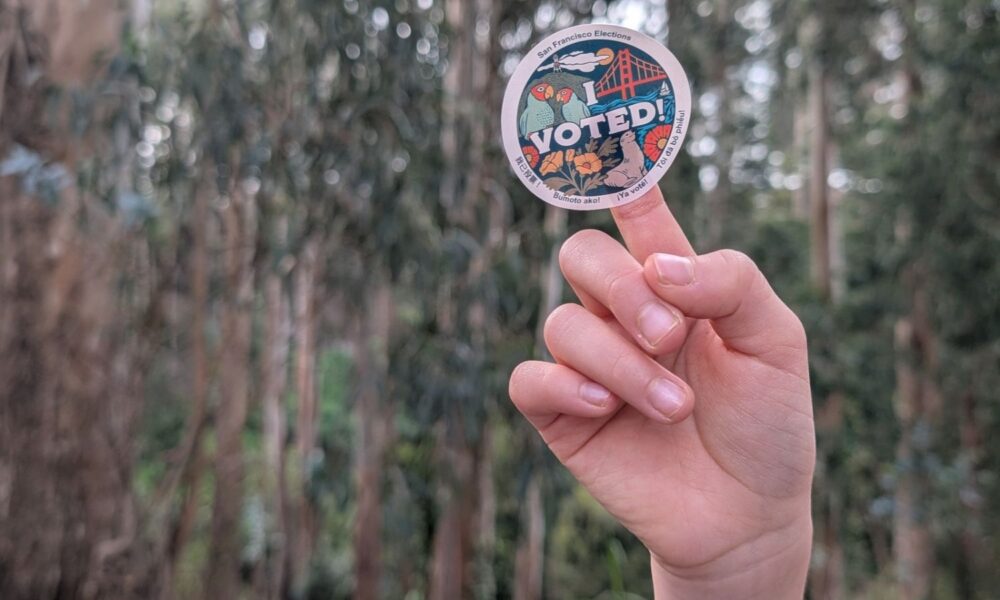

My daughter, 6 years old, likes to sit with me as I fill in my mail-in ballots. Maybe she’s motivated by the beautifully designed “I voted” sticker from the City and County of San Francisco’s Department of Elections. Maybe filling out the circles on the ballot looks like the worksheets that she’s used to doing at school. But I also hope she’s curious about what the adults are doing around Election Day.
I try to bring her into why we vote, understanding who the candidates are, what the issues are, and how we vote. Living in San Francisco, I start with an issue that is local and easy to explain to a 1st grader. I explain how some people want to use an area next to the ocean as a highway for driving cars, some people want to use it as a park for playing, and San Franciscans choose between the two options by voting.
Which has happened three times in her lifetime, in 2022, 2024, and 2026.
Many San Francisco voters are probably exhausted by this issue coming back again and again on our ballots, but I have some appreciation that a lesson is easier to teach to your kid when you can repeat it a few times.
Who else showed up?
But my explanation of how we vote left out who else showed up in the election.
Leading up to the 2026 midterms, a small number of powerful people spent staggering amounts of money to influence the election. The top 20 megadonors spent $2 billion on federal races in this year’s election. In California, ultra-wealthy donors spent $378 million to defeat a proposition that would have taxed the state’s few hundred billionaires to fill the gap left by federal Medi-Cal cuts. There’s no sticker to record their participation in the election. If there were, it would say, “We spent billions to influence votes.”
The influence extends beyond elections, as those with extreme wealth and power are using disinformation to influence the policy fights. Oil companies try to shift the blame for the affordability crisis away from their own sky-high markups to California regulations designed to keep people safe and preserve a healthy environment. After decades of fossil fuel companies misleading the public about their products’ contributions to climate change and blocking climate action, we now know that 94% of industrial CO2 emissions since 1959 trace to just 122 oil, gas, coal, and cement companies.
Tech companies are resisting protections for children and consumers, while forcing data centers on communities where the pollution, noise, and energy costs are not welcome. Industrial agribusinesses are more concerned with protecting their bottom lines and maintaining California’s resource-intensive and unsustainable agricultural system, while communities, public health, and local economies pay the price.
What must come next: science-based policymaking free from corporate influence
To help see past the disinformation and deliberate deception on such complex issues, UCS works to ensure that independent science, free from corporate or political bias, can guide decision-making. The midterm elections opened up opportunities with the 120th Congress and with states to prioritize the public good over distortion of facts and to continue the work to protect democracy, science and public institutions.
Even with these new opportunities, issues like climate change, energy affordability, and sustainable land use remain complex. In California, leaders including the newly elected Governor Becerra will have to tackle challenging questions.
- Addressing energy affordability in California needs to include reducing risk of future wildfires, paying for the costs of wildfires that have already ravaged communities, and transitioning to an electricity system that no longer exacerbates climate change. Read my colleague Mark Specht’s piece on the seven energy priorities for our Governor-Elect.
- We can—and must—tackle unfair gas prices without sacrificing environmental progress. Read my colleague Jeremy Martin’s piece outlining a path to taking on the oil monopoly and restoring fair competition.
- Despite federal attacks on California’s authority to regulate air pollution, we have effective options to transition to clean transportation to save Californians money at the pump, while avoiding the worst public health and climate impacts. My colleague Don Anair lays out a bold agenda for California’s new governor to target the most polluting vehicles on the road and make electric cars more affordable for more people.
- As California transitions away from unsustainable agricultural practices, communities need to be in the driver’s seat, leading a coordinated transition towards thriving and resilient local economies. Read my colleague Erin Wooolley’s piece to hear more about the multiple benefits that can be achieved with a just cropland transition and how to focus resources and coordinate planning to achieve transformational change.
These are all hard problems with no easy solutions. In each of these linked posts, my colleagues at UCS sift through the noise of unfounded claims to understand real trade-offs and feasible solutions. When we put science at the center of the policy process, we can build a California that is more affordable, healthier, and fairer. Whether in Sacramento or Washington, DC, decisions should be grounded in evidence, not in the interest of the biggest donors.