
Each year, the EPA releases a report on its environmental enforcement for the previous fiscal year; last year’s report was finally released on Monday, March 9, the latest release this century. In a press release, the agency claims the results show “the strongest enforcement and compliance results in years.” But three independent groups’ analyses of this report, including the group we represent, paint a much different picture: of a record plunge in the agency’s enforcement of the nation’s laws protecting human health and the environment.
We are members of the research collaborative the Environmental Data & Governance Initiative (EDGI), and the analyses we’re discussing include EDGI’s report on the EPA’s 2025 enforcement track record and annotation of EPA’s announcement of its fiscal year report.
Bedrock environmental pollution laws in the United States like the Clean Air and Clean Water Acts received bipartisan support when they were established in the late 20th century—but these laws only work if they’re enforced. Enforcement involves detecting violations (typically through inspections), adjudicating them administratively or judicially, and resolving cases through remedies (to ensure compliance) and penalties (to deter future violations). Vigorous, effective enforcement is crucial to protecting human and environmental health.
Why the discrepancy in the agency’s claims? There are two reasons. First, many of the actions highlighted by EPA’s press office were actually initiated under the Biden administration. And second, the agency’s comparisons rely on unusually weak enforcement numbers in recent years, masking the fact that federal environmental enforcement has been in serious decline since the first Trump administration.
EPA’s enforcement record under the second Trump administration
The EPA claims that its strong enforcement results “have taken place since President Trump was sworn back into office.” But this is highly misleading because EPA’s numbers are based on fiscal year 2025, which runs from October 1, 2024, to September 30, 2025. Trump’s first full day in office, however, was not until January 21, 2025, which means that 112 days (or 30%) of the fiscal year already passed before he could have had any effect on the EPA.
While federal agencies typically report by fiscal year, attributing all of this last fiscal year’s actions to Trump is misleading, as many initiatives began under the Biden administration. For example, the EPA claims it closed 2,300 civil enforcement cases (or 2,137—it provides both numbers in a press release), representing an increase over the previous administration. Yet many of the cases closed in 2025, including 87% of air pollution cases, were initiated before Trump took office.
This is like comparing Michael Jordan and Lebron James’ NBA seasons, but using part of Jordan’s season for James’ statistics. In our analysis, we eliminated this misleading and muddled approach by using the EPA’s own raw enforcement data, and comparing periods from January 21 to November 30 over the past 20 years. Our findings do not support the claim that the second Trump administration is stronger on enforcement than Biden. And on many measures, the opposite is true.
For example, the agency conducted fewer facility inspections compared to 2024 across the board—including for toxic, air, and water pollution—with inspections for toxic substances dropping the most sharply, with at 36% decrease. Civil judicial cases, which try the most serious offenders of civil laws, declined in terms of both cases initiated and cases concluded, and the number of these cases that were concluded with zero dollars in both penalties and compliance costs was higher than in any year of the Biden administration. While this EPA did initiate and conclude more administrative cases, penalties for these cases were much lighter.
We considered the question of whether an incoming administration might face unique challenges that would make its enforcement record weaker in the first year. But the data doesn’t suggest that is a major barrier. The Trump 2.0 EPA hit historic lows in civil judicial cases concluded—just one of many measures it was historically low on as we discuss below—but one of the top years of judicial cases concluded was Barack Obama’s first year in office, 2009.
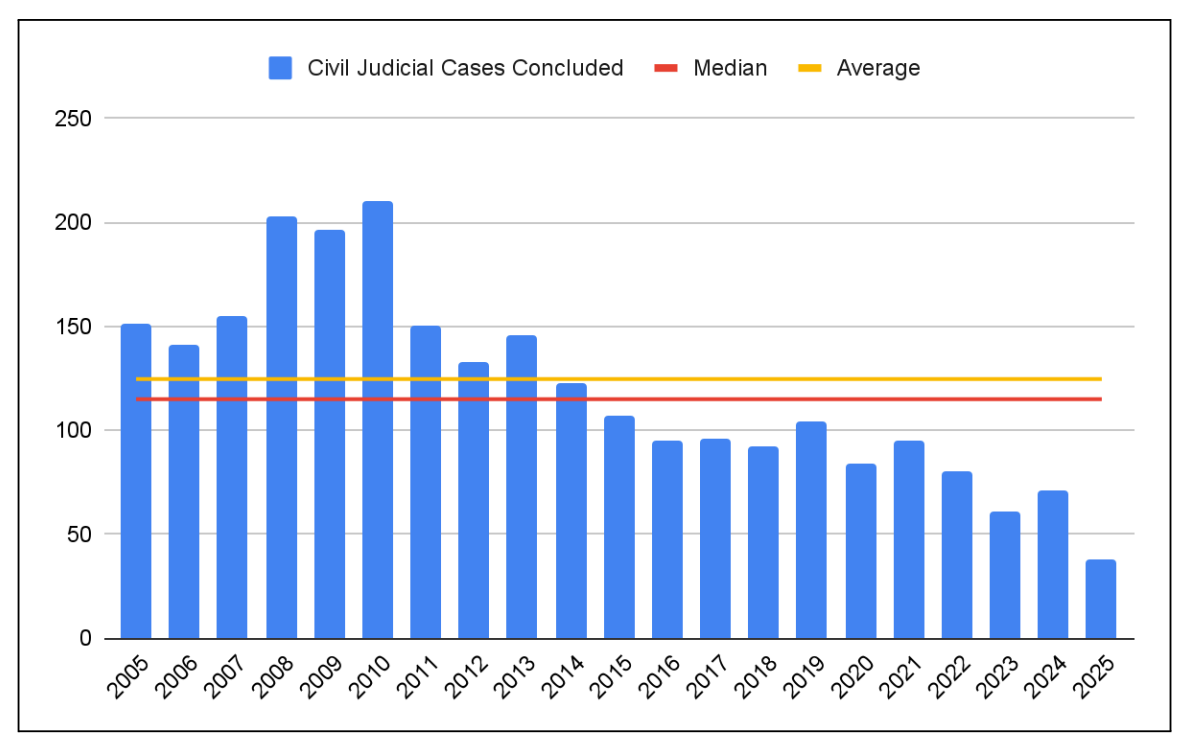
Annual number of civil judicial cases concluded from 2005-2025, with cases tracked from January 21 through November 30 each year and data from EPA ECHO. Image shows Figure 31 in the report Making America Polluted Again: The Trump EPA’s 2025 Enforcement Record.
Enforcement in historic decline
Perhaps most misleading in the EPA’s framing of its 2025 record is its reliance on what analysts call the “low base effect,” which essentially measures progress from the bottom of a deep hole. For example, say it’s 1934 and you claim that the unemployment rate is “great” because it is better than it was the previous year. It’s true that unemployment was better in 1934 than 1933. But 1933 was the worst year of the Great Depression, and unemployment in 1934 was still over 20%—hardly worth celebrating!
We are currently in the Great Depression of EPA enforcement, ushered in by the first Trump administration in 2017. As EDGI documented at that time, the Trump administration drove EPA enforcement to historic lows across the board. Likely hampered by the COVID-19 pandemic, the Biden administration did not return the EPA to its previous level of enforcement activity, though it did make strides toward this end in some categories of enforcement inspection activities, including for lead paint as well as activities conducted under the Clean Water and Clean Air Acts.
Thus, when we compare the current Trump EPA’s enforcement actions to historic levels, we find that we are still in a period of deep retrenchment against strong enforcement. Our analysis looked at 24 measures of enforcement, including inspections, case initiations, case conclusions, penalties, and compliance costs. In seven of these categories, EPA performance in 2025 was the weakest it has been in 20 years. In another seven, it was second weakest (second only to the first year of COVID-19). That’s 58% of enforcement activities in historic decline under this EPA, broadly contradicting Administrator Zeldin’s claim that the agency is bringing the “rule of law back to environmental enforcement and compliance.” The courtroom is where the nation’s worst polluters are held accountable, and EPA’s low rate of case initiation in 2025 suggests fewer polluters will be held accountable in the years to come.
We can neither accept the misleading claims of the current EPA about its enforcement record, nor accept this Great Depression of EPA enforcement as a new normal. By retreating from its enforcement responsibilities, this EPA is bypassing Congress and the Supreme Court to undermine the laws that keep our air and water cleaner, and help keep toxic substances out of our bodies.