
In his 1961 farewell address from the Oval Office, President Dwight D. Eisenhower famously warned against “the acquisition of unwarranted influence, whether sought or unsought, by the military-industrial complex.” In the past 65 years, his words have been by and large unheeded, as the power of the military-industrial complex has grown from the end of the Cold War through US-initiated wars in Afghanistan and Iraq. Today, we face the most present danger of unchecked military-industrial power to date. Defense spending is rising dramatically as the United States struggles to justify the goal of that spending. My time at UCS as a Herbert Scoville Jr. Peace Fellow focuses on analyzing how the scope of our military-industrial complex has grown and changed in recent years.
To be clear, I believe the United States should have a strong national defense. But I’m not blinded by militarism or nationalism—two ideologies that seem to be comingled more than ever. The current era of growth in the military-industrial complex has been littered with waste, contracts to nowhere, and unclear goals. For those who seek peace, democracy, or even just solid economic policy, we must reverse the growth in scope and influence of the complex.
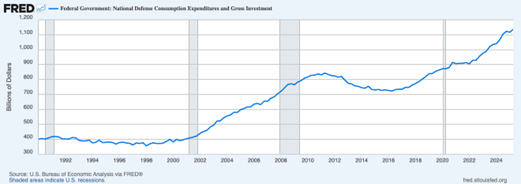
Since the start of the second Trump administration, there has been rising militarization of our streets, massive anti-immigration actions, and a toxic nationalist culture at the top ranks of our government, but increased defense spending is not new. The nominal budget for defense has been steadily growing in the last 10 years and has almost tripled since a relative low point in the 1990s following the end of the Cold War. In 2025, with the passage of President Trump’s One Big Beautiful Bill Act, US defense spending topped $1 trillion for the first time, a new frontier in spending. In real terms, which factor in inflation, US defense spending has been growing since 2022, when inflation peaked and the war in Ukraine drastically changed the international security situation.
Annual US Defense Spending 1990–2025
Defense contracting has been booming due to the recent influx of defense spending. Since December 2020, the defense and aerospace industry’s total market cap (the value of outstanding shares of all publicly traded companies) has grown 136%, more than doubling. Meanwhile, more than a dozen members of Congress on defense-related committees own stock or have some other direct financial incentive in the industry. The Department of Defense paid $381.2 billion to contractors in fiscal year (FY) 2019, a figure that jumped to $445.1 billion in FY 2024. Defense contractors directly employed 370,084 people in 2019, which jumped to around 493,560 individuals in 2024, averaging 6.7% yearly growth. And this is before additional jumps expected to be reported from 2025, as major increases to defense spending from the One Big Beautiful Bill Act come into effect. Trump’s Golden Dome missile defense scheme, an infeasible mess that has been heavy on goals and light on details, has already been allocated $25 billion in this spending boost, most of which will likely go to contractors.
All this growth has fed an increasingly powerful defense lobby. From 2020 to 2024, defense lobbying expenditures have grown 38.3%. In that period, Congress has seemed unwilling or unable to stop dozens of high-profit, low-output programs in the Department of Defense. One recent example of the robust influence of the defense lobby is the quiet killing of a “right to repair” provision in the recent National Defense Authorization Act, which would have given service members the ability to conduct some routine repairs on their equipment that currently must be done by contractors. This bipartisan provision was taken out of the bill after defense contractors allegedly met with congressional leaders and made clear their continued opposition to the reform.
By many other metrics, the US military is also exploding in domestic scope. The United States is currently undergoing a “once in a generation” nuclear modernization program that will cost nearly $2 trillion over its lifetime and, ironically, take multiple generations to complete due to delays. One aspect of this total overhaul of our nuclear enterprise is a new intercontinental ballistic missile, Sentinel, that is already 81% over budget and years behind schedule. This program will also require the digging of hundreds of new nuclear missile silos, a chilling reflection of the US government’s renewed interest in participating in a nuclear arms race. The United States recently reactivated a dormant installation in Puerto Rico as it ramps up its military engagements in South America, expanding the footprint of around 420 domestic military installations.
The military has failed to even accurately account for its ballooning budget. The Pentagon has failed every audit since it was legally required to start submitting them in 2018, and reports say it will continue to fail them at least through 2028. Through all of this, analysts have repeatedly noted that despite increases in funding and scope, the US military’s dominance is fading.
A glimmer of hope
I do not write this to be an alarmist or to suggest that nothing can be done. At least a portion of the political establishment has started to wake up to some of the unchecked power of our military, due in part to the rash actions of the Trump administration. Democrats and Republicans in Congress have called for lowering various aspects of defense spending in the wake of recent increases, citing moral, fiscal, and strategic concerns. Some members of Congress have recognized problems with the status quo related to unfair competition and undue political influence by major contractors, and have introduced legislation to regulate it. At present, these are not mainstream policies for either party, but fights over specific programs included in the defense appropriations process have become fiercer. Even President Trump has stated he would like to work with China and Russia to cut all three nations’ defense spending by half (while requesting a 13.4% increase for our own defense budget, but, hey, baby steps).
It’s up to all Americans interested in a more peaceful world to question why we have a system of increasing investments and decreasing returns, and why this system continues to need such a large scope. A defense budget that stops overspending on bloated programs while preserving priorities that strengthen our national defense and support our service members is within view. It starts with a sound rejection of the idea that the United States must continually and uncritically seek militarism instead of a smart, nuanced defense policy. Especially as the nation faces the risk of domestic tyranny, strong opposition to the ballooning scope of the military-industrial complex is more important than ever. Throughout my fellowship at UCS, I will continue to dig into individual aspects of this complex, putting its wins and failures into focus. In the case of the US military-industrial complex, it’s hard to not find aspects that warrant increased scrutiny.