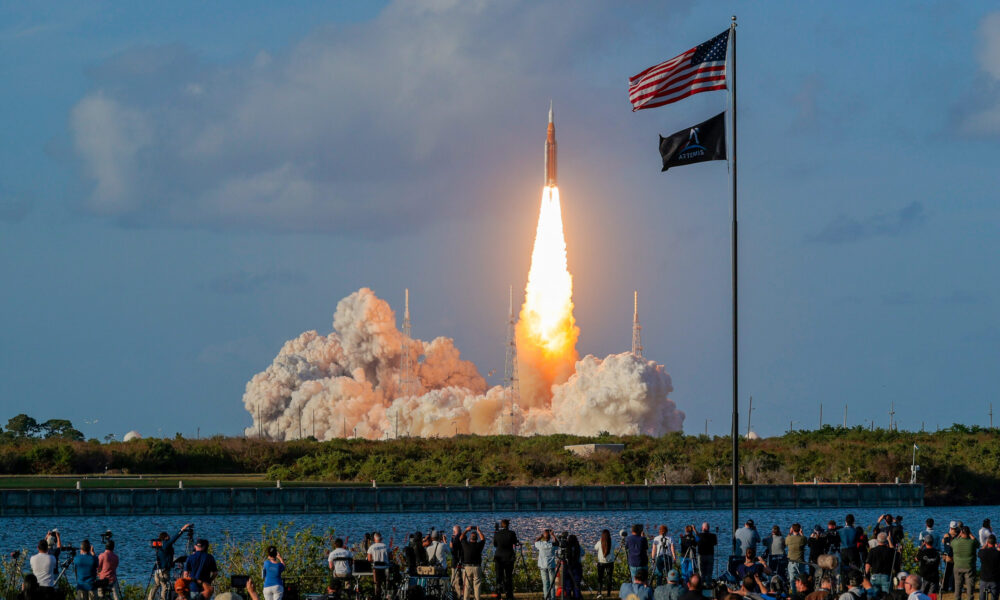

On Wednesday, April 1, like millions of Americans, I turned my TV on to watch a once-in-a-generation moment: Artemis II beginning its mission to send humans around the moon for the first time in more than 50 years. Being born in the 2000s, this was the first time I had ever had the chance to watch humans go to the moon—a moment I had been looking forward to for years.
In a true sign of the times, when the thrusters stopped burning and the mission was a seeming success, I immediately opened my phone to check social media to see how people were reacting. While I saw dozens of my peers expressing the same joy I had, I also saw a steady drumbeat of people questioning the cost of this mission and why their tax dollars had gone to this. As someone who has spent time looking at the federal budget, I couldn’t help but chuckle. NASA’s fiscal year 2026 budget was $24.4 billion—a minuscule portion of the federal government’s nearly $2 trillion budget.
On Friday, April 3, President Trump released his budget request for fiscal year 2027. It revealed just how ludicrous is the idea that NASA funding is a waste of tax dollars: the request includes a whopping $1.5 trillion for defense, up more than $400 billion from last year. Meanwhile, it slashes NASA’s budget by 23%, gutting $5.6 billion from the agency. Watching the Artemis launch, I felt hope for US science for the first time in a while. The president’s budget request brought me back down to Earth.
The costs of a much bigger military
In a previous piece, I discussed how a $1.5 trillion defense budget would not only achieve very little, but end up hurting the United States through its waste. With the president’s budget finally out, the $1.5 trillion in defense spending Trump called for on Truth Social in January came true. What I did not imagine was that the president would pair his exorbitant defense budget with cuts to vital environmental, healthcare, education, and science budgets. The administration plans to cut 10% of non-defense discretionary spending across the board—not enough to make up for the ridiculous increase in defense spending, but enough to devastate a host of important programs.
More clearly than ever, the current administration has demonstrated the trade-offs in our federal budget. The new budget would fund fantasies like “Golden Dome,” Trump’s infeasible anti-missile system, and “Golden Fleet,” his nonsensical shipbuilding program. Meanwhile, it would cut more than half of the Environmental Protection Agency’s funding, almost 20% of the Department of Agriculture’s funding, and 12.5% percent of the health department’s budget, among others. Most telling of all, the president’s budget request would more than halve funding for the National Science Foundation. This administration would rather fund its war against Iran than invest in our society’s basic needs.
The launch of Artemis II proves the United States can still do big things in science and technology, even while the federal government is starving our science agencies of the necessary funding. There are reasons why science is worthy of government funding: it saves lives, drives economic growth, and improves quality of life. The Apollo missions—the best analog to the Artemis missions—drove major advancements in flight control, food safety, and materials science that still benefit us all today.
The Trump administration has repeatedly tried to sell voters the theory that its budget cuts are intended to prevent waste, fraud, and abuse. But the president’s new budget request has put in starker relief than ever that cuts to our domestic institutions, including science, are actually done to spend more on weapons and war fighting—even if the cuts do not make up for the jaw-dropping military spending. Especially given the recent wars of choice undertaken by the Trump administration, the threats from a massively expanded military budget and handouts to defense contractors are clearer than ever.
A moment of hope in challenging times
The launch of Artemis was truly a moment of hope for many people my age. My generation was in elementary school when the Great Recession scrambled our home lives, finishing high school when the COVID pandemic forced schools to go online, and graduating college when DOGE ripped the federal workforce apart. This makes it easy to fall into a sense of dread, in an era where backsliding feels normal.
Artemis II should remind us all that the United States can still do great things in science when we put our mind—and money—to it. The president, sadly, has other plans.