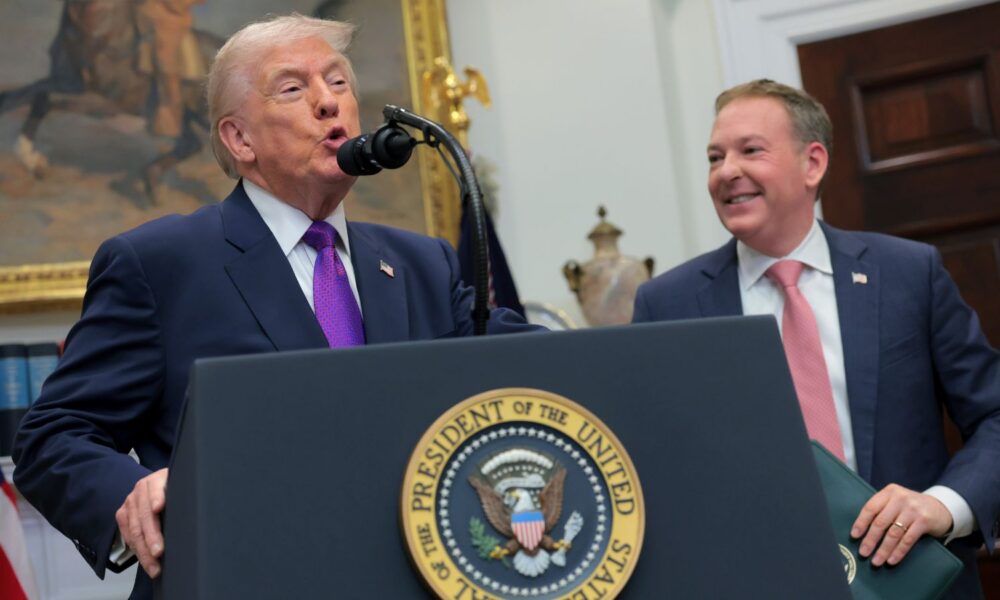

On February 12, the Trump Environmental Protection Agency (EPA) finalized its repeal of the Endangerment Finding, which establishes EPA’s statutory obligation to regulate greenhouse gas emissions. Alongside, EPA also repealed the associated vehicle greenhouse gas emissions standards.
This action is monumental in its significance for three reasons.
First, for its direct attack on the nation’s capacity to tackle climate change.
Second, for the pure totemic power of climate denial now adopted as official US climate policy.
And then finally, this: For all its staggering import, the EPA’s new repeal is wildly weak in its execution.
Imagine being so contemptuous of the people across this country staring down the towering costs of climate change that you don’t just attempt to shred the EPA’s capacity to act, but do so with this shoddy, full farce of a bad-faith rulemaking, incoherent in its logic and actively disdainful of facts.
The upshot is a rule that should be taken seriously for the staggering significance of its impact, yes, but not to confuse that with the effort being serious, because on statute, on science, on consideration of impacts: this repeal is anything but.
What is the Endangerment Finding?
The EPA first issued the Endangerment Finding in 2009, making a science-based determination that greenhouse gases, such as carbon dioxide and methane, endanger public health and welfare and that greenhouse gas emissions from vehicles contribute to that endangerment. As a result of that finding, the agency has a statutory obligation to regulate heat-trapping emissions. The agency started with vehicle greenhouse gas emission standards, followed by power plant carbon dioxide standards and oil and gas methane standards.
The EPA did not arbitrarily undertake the Endangerment Finding process: The agency was specifically prompted by the 2007 Supreme Court decision Massachusetts v. EPA, which found that “greenhouse gases” were unambiguously air pollutants under the Clean Air Act. As a result, if the EPA found that greenhouse gases endangered public health and welfare, then the agency would have a statutory obligation to act.
The law was clear, the Supreme Court was clear, and the subsequent science-based finding was unequivocal. Multiple efforts to challenge the Endangerment Finding and the obligations underpinning ensuing regulations were rebuffed.
So, how now does the Trump administration seek to overcome all that? Contortions of law, and avoidance of fact.
What is the Trump EPA’s statutory-based argument for repeal?
In the EPA’s proposed repeal of the Endangerment Finding issued this past summer, the agency put forward a two-pronged argument: first, that the underlying statute, the Clean Air Act, precluded the agency from regulating greenhouse gas emissions, and second, spuriously, that the scientific determination was unsound, with “uncertainties” in climate science undermining claims of endangerment.
In the EPA’s final repeal, the agency only kept the first part, the statutory argument, and claims to have dispensed with challenging climate science. However, as detailed in the next section, the agency in fact still makes numerous arguments that are ultimately entirely reliant on challenging foundational climate science, it just now does so while cloaking them as “statutory” arguments and, in so doing, attempting to bypass otherwise-required evidentiary requirements.
The EPA makes two main arguments in the final rule for its repeal of the Endangerment Finding and vehicle greenhouse gas emissions standards:
- Statutory authority: Trump’s EPA argues, in various ways, that the Clean Air Act does not in fact provide the agency with the authority to issue vehicle greenhouse gas emissions standards, and as a result precludes the agency from even making an Endangerment Finding. The EPA first argues that under the Clean Air Act, “air pollution” must be understood as having local or regional impacts, not global impacts. With this argument, EPA fully side-steps the fact that the Supreme Court explicitly affirmed that greenhouse gases are “air pollutants” under the Clean Air Act, that subsequent cases upheld EPA’s approach, and that—obviously?—pollution with global impacts alsohas impacts felt heavily locally and regionally.
Separately, the EPA is also now arguing that the agency cannot issue a stand-alone finding of endangerment without also considering the impact and efficacy of ensuing regulations—again, fully side-stepping the fact that the courts have repeatedly upheld the agency’s stand-alone finding. But, this new assertion is required for the EPA to then be able to claim that regulating vehicle emissions is “futile” to addressing global climate change concerns (see next point), arguing that it consequently allows the agency to, coincidentally, entirely evade the question of whether greenhouse gases endanger public health and welfare. - Futility of regulation: Beyond the complete unfoundedness of the “no material impact” argument itself, the EPA also attempts to argue that this claim, which is clearly a question of science, is instead strictly a statutory analysis—a desperate attempt to evade the evidentiary responsibility that would be otherwise required. This clearly doesn’t pass the laugh test, with the agency simultaneously arguing that: first, its rulemaking “does not turn on scientific findings made with respect to the validity, certainty, or extent of global climate change” and therefore does not need to engage with the scientific record, while secondly, also arguing that its non-analysis analysis of eliminating all vehicle greenhouse gas emissions from here through 2100 would result in de minimis climate impacts (without, of course, actually playing those impacts out). How can EPA possibly make this conclusion without engaging with climate science? Of course: it cannot.
These arguments are just staggering contortions of law and fact. This is backed up by the agency heavily leaning the crux of its arguments on two specific Supreme Court decisions:
- West Virginia v. EPA (2022), which established the so-called “major questions” doctrine, finding that it required a clear congressional statement of authorization in “extraordinary” cases when an agency exercises a previously unheralded power, in a manner that is a transformative expansion of its regulatory authority, and economically and politically significant.
- Loper Bright Enterprises v. Raimondo(2024), which overturned “Chevron deference,” where courts deferred to reasonable agency interpretations in instances of statutory ambiguity. Loper Bright instead argued that courts maintain responsibility for determining the best statutory interpretation.
These Supreme Court decisions were worrying at the time of their release specifically for the future threat of how they could be arbitrarily weaponized by the court. Of course, they can also cut the other way—and more critically, it’s misguided to argue that they even apply at all. Time will tell how it plays out for this case, but the very fact that EPA so heavily hangs its arguments on them signals how weak an argument EPA otherwise has.
What is the Trump EPA’s science-based argument for repeal?
When the EPA issued its proposed repeal of the Endangerment Finding this summer, it did so by partially relying on a direct questioning of the climate science underlying the original determination. The EPA’s arguments repeatedly invoked assertions made in a report by the sham-from-the-start “Climate Working Group,” a hand-picked group of five known climate contrarians commissioned by the Department of Energy.
The Climate Working Group report, and EPA’s related arguments, were thoroughly refuted over the course of an overwhelming activation and response by the scientific community, which detailed all the many ways the report misrepresented research, cherry-picked data, ignored peer-reviewed papers, exaggerated uncertainties, and employed deceptive framing. The National Academies also launched a fast-track effort to respond to EPA’s assertions, reviewing work since the 2009 finding and powerfully concluding that the “evidence for current and future harm to human health and welfare created by human-caused greenhouse gases is beyond scientific dispute.”
But that’s not all.
The Climate Working Group was also subject to a lawsuit—in which UCS participated—for violating the Federal Advisory Committee Act (FACA), which is specifically designed to guard against the very thing that happened here, with policy advice arising from a biased, non-transparent, non-public process. And indeed, the court agreed, finding that the Trump administration had violated federal law.
As a result, it’s unsurprising that in the final rule, the EPA officially distanced itself from the toxic Climate Working Group report and, alongside, any explicit questioning of climate science.
But Trump’s EPA didn’t really let science alone in the final rule. Challenges to climate science are still littered throughout: they’re just now all under the guise of statutory arguments. Theoretically, and not at all coincidentally, this shift would enable the agency to avoid contending with actual science. In fact, though the EPA hinges a significant share of its argument on how climate change works as well as the relative impact of reducing transportation emissions on human health and welfare, the agency entirely—entirely—dismisses the whole of the scientific record in a brief three paragraphs out of a total of 338 pages of public comment responses, stating, “Therefore, comments related to climate science are out of scope of this rulemaking.”
The EPA can’t have it both ways. It’s trying, desperately, but it just can’t reinvent and invert climate science to aid its arguments while also fully declining any true engagement with climate science. The two simply cannot square.
What are the impacts of repealing the Endangerment Finding?
The immediate effect of this repeal is the loss of vehicle greenhouse gas emission standards. The transportation sector represents the largest share of US heat-trapping emissions, in 2024 on their own equivalent to the fifth-largest emitting country globally. Losing vehicle emission standards doesn’t eliminate the full suite of tools available to driving down emissions reductions from the sector, but it is unquestionably the most significant when it comes to vehicle emissions accountability.
There’s more to the repeal of this Endangerment Finding than just the vehicle emissions standards, though.
First, the EPA has relied upon the Endangerment Finding to subsequently issue regulations for other major sources of heat-trapping emissions, including carbon standards for power plants and methane standards for the oil and gas sector. Neither of these are undone by this rulemaking alone, but the Trump EPA has separately begun efforts to attempt their full repeals, and without question rescinding the Endangerment Finding here puts them in an immediately more precarious position.
Second, it’s back to symbolism. The very fact that the nation’s foremost environmental agency, with a mission to protect human health and the environment, is aggressively, recklessly, gleefully turning its back on climate action matters far beyond the bounds of any given regulation.
It matters that the official position of the US government on climate action is inaction. It matters that the official position of the US government on climate science is climate denial. It matters that the official position of the US government on climate accountability is unaccountability.
It matters, all of it. It matters for how people across this country see their government abandoning action as prices spike from climate impacts; it matters for how people around the globe see potential for the world’s progress when the largest historical emitter attempts to well and fully pack it in.
It matters.
It’s sloppy, it’s incoherent, it’s baseless—and it matters.
And that’s why we’re here for the fight.
What comes next?
Not only will this rule be challenged—the legal fight has already begun. And because of both the seriousness of the consequences of this repeal as well as the unseriousness of the pursuit, the Union of Concerned Scientists is proud to be joining in the lawsuit challenging it.
This lawsuit will take time to play out and may well head to the Supreme Court. In the meantime, everything is cast into uncertainty—for regulators, for the regulated, and for people everywhere. Will this repeal stand? If this rule stands, will a deluge of liability lawsuits follow? Will the power sector and oil and gas standards be next? And on, and on. There is an enormous amount of uncertainty arising from this action.
But for all the uncertainty, two things are abundantly clear.
First, this repeal is a real and true blow to climate action, and a dismal reflection of where this nation’s federal government stands on climate. And there’s every reason to believe this won’t be the last of the Trump administration’s attempted attacks on the nation’s capacity to act on climate.
Second, the science has never been more certain on the present and looming costs of climate impacts, as well as the magnitude of action required to bridge the gap from where we are to where we need to be.
Which leaves us with this: The people are staring down the facts, while the government turns its back. An untenable state, an untenable fate. The only workable path ahead? Doubling down on commitment to action.