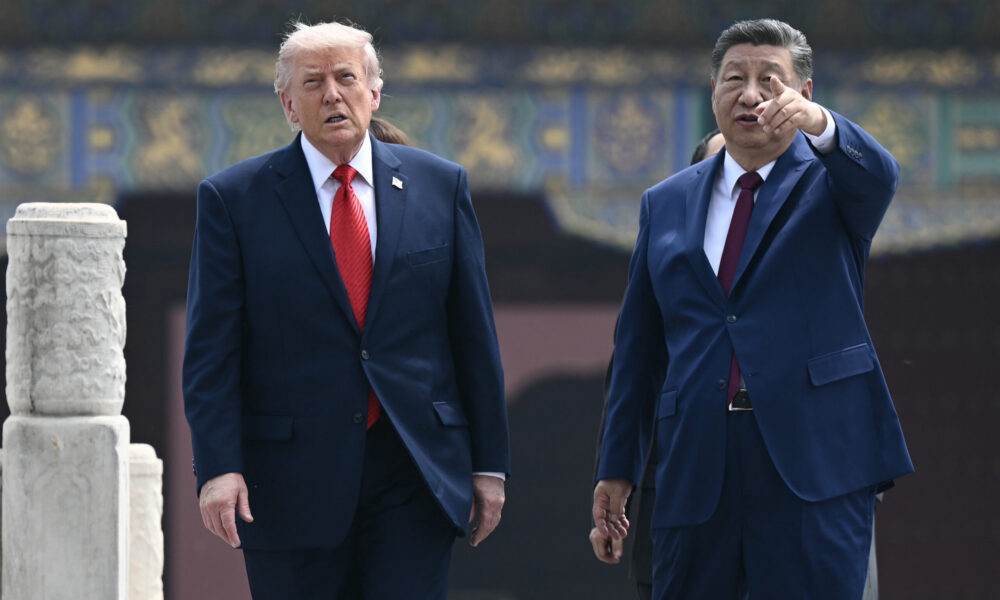

After months of “will they, won’t they,” President Trump finally touched down in Beijing on May 13 for a brief state visit with Chinese President Xi Jinping, made up of photo-ops, handshakes, and privileged strolls in Xi’s garden.
Primarily, this visit was about setting the tone for a year in which the two leaders may meet up to four times, as well as for the rest of the Trump administration. With this in mind, the most important outcome was an agreement on how the bilateral relationship should be framed: government readouts from both sides mentioned that the two leaders agreed on building a US-China relationship shaped by “constructive strategic stability.”
I’ll get to what that means exactly in a second, but the bottom line is that this is a positive first step toward resetting what has become an increasingly fraught relationship over the past decade. It could also lay the foundation for increased cooperation on nuclear weapons.
What is strategic stability?
Traditionally, the term refers to a stasis between two nuclear-armed states where neither side has the incentive to strike the other first, as both sides are assured of their (and their opponent’s) ability to retaliate with devastating effect. The constructive strategic stability that Trump and Xi agreed to in Beijing, however, is a broader and more abstract concept. Per Xi’s comments from the official Chinese readout, it refers to a stable relationship characterized by cooperation, benign competition, peace, and manageable differences. Essentially, a balanced equilibrium that acknowledges differences while making space for cooperation.
Xi stating that managed, healthy competition should be the goal is actually a change to China’s position. Over the past decade, comments from Chinese leadership have repeatedly insisted that competition is a fundamentally unhealthy framing of the relationship. When Xi met Secretary of State Antony Blinken in Beijing in 2023, he said that “great power competition does not accord with the times and cannot solve the United States’ problems.”
While China’s approach to its relations with the United States mostly remains unchanged from 2023, the pivot to “managed competition” is notable. It reflects acceptance that at the end of the day, the two global leaders are naturally going to compete for influence and leadership in a number of sectors, and that it is important to clarify exactly what harmful competition would look like and what both sides’ red lines are. It is a tentative agreement between two parties that there is mutual interest in avoiding tension and direct confrontation, while also maximizing cooperation in areas where interests align.
This is not an especially high bar, but it is a good start. “Stability” is about avoiding bad outcomes, but the “constructive” part suggests working together and not simply accepting the conditions of the relationship as they currently exist.
Will it stick?
China will be watching whether a Trump administration prone to wild swings in rhetoric and policy actually sticks to this framework. Beijing’s issue with the United States has typically been what it sees as a tendency to call for guardrails and stability-creating measures, only to turn around and provoke confrontation or crisis through its China policy. China wants to focus on crisis prevention over crisis management. Meanwhile, the United States criticizes China for abandoning or ignoring crisis management measures to protest US actions in other parts of the relationship; Washington wants guardrails that are “siloed” from other bilateral developments.
The Trump administration, especially Defense Secretary Pete Hegseth, has emphasized the need for more robust military communication between the two countries. The apparent US willingness to talk with and listen to China is positive, but Beijing will still be waiting to see if actions spoil these words. The second Trump administration features fewer establishment figures with a negative view of China. Whoever is currently influencing China policy in the White House, it is not John Bolton or Mike Pompeo from the first Trump administration, who were dead set against any constructive relationship with Beijing.
Thus, while we shouldn’t overreact to constructive strategic stability just yet, the simple fact that both sides agreed to it is notable and promising. Speaking on the Shēng Dōng Jī Xī podcast, Da Wei, director of the Center for International Security and Strategy at Tsinghua University, made the point that the United States agreeing to a concept for the bilateral relationship posed by China is a first. Its inclusion in the White House’s readout as something Xi and Trump agreed to, he argued, is a positive indication that the United States is willing to take Chinese concerns seriously and work on a mutually acceptable framework.
Similar to the question of crisis management versus crisis prevention, the United States has preferred to jump straight to resolving specific issues without addressing bilateral ties more broadly, which is the opposite of China’s approach. To Da Wei, agreeing on constructive strategic stability may be the first step toward resolving this bottleneck.
The nuclear side
Constructive strategic stability may also lay the groundwork for strategic stability in the more traditional context of nuclear weapons.
Chinese arms control experts have already laid out how the most likely type of arms control between China and the United States is risk reduction, as opposed to treaties like New START that restricted the deployed number of US and Russian warheads and launchers. China’s smaller, asymmetric nuclear force has led it to keep its exact warhead numbers and launcher locations secret while engaging on multilateral treaties—but showing limited interest in bilateral agreements.
Chinese experts increasingly worry that the United States is unconcerned with nuclear strategic stability, especially after the announcement of Golden Dome, a missile defense system designed to defend against not only small nuclear threats but also nuclear powers like Russia and China.
While China’s nuclear arsenal has grown in recent years, in large part due to worries about US advances in missile defense and conventional military capabilities, it maintains its policy of “no first use” and continues to insist that it keeps its arsenal at the minimum level necessary for national security. Still, greater confidence in the ability of its arsenal to survive a first strike removes one barrier to China engaging more on nuclear risk-reduction measures. If the United States demonstrates a commitment to building constructive strategic stability across all parts of the relationship, the likelihood of progress on nuclear dialogue will increase.
However, such progress will require some accommodations from the Trump administration. Specifically, China has long wanted the United States to accept a state of mutual vulnerability between the two sides. This means accepting that neither side can fully prevent the other from launching a retaliatory strike, a key underlying factor for strategic stability.
A year ago, it would have been hard to imagine this administration considering that for even half a second. Then again, few would have predicted a meeting in Beijing where Trump agreed that the two sides should pursue constructive strategic stability. To get this relationship on the right path, we need to agree on where we want to go. Constructive strategic stability may be a vague destination, but it’s a start.