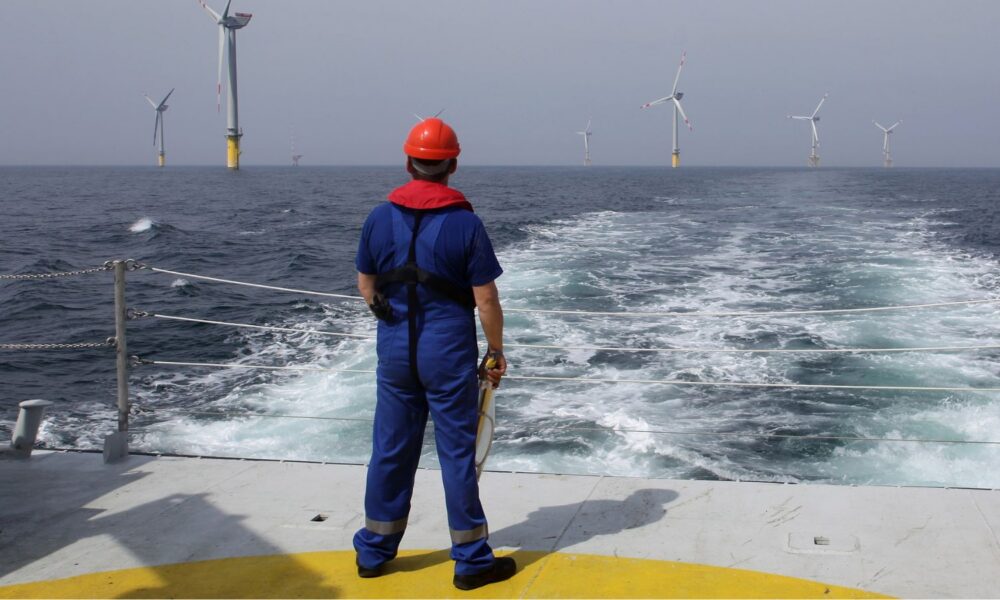

The Trump administration recently announced its latest salvo against offshore wind, the most recent deal in a series of deals over recent months that involves using billion dollars of US taxpayer money to buy wind developers out of their offshore leases across the country. These so-called “settlements,” crafted in the absence of any sort of legal proceedings that could have actually justified settlements, constitute a grand pay-to-delay scheme aimed at taking offshore areas out of consideration for wind turbine placement for the foreseeable future, or forever.
This scheme keeps huge chunks of clean energy offline, with real consequences. Here’s where things stand, by the numbers:
- 5 = number of offshore wind developers involved in the “settlements”
- 12 = number of leases involved
- $3.9 billion = amount of US taxpayer money being used for the buyouts
- 21,000 = megawatts (MW) of potential offshore wind capacity lost without the lease areas
- 6–8 million = approximate number of households the lost offshore wind capacity could have served, at a minimum
Add to those figures the number of jobs that aren’t being created as a result of the buyouts, and the economic development that evaporates: a single 1000 MW project could generate more than 3,000 jobs and some $9 billion in US economic output. Also lost in these transactions is the potential for offshore wind to help homes and businesses manage or even cut their energy costs with stably priced power for the long term, while displacing dirty fossil fuel generation and improving the resilience of regional power grids in the face of extreme weather.
Broken leases, broken laws?
There’s another important figure that should be on the list in considering this woefully misguided push to take offshore wind off the table: the number of laws that the administration has broken in these deals.
That last number is still to be determined, but some of those potential laws are the basis of suits against the administration that have been, or are about to be, filed by states that are counting on offshore wind to meet their energy and climate needs. One such case is New York et al., filed in June by New York Attorney General (AG) Letitia James and the attorneys general of six other Northeast states in response to the first of these buyouts. That “deal” involved two leases held by TotalEnergies, one off New York and the other off North Carolina. In July, based on two subsequent buyouts, eight states in the Northeast and Mid-Atlantic, led by Massachusetts AG Andrea Campbell, filed “Notices of Intent to Sue”. California AG Rob Bonta similarly announced the state’s intent to sue over two of the deals involving leases off its shores.
The illegality of the buyouts is also the subject of various oversight pushes by members of Congress. Those include communications from the Ranking Member of the Senate Environment and Public Works Committee, Sheldon Whitehouse (D-RI), and multiple communications from the Ranking Members of the Natural Resources and Judiciary Committees of the House of Representatives, Jared Huffman (D-CA) and Jamie Raskin (D-MD), respectively. Other members of Congress followed on with additional questions about some of the deals.
Here is a taste of some of these laws—and how they may have been broken.
Administrative Procedure Act – “Arbitrary and capricious” actions don’t fly
Congress passed the Administrative Procedure Act (APA) in the mid-20th century “to improve the administration of justice by prescribing fair administrative procedure.” These buyout deals have failed that test in many ways, according to the AGs and members of Congress.
In their complaint in New York et al., for example, the attorneys general contend that the TotalEnergies New York lease cancellation “is arbitrary and capricious, is not in accordance with law, and occurred without observance of procedure as required by law.”
If that “arbitrary and capricious” phrase seems familiar, it’s because it is one that has shown up often in court decisions that have struck down other illegal Trump administration actions. Those include the cases involving the “stop work” orders that the administration issued in December 2025 against the five offshore wind projects under construction at the time. The judges for each of the five cases allowed the projects to get back to work after ruling that the administration had shown no good cause for the stoppages.
In the New York et al. case, plaintiffs similarly argue that “Defendants failed to (1) provide a reasoned explanation for cancelling the Lease; (2) explain their change in position or account for New York’s reliance interests; (3) address alternative means of achieving their objectives; or (4) provide a genuine justification for their actions.” The filing explains in detail each piece of the administration’s actions that appear arbitrary and capricious, and each piece of the other alleged violations of the APA.
The letter from Reps. Huffman and Raskin, too, points to the APA, noting that the timing of some of the lease buyout processes suggest that the Department of the Interior (DOI) may have illegally relied on a rationale that they didn’t actually have at the time they made their decision: “DOI’s excuse of national security to cancel offshore wind leases may have been fabricated to justify the deal after it was already sealed,” whereas under the APA, “an agency cannot rely on a justification it did not actually have when it made its decision.”
National Environmental Policy Act – Impacts and alternatives have to be considered
The National Environmental Policy Act (NEPA) requires that “all federal agencies … prepare detailed statements assessing the environmental impact of and alternatives to major federal actions significantly affecting the environment.” The statements can be either environmental assessments (EAs) or, for larger projects, environmental impact statements (EISs). These reviews have to provide the opportunity for public comment and consider alternatives.
Aas the New York et al. plaintiffs point out, the DOI did not prepare an EA or EIS, did not include opportunities for the public to comment, nor did they give consideration of alternatives to proposed actions. Given that the deal in question involves getting rid of a large quantity of offshore wind energy, with all of the implications for the environment that would entail, plaintiffs suggest it is clearly “a major federal action requiring Interior Defendants to consider the impacts of and alternatives to their action.”
Outer Continental Shelf Lands Act – Laws don’t stop at the water’s edge
The Outer Continental Shelf Lands Act (OCSLA), which governs how the federal government manages the seabed off our coasts, features prominently in each of these legal and oversight efforts. The plaintiffs in Massachusetts et al., for example, point out that to cancel a lease under OCSLA, the DOI would be required “to hold a hearing and specifically find that continuing the lease would likely cause serious harm to life, property, national security, or the environment, and further determine that the benefits of cancellation outweigh the benefits of allowing the lease to continue.”
That didn’t happen.
As the Mass. et al., New York et al., and California AGs each point out, the law also requires coordination with the governor of any state on any action that “has a direct and significant effect on the outer Continental Shelf or its development.”
That likewise didn’t happen.
California underscored the importance of OCSLA for ensuring that the state “gets a say in the offshore wind leasing program and prevent corrupt backroom deals.”
Judgment Fund Act – The settlement fund isn’t a slush fund
One of the biggest apparent legal deficiencies of the buyout deals is the source of the funds. The Judgment Fund Act provides resources for settlements coming out of lawsuits or likely lawsuits against the United States.
The New York et al. plaintiffs note that the settlement fund is for use for compromise settlements between “adverse parties”—and that in this case, there hadn’t been any lawsuit against the administration by the offshore wind leaseholder. As Sen. Whitehouse notes, there was “no evidence that Total had filed any claim in any forum against DOI or any other agency of the US government,” and no evidence of any imminent litigation.
Sen. Whitehouse and others also point out that the judgment fund is usable only in situations where there aren’t options—which appears not to be the case here, given that OCSLA includes provisions for canceling leases and potentially providing compensation. Reps. Huffman and Raskin state that the Total deal “violates federal law because it does not adhere to the congressionally determined formula for calculating compensation for cancelled leases,” and that “OCSLA is the governing statute in this case.”
Another challenge to the legality of the deals based on the Judgment Fund is the apparent lack of serious Department of Justice (DOJ) involvement, which would be a prerequisite for tapping the Judgment Fund. Per Reps. Huffman and Raskin, the “only public role” in the Total case for DOJ was a quote from then-US Attorney General Pam Bondi in the press release announcing the deal.
Antideficiency Act – Agencies can’t spend money that’s not theirs
The money piece of the buyouts also brings in another important law. The Antideficiency Act “prohibits federal agencies from obligating or expending federal funds in advance or in excess of an appropriation.”—ssentially, agencies can’t spend more than they’ve been given. Sen. Whitehouse points out that “no relevant bureau or office within DOI has sufficient funds to pay Total the nearly $1 billion it has been promised.”
The New York et al. plaintiffs similarly claim that the NY lease buyout is “in excess of statutory authority” because there’s no law that would authorize them to enter into such a “sham settlement agreement to unlawfully cancel an offshore wind lease and redirect the money paid for the lease to a separate, unauthorized use favored by the President”—in these cases, investment in fossil fuel projects.
On the broader issue of the “settlement” in the absence of a judicial proceeding, and the source and use of the funds, the letter from Reps. Huffman and Raskin further spell out all kinds of ways this approach, if legal, could be used—including supplanting oil leases with renewable energy investments, for example. “The only requirements would be a hypothetical thread, a side agreement, and a check drawn from a permanent, uncapped federal account that Congress never authorized for this purpose.”
Under those circumstances, they say, the Judgment Fund could become “the ultimate political slush fund.” The Antideficiency Act “exists to prevent exactly this kind of executive waste, fraud, and abuse.”
And more
If this recitation of legal impediments makes the likely illegality of the Trump administration’s actions seem readily apparent, that notion may not be lost on the administration either. These agreements include explicit clauses that claim courts can’t review these agreements in most cases.
Reps. Huffman and Raskin say in their letter to Total’s CEO that including that language is “not only legally ineffective but almost certainly unconstitutional,” and that its inclusion “suggests that DOI and you both knew this deal was indefensible” and “is itself evidence of consciousness of wrongdoing.”
What’s next
Despite the apparent illegality of each of the deals, the most recent “settlement” may not be the last of them, given how enamored the administration seems to be with this approach. That makes legal and oversight efforts like these all the more important.
On the judicial front, New York et al. is likely to be followed by lawsuits from the group led by Massachusetts and from California based on the Intent to Sue notices, once each has passed the 60-day waiting period required by OCSLA. Other suits may follow. Congressional investigations in parallel with those efforts can help draw more attention to everything lost if the Trump transactions stick. Recently introduced legislation could also get those offshore wind leases back into circulation.
All of the filings and documents point to one thing: a strong suspicion, based in law, that this scheme is yet another example of the Trump administration using a wrecking ball without regard to process or to legality. Or to the workers, households, businesses, and communities hurt by these reckless decisions. And, again: all with US taxpayer money.
President Trump’s strong authoritarian tendencies have hit the US energy sector, as they have other areas of the economy. For offshore wind, establishing which or how many of these various laws his administration is actually breaking in these buyout deals is key to stopping this brazen attempt to cut the legs out from under a key source of clean renewable energy.
Offshore wind is too powerful a source—of jobs, energy savings and resilience, community development, and clean renewable energy—for it not to be allowed to live up to its potential.
Thanks to UCS Schneider Clean Energy Fellow Riya Bhatia for the research help for this post.