

These are tough times, policy-wise, for clean energy. The Trump administration is trying every trick it can dream up, legal or not, to slow down the transition to clean sources of electricity and away from dirty fossil fuels.
But clean energy’s favorable economics, its environmental and health advantages, the ability to build it quickly, and its awesome momentum keep pushing it to greater heights—despite the forces looking to drag it down.
That progress is worth celebrating. As we mark Global Wind Day and the summer solstice in these unusual times, it seems good to take note of the wind at our backs, the sun overhead, and what they make possible.
What we’re up against
First, more on these times. The Trump administration began its assault on solar and wind right at the start, with Day-One executive orders in January 2025 that halted different types of renewable energy and looked to “unleash” American energy (by which Pres. Trump meant fossil). And it has continued through a range of administrative actions that have clearly discriminated against those two energy sources.
One recent tactic might be called the $1.8 Billion Scheme. No, not that $1.8 billion scheme. This one involves using US taxpayer money to take energy options off the table, by buying back offshore wind leases from companies that secured them in auctions in recent years, to keep those same companies from moving forward with offshore wind (a particular bête noire of the president’s). The total amounts in the three deals the administration has struck is that $1.8 billion figure (which also happens to be almost the exact amount of proposed cuts in healthcare funding just passed by the US House of Representatives).
The push to hamstring the leading sources of new electricity supply has been abetted by the actions of the administration’s allies in Congress, with the 2025 megabill that further undercut support for clean energy.
The administration has also worked to prop up fossil fuels, including dirty, uneconomic coal. One recent manifestation of that is Pres. Trump’s announcement that he was invoking the Defense Production Act and using other funds to provide up to $850 million to keep online more than a dozen coal plants around the country, and build a couple more. The EPA also just told another about-to-be-shuttered coal plant in Wyoming that it can stay open and is free to operate without new equipment to reduce its harmful air pollution. That support for a fuel that is on its way out is a cruelty to communities desperate for a real future, and by undermining more movement on solar and wind, the administration is pushing toward higher energy bills and worse health impacts in communities nationwide.
These examples are just a taste of the headwinds clean energy is facing.
And yet…
The progress wind and solar are making anyway
Despite Pres. Trump’s irrational animosity toward solar and wind, those sources have repeatedly answered the call for new and cleaner power. Installations of solar panels and wind turbines in the United States have been on a tear in recent years, and recent results show continued progress in increasing that generating capacity. Solar, wind, and energy storage have accounted for more than 90% of new electrical capacity in each of the last two years, for example, and accounted for 96% in the first three months of this year. Solar has been the largest source of new generating capacity for at least 28 straight months.
All that new capacity has been reflected in the ever-increasing amounts of clean electricity in the US supply. One good way to see the progress is to focus on wind and solar power’s contributions over the course of each year. You can do that right here:
Wind and solar generation as a percentage of US electricity supply, January 2001 to April 2026, with thanks to UCS Multimedia Producer Nick Davis-Ianacco (Sources: UCS analysis of EIA data, Ember)
The graph, based on UCS analysis of data from the US Energy Information Administration (EIA), shows monthly electricity generation from solar—everything from large-scale systems to ones on tops of homes and businesses—and wind, divided by the total generation for that month. The highest wind and solar percentages are typically in the spring and fall, as times when renewable energy generation is stronger and electricity demand is lower (shoulder seasons = less need for heating and cooling).
And here’s some of what the data show:
- Humble beginnings – The EIA data start in 2001, which was still early days for both wind and solar power. Their combined contribution broke the 1% mark on a monthly basis for the first time in 2007—almost entirely thanks to wind. (Solar by itself first passed that 1% mark in 2015.)
- Acceleration – And then things heated up. Wind+solar’s monthly output passed 5% in 2013, and 10% in 2017. In 2021, their combined forces for the first time reached 15%, and 16%, and 17%, and in 2022, the monthly tally blew past 20%.
- Leaps – And now the two technologies together have leapt past another notable threshold: according to preliminary EIA data for April 2026 via global energy think tank Ember, solar and wind together provided 26% of US electricity. That means that more than one of out of every four kilowatt-hours used by homes, businesses, institutions, farms, and communities across the country came from the wind or the sun.
Also remarkable is the fact that in 2025 the lowest monthly total for solar and wind was almost 16% (1/6 of US electricity). And solar generation for the first quarter of 2026 was more than 20% higher than in the same period last year.
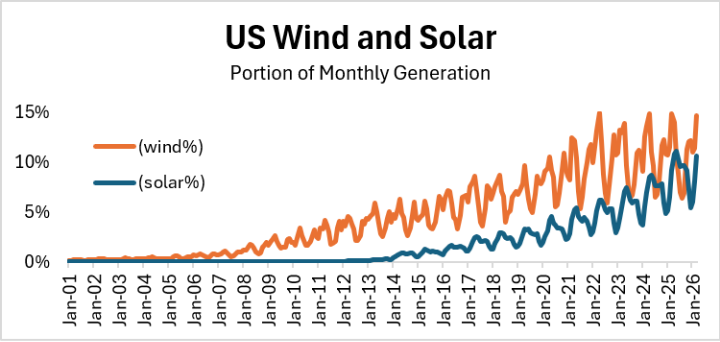
The growth of wind and solar’s contributions, 2001-March 2026. Monthly variations reflect changes in both wind and solar generation and overall generation. Source: UCS analysis, EIA data
Keeping up the momentum
It’s clear that clean energy is by far the best option for electricity generation in so many ways, as not just the cleanest source but also often the lowest-cost option for new electricity supply, a key solution to energy affordability challenges, and the option that can get built the fastest. Sustaining clean energy’s momentum, though, will require pushing back on the forces that are looking to prop up fossil fuels and hold back clean energy.
A key source of energy (no pun intended) for renewable energy growth for years has been state action, and that continues to be the case, as governors and legislators look to clean energy for affordability, pollution reduction, and resilience, and look for ways to compensate for the Trump administration’s anti-clean energy actions. One interesting new approach to increasing access to clean energy is plug-in solar, which various states have endorsed with recent laws, starting with Utah in 2025. Plug-in solar, also known as balcony solar, involves households (including renters and people in multi-family buildings) buying solar panels that they can easily install and connect. The solar can cover a portion of their energy use and whittle away at their electricity bills. It’s a generation option that is as grassroots as can be, and one that appeals to people across the political spectrum.
For states and others, another force in favor of wind and solar has been the justice system, as the administration keeps getting challenged in the courts, and keeps losing. A few recent examples from the courthouse:
- Pres. Trump’s push to stop work on the five offshore wind projects under construction failed in each of the five attempts. And the first of those five projects is now fully built (and doing its thing, saving money for Massachusetts electricity customers and helping keep the lights on).
- In a lawsuit against the administration about many of the ways it has discriminated against wind and solar to block deployment, the plaintiffs (including, indirectly, UCS) have won a preliminary injunction against the administration’s actions.
- A coalition sued the administration over the IRS’s anti-solar and anti-wind changes to the tax code, and a federal judge has just ruled that the administration’s actions were indeed “arbitrary and capricious,” and would have had the effect of limiting clean energy development and raising energy costs for consumers.
- Seven Northeastern states have just sued to stop the $1.8 Billion Scheme, with lead plaintiff NY Attorney General Letitia James calling it “a sham deal” and “an illegal agreement” intended to push companies away from offshore wind and toward fossil fuels.
Continued action is needed in each of those areas, and many more, to make sure that the unwise, spurious, and illegal actions of the administration not be allowed to persist and undercut the US’s clean energy future.
Spiraling outward and upward
Meanwhile, wind and solar, and the people who can use them, aren’t taking the Trump administration’s “no” for an answer. While the most recent projections from the solar industries association and energy analyst firm Wood Mackenzie suggest new US solar installations will be down from last year’s, it could still be the third highest year on record.
And the latest data offer what might be the clearest recent illustration of the transition underway—toward clean energy and away from fossil fuels—despite it all: in May 2026, for the first time ever, the United States got more electricity from solar than it did from coal.
As the spirals of our latest graphic of progress, and so many other recent numbers, make clear, clean energy has a whole lot of momentum. The job now is to keep that momentum growing.