

In April, I blogged about the possibility of a super El Niño developing towards the end of this year. Well, not only has the El Niño already developed, but according to recent numbers from nearly all seasonal forecast models, there is now a roughly 90% chance of this El Niño becoming the strongest in recorded history. You read that right: nearly every seasonal forecasting model available to climate scientists and meteorologists is predicting an unprecedented El Niño event.
Earth is going to shatter global temperature records
A record-breaking super El Niño has a lot of implications for the world’s weather and climate system, and for the human systems that depend on them, like agriculture and food security. In a typical El Niño, the overall global average temperature is warmer than usual due mainly to warm ocean surface temperatures in the eastern Tropical Pacific. When ocean temperatures are warmer, they release a lot more heat into the atmosphere, warming up global air temperatures.
As I mentioned in my last blog, El Niño and fossil fuel-driven climate change together make a terrible team. While El Niño is a natural cycle in Earth’s climate system, fossil fuel-driven climate change is not. When you combine an El Niño event with the overall warming of Earth due to emissions from heat trapping fossil fuels, you get an exceptionally warm planet.
A super El Niño, which is a very strong El Niño event, would almost certainly push global temperatures into record territory. Check out the latest model forecast simulations from the North American Multi-Model Ensemble (NMME; below). The observed global surface temperature anomaly (compared with the 1850-1900 average) is on the left side of the graph. You can see that, so far this year, we’ve been above 1.0°C (1.8°F) warmer every single month compared with the same temperature values in the late 1800s.

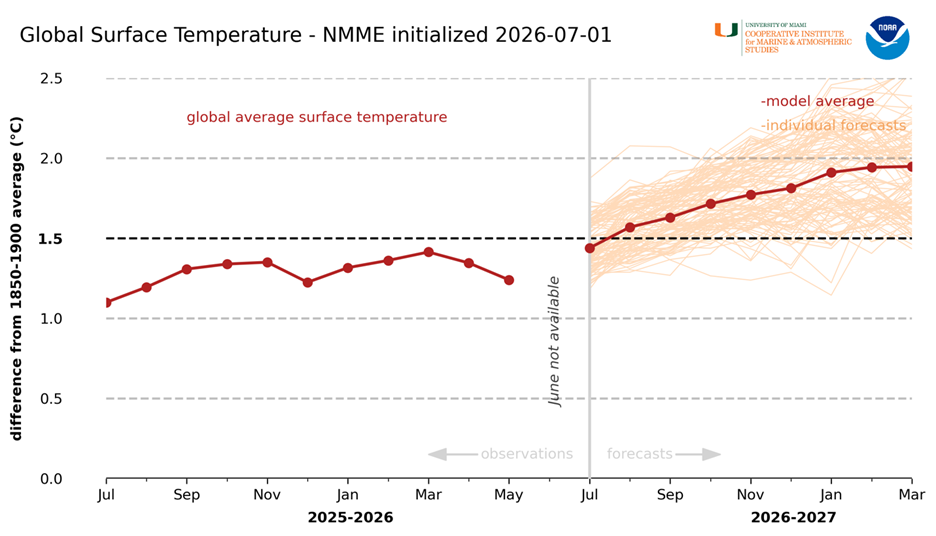
Global surface temperatures from July 2025 to March 2027, showing observed temperatures up to July 2026 and projected temperatures after that. On the right, the thin orange lines show individual model projects, and the red line shows their average. NOAA/University of Miami.
The right panel of the graph shows the forecast through March 2027: with a super El Niño, global average temperatures will skyrocket. Monthly temperature anomalies are expected to approach 2.0°C for January, February, and March 2027, with nearly half of the models forecasting well over 2.0°C values. A couple models are literally off the chart, over 2.5°C! That means there’s a possibility of reaching a monthly global average temperature anomaly of 2.5°C. This would be a shocking escalation of global warming, as we only just crossed the 1.5°C threshold (temporarily, in terms of yearly average) in 2024.
As a reminder, 1.5°C and 2°C are the internationally agreed targets, encoded in the Paris Climate Agreement, as the safer temperature limits that we should strive to remain below. Fossil fuel-driven climate change plus this Super El Niño could, at least temporarily, breach these targets.
Climate change and El Niño
So what’s up with this record-breaking super El Niño? Is it related to fossil fuel-caused climate change? I have two responses for you:
1) In today’s world, every part of our climate system (ocean, atmosphere, land, cryosphere) is fundamentally different due to climate change in some way. This isn’t the same climate system as the 1950s. Therefore, every meteorological or climatological phenomenon that occurs, even if it’s a natural cycle like El Niño, is being affected by our changing system.
2) There is evidence that fossil fuel-driven climate change is directly influencing El Niño. As I mentioned in my last blog, one study found in recent observations that El Niño and La Niña events are becoming more extreme. Another study found that the impact of El Niño events on our weather patterns is getting worse with climate change.
The oceans are blazing hot
One would think we wouldn’t reach record-breaking ocean surface temperatures in the eastern Tropical Pacific until the super El Niño is in full swing, but that’s not the case. Ocean surface temperatures in the main development region for El Niño events are already at record levels for the date (below). And not just barely breaking the record, we are nearly 0.5°C (0.9°F) warmer than the previous record for mid-July, and over 2.0°C (3.6°F) warmer than the 1991-2020 average.
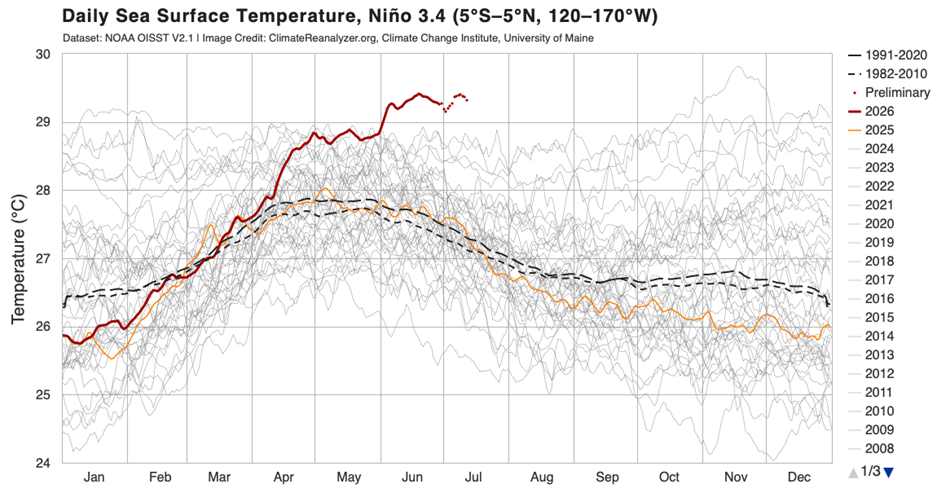
Daily sea surface temperature in the Niño 3.4 region, which is an area in the eastern Tropical Pacific where El Niño typically develops. The red line is 2026 values, the orange line is 2025. The dashed lines are 1991-2020 (thicker dashed) and 1982-2010 (lighter dashed) averages. ClimateReanalyzer.
Globally, ocean surface temperatures are also in record territory for this time of year, driven not just by the El Niño region but by marine heat waves currently affecting nearly 40% of the ocean. According to the marine heatwave tracker from NOAA, abnormally hot ocean temperatures are being observed in every ocean basin around the world (below). There’s a huge bullseye in the Pacific Ocean where the super El Niño is developing, but look at the Indian Ocean, Atlantic Ocean north of the Caribbean, and the Mediterranean. That patch of heat in the Mediterranean actually helped produce the heat dome leading to the record high temperatures Europe experienced last month, leading to over 20,000 excess deaths.
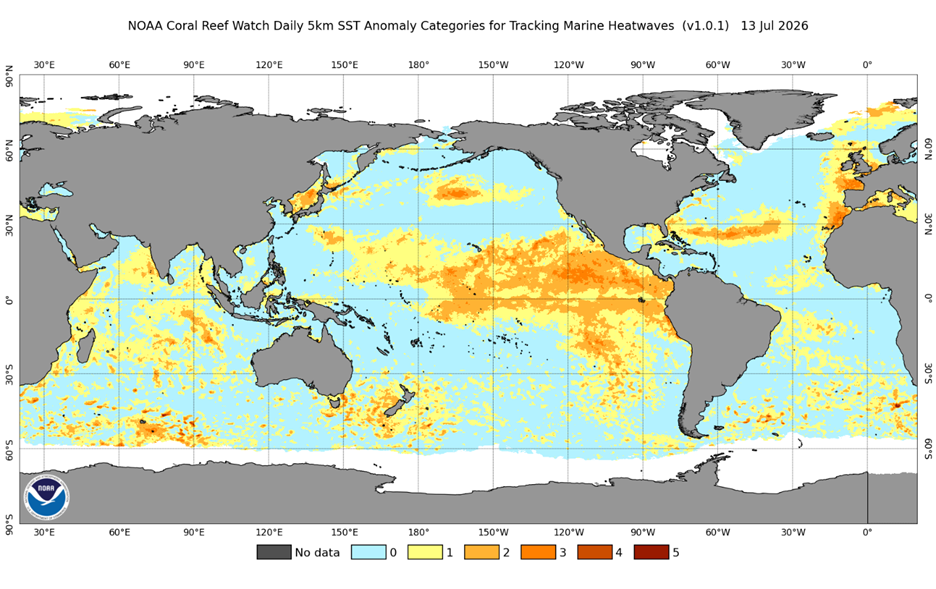
NOAA coral reef watch daily map for tracking marine heatwaves. The areas in yellow, orange, and red denote oceans currently experiencing a marine heatwave. NOAA.
It’s no surprise that the oceans are blazingly hot. They have absorbed over 90% of the heat added to the climate system from the additional heat-trapping gases in the atmosphere from the burning of fossil fuels—a truly mind-boggling amount of excess heat. These marine heatwaves that we’re seeing covering 40% of the world’s oceans are yet another indicator of accelerating fossil fuel-driven climate change.
Climate change, El Niño and the heat dome in western US
What goes on in the ocean doesn’t stay in the ocean. If record ocean surface temperatures are occurring, whether it’s from El Niño or a marine heatwave, we’re going to feel those effects on land. Now, a heat dome has started in the western US which could last through the end of July for the west coast. And we’re seeing some unprecedented temperatures: both Salt Lake City, Utah and Helena, Montana have broken their all-time record high temperatures.
The fingerprints of fossil fuel-driven climate change are all over this heat dome. According to Climate Central’s Climate Shift Index, a broad swath of temperatures in the Mountain West (the day of the Salt Lake City and Helena record highs) were made 5x more likely due to climate change on Sunday, July 12.
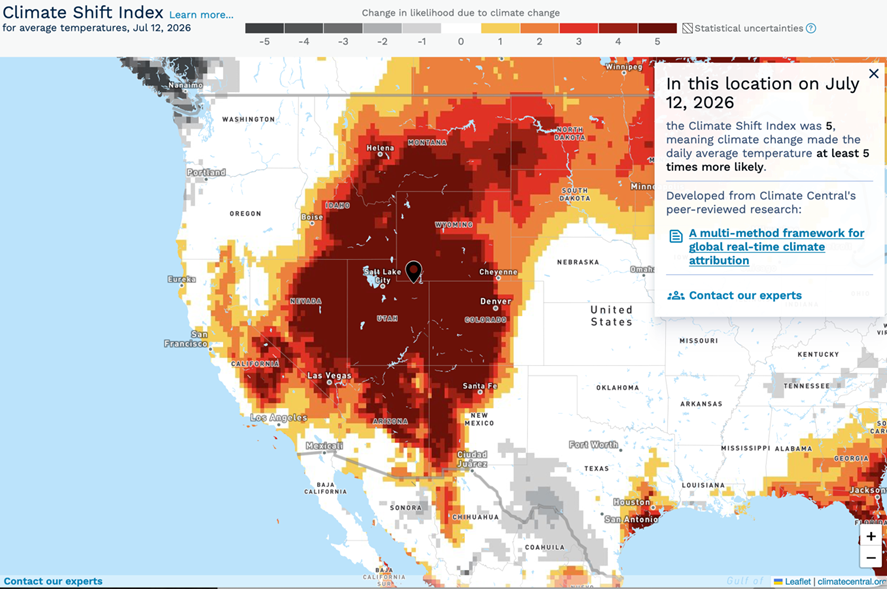
The Climate Shift Index for Sunday, July 12, 2026. Places in dark red show areas that experienced temperatures made 5x more likely due to climate change. Climate Central.
You also might be thinking, “wait, are the developing super El Niño or the marine heatwaves related to this heat dome?” That is an excellent question, and most likely, yes. The weather of the western US is often directly influenced by ocean surface temperatures in the Pacific, as my own research showed in 2024. Another study released in 2024 found that anomalous storms/rainfall south of Hawaii, which develops from warmer ocean surface temperatures, influenced the Pacific Northwest heatwave in 2021. Record warm ocean surface temperatures as a result of climate change and the developing super El Niño are likely influencing the strength and duration of the current heat dome in the western US.
Earth’s climate has changed
We are now living in a dangerous new world thanks to the emissions of heat-trapping gases from the burning of fossil fuels. The climate of yesterday is no longer present. El Niños will look different, marine heatwaves will become more frequent and longer lasting, and heat domes that produce unprecedented heatwaves are here to stay. But there’s still hope. We know what to do to tackle the climate crisis we’ve brought onto ourselves. It’s time to take action.
Here are two things you can tell your Congressional representatives today.
Stay safe and fight on.
Correction: Fossil fuel-driven climate change plus this Super El Niño could, at least temporarily, breach 1.5°C and 2°C temperature targets. An earlier version of the story stated that the targets are already being breached.