

The next Governor has the opportunity to lead California into a new future where agriculture is a thriving component of local economies that provides food and good jobs to nearby communities and improves public health. In this future, beneficial farming and soil practices are incentivized, communities have equitable access to clean, reliable, and sustainable sources of water, and rural communities are leaders in a systemic transformation that prioritizes public health, the environment, resilience, and self-determination.
Agriculture is a vital part of California’s rural economy. But conventional irrigated agricultural practices have contributed to groundwater declines and subsidence in the Central Valley, contaminated drinking water wells, and exposed communities to pesticides, dust, and poor air quality, among other public health concerns. These problems can be addressed by employing better agricultural practices, converting marginal lands to other uses, prioritizing nature-based solutions, and most importantly: ensuring that impacted communities are leading in a just land transition.
The state can do better for Californians and resolve the systemic inequities that have plagued rural communities. We need the next Administration to become a partner and a leader to implement a just land transition.
The next Governor will not be starting from scratch. California passed landmark legislation to sustainably manage groundwater throughout the state and doubled down to support a $10 billion Climate Bond, including over $200 million for multibenefit cropland repurposing. The Fifth California Climate Change Assessment, released in October, provides new tools for California communities to better understand and prepare for climate change impacts. California needs a Governor committed to building on this progress.
Cropland repurposing is a multibenefit solution
California’s challenges on water and agricultural policy represent major barriers for public health and equity, and while work has begun in earnest to tackle these issues, more needs to be done.
California’s groundwater basins are overdrafted due to a combination of overpumping and climate change impacts. Up to one million acres of irrigated agriculture may need to be repurposed in the San Joaquin Valley to achieve groundwater sustainability. Surface water is also stressed: recent research by scientists at UCS and UC Merced found that climate change has reduced April snowpack by 36% and warm season streamflow by 13%. At the same time, irrigation demand has increased by 4.3% in the western United States. In California’s Central Valley, our research found that human-caused climate change accounts for 20% of observed groundwater loss. Conversely, extreme wet periods cause destructive flooding to Central Valley communities, especially those without adequate flood protections.
A just land transition is a multibenefit solution to these challenges that will help rural California communities tackle longtime pollution and water equity issues, while also better preparing them to face climate events in the future.
But what does it mean to pursue just cropland transition? Rather than allowing the status quo to persist, and irrigated cropland to go out of production based on market forces alone, a just land transition takes strategic action to ensure that frontline communities are centered and included in cropland repurposing decisions, ultimately reshaping the agricultural system from an extractive to a just economy.
UCS developed principles and outlined several next steps for how various decisionmakers can pursue a just land transition. Ensuring frontline communities are leaders and decisionmakers in the cropland repurposing that occurs inside and around their communities is paramount to implementing these principles.
Where and how this transition happens is critical to maximizing community benefits and minimizing economic losses from unmitigated cropland retirement. Repurposing cropland within a one-mile buffer of rural disadvantaged communities in the Central Valley can significantly reduce water use, pollution from pesticides and nitrate leaching, and greenhouse gas emissions. Investments in multibenefit cropland repurposing can help recover a portion of revenues and jobs lost in the agriculture sector.
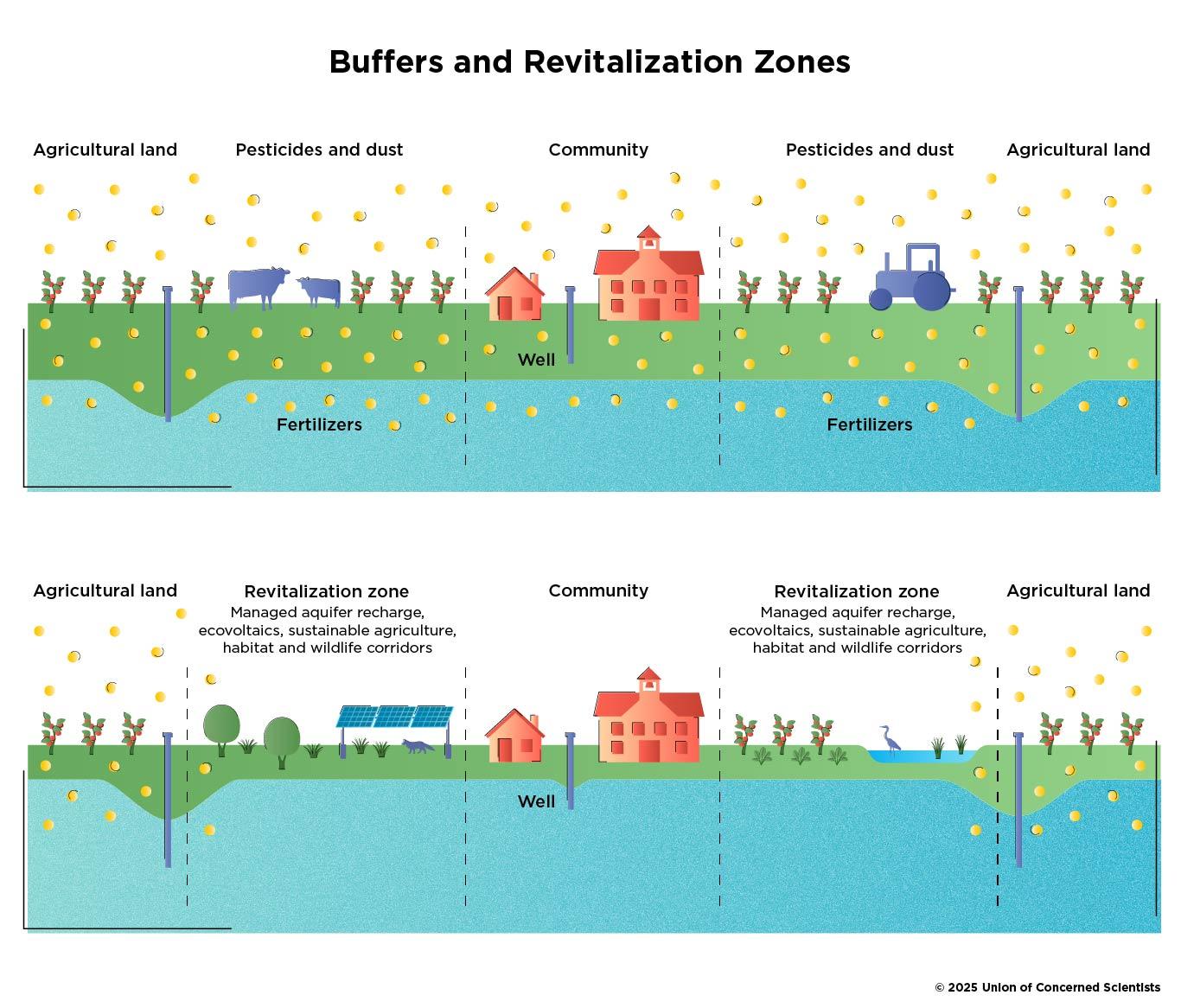
Beyond reducing harm of extractive practices and mitigating adverse economic impacts of cropland retirement, multibenefit cropland repurposing presents an opportunity to build capacity and climate resilience in rural disadvantaged and vulnerable communities. California is facing a future of weather whiplash, with increased dry and wet periods. In addition to the challenge of remedying historical groundwater overdraft, communities will continue to face periods of drought and flood. Repurposing cropland and employing nature-based solutions can produce numerous benefits tailored to the needs of different communities. Managed aquifer recharge and floodplain restoration, for example, can produce water supply benefits, helping to restore depleted aquifers while reducing flood risk for California communities. Sustainable agricultural practices are also part of the solution by reducing water use, building soil health, and reducing pollution and runoff. Incorporating solar through agrivoltaics and ecovoltaics can also build out renewable energy resources, provide local energy security, deliver shade, and save water. Prioritizing multibenefit opportunities for cropland repurposing can result in reduced groundwater demands and more widespread adoption of nature-based solutions that reduce flood risk and replenish aquifers. Together, these strategic multibenefit cropland repurposing efforts lead to a just land transition that can help address historic inequities while increasing resilience ahead of future climate disasters.
Three opportunities to advance just cropland transition in the next administration
Focus public resources on improving systems inside and around communities.
We know that investing in cropland repurposing in buffer zones can produce benefits for nearby communities and reduce economic losses from retired cropland. While California took numerous steps to increase planning and investment around sustainable groundwater management, including demand management and cropland repurposing, additional steps must be taken to ensure those benefits reach communities most impacted by land use transitions.
During the Newsom Administration, over 90 groundwater subbasins adopted Groundwater Sustainability Plans that will guide local implementation of measures to achieve sustainable management of California’s aquifers. The Legislature also established and funded the Multibenefit Land Repurposing Program (MLRP) to fund cropland transition in high and medium priority groundwater subbasins, with over $200M in additional funding provided through the Climate Bond.
Both MLRP and Proposition 4 included strong standards that prioritize funding for projects that directly benefit disadvantaged and vulnerable communities. However, more could be done to expand applicability of best practices and target investment to ensure that all rural disadvantaged and vulnerable communities are resourced to strategically implement cropland repurposing solutions in and around these communities.
Ensure decision-making processes are inclusive and equitable: communities must be included in planning and decision-making
A cornerstone of a just land transition is that communities must be included in decision-making processes.
Efforts have been made to create greater guidance and accountability about how to conduct community engagement and what it means to prioritize community needs. In 2025, the MLRP guidelines were amended to include language defining “meaningful community benefits.” Proposition 4 further requires that 40% of bond investments provide direct and meaningful benefits for disadvantaged and vulnerable communities. Public funding that prioritizes meaningful community engagement and outcomes is progress. However, we will look to the next Administration to ensure that a consistent definition of community benefits is applied across bond-funded programs, track expenditures, and provide oversight to program implementation. Looking beyond the Climate Bond, we would also encourage the Administration to carry this forward by including community decision-making processes and community benefits as requirements of future funding allocations.
Coordinate across agencies involved in a just land transition
A just land transition is a systemic transformation governed by a suite of agencies at the state, regional, and local level. For example:
- Both the Department of Water Resources and the State Water Resources Control Board hold oversight authority to ensure that the Sustainable Groundwater Management Act (SGMA) is appropriately administered.
- Local Groundwater Sustainability Agencies are responsible for developing and implementing plans to achieve the groundwater sustainability goals set out by SGMA.
- The Department of Conservation administers the Multibenefit Land Repurposing Program to fund local block grants to assist in local cropland repurposing.
- Local government agencies hold land use and permitting authority that shape cropland repurposing opportunities and benefits within their jurisdictions.
Each agency plays a critical role in guiding just land transition actions. Their cooperation is critical to ensure a swift, strategic, and coordinated transition that maximizes equity and opportunity and minimizes harm.
Transformational change is possible
With the leadership of Governor Becerra, California can enact meaningful change to develop a healthy and sustainable agricultural economy centered around healthy communities and the environment. Cropland repurposing can support communities pursuing a healthy environment, climate resilience, and groundwater sustainability. To advance this solution, we encourage the Becerra Administration to (1) focus public investments on public benefit projects near communities, (2) include communities in planning and decision-making, and (3) coordinate agencies at every level throughout California that are involved in achieving a just land transition.
Planning for and executing a just land transition will be challenging. The Union of Concerned Scientists looks forward to working with Governor Becerra and his administration with our science and evidence-based advocacy.