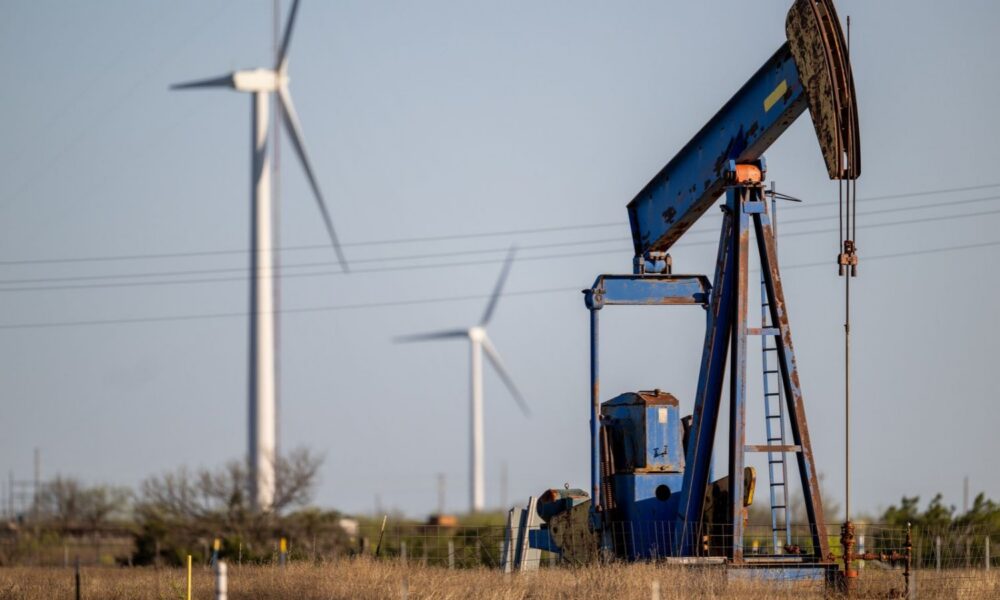

To address the energy affordability crisis and climate crisis, what’s needed most are critical improvements to the power grid that will accelerate deployment of clean energy across the country. Instead, the Senate Bipartisan American Affordability and Jobs Act (BAAJA) sponsored by Senators Capito (WV), Whitehouse (RI), Lee (UT), and Heinrich (NM)—also known as S. 5653 or the Senate permitting deal—is warped in favor of fossil fuels and would harm people, communities, and the environment if enacted.
BAAJA undermines bedrock environmental laws while granting the fossil fuel industry more power, more access to public lands, and less accountability. In return, the package includes tenuous renewable energy and transmission provisions, many of which could be achieved under current law. Without significant improvements, which seem unlikely, enactment of BAAJA could be worse than the status quo.
The status quo is already terrible
Senate negotiators appear to have “compromised” between the Trump administration’s harmful current energy policy and something worse, rather than undoing recent attacks on clean energy and environmental and community protections.
In 2023, as part of a bipartisan deal to raise the debt ceiling, the National Environmental Policy Act (NEPA) was amended to narrow the scope of the statute and insert arbitrary time and page limits on environmental reviews. The Trump Administration then issued an Executive Order revoking the authority of the Council on Environmental Quality (CEQ) to promulgate NEPA regulations. The Supreme Court then further narrowed the scope of the law in Seven County Infrastructure Coalition v. Eagle County (145 S. Ct. 1497 (2025)).
The courts, this Congress, and the Trump administration have taken similar steps to undermine decades of settled law and practice under the Endangered Species Act (ESA) and Clean Water Act (CWA). Rather than demand that BAAJA reverse any of these trends, Senate negotiators appear to have accepted the Trump administration’s position as a new baseline and then agreed to even more dangerous backsliding as the price to help modernize our antiquated grid.
Small “wins” are even smaller than they appear
To be clear, the package includes provisions to speed deployment of transmission lines and renewable energy projects, which should be enacted.
Federal Backstop Authority
The Federal Energy Regulatory Commission (FERC) has long had authority to resolve interstate transmission siting disputes, but the process has never functioned effectively. The new bill would remove bureaucratic and technical challenges that have rendered this federal “backstop” siting authority ineffective and would empower FERC to approve interstate transmission projects that provide benefits to consumers and are in the public interest.
Order 1920
In 2024, FERC issued Order 1920 to mandate robust, forward-looking regional grid planning and cost allocation, but compliance has been slow and multiple court challenges to the Order are pending. The Senate bill would write a similar regional and interregional planning mandate into law, strengthen it to help ensure beneficial projects actually get built, and add further ratepayer protections to the process. If enacted, this provision would achieve the goals of Order 1920, regardless of the outcome of pending litigation.
Advanced Transmission Technologies
Advanced transmission technologies (ATTs) are widely recognized as a quick and cost-effective way to get more from the existing grid, but utilities have long resisted installing ATTs, preferring larger new investments that provide more (and more certain) profits. The Senate bill would require deployment of cost-effective ATTs when building new lines or upgrading existing lines that would provide a pathway for relatively quick cost savings for consumers and improved reliability of the existing system.
eNEPA
The legislation also includes “eNEPA” provisions, directing CEQ to implement a program to put uniform standards, definitions, and metrics online, so that permitting agencies can better coordinate reviews, and to provide public access and transparency. While a funding source for the project is not identified, this program, if implemented, would help streamline and standardize the federal permitting process.
Data Centers
Finally, the legislation would require FERC to revise its transmission pricing policies to require utilities to charge data centers for cost increases they cause and prohibit those costs from being passed on to other customers. The provision would require cost recovery to continue until the full cost is paid, even if the data center ends its contract, to protect other ratepayers from being on the hook for potential “stranded assets.”
Most of the remaining provisions in the transmission title of BAAJA, while positive, are achievable using authority FERC or other agencies already have in law. Even the new federal backstop authority and regional planning mandate could be underused or even abused by the Trump administration.
Overall, the transmission title is a collection of provisions with potential, long-term benefits, dependent on adequate funding and good-faith implementation by this Administration. What is sorely needed, and missing from BAAJA, are transmission investments that would provide a host of benefits in addition to access to clean energy. Better reliability, improved public health, greater resilience to extreme weather, strengthened national security, expanded economic development, and lower energy costs as more people access renewable energy resources are among the many benefits that aggressive, smart grid investments would deliver.
What is unclear is why negotiators failed to think bigger and why the transmission and clean energy improvements that are included in the bill require devastating, pro-fossil fuel provisions as “offsets” to secure bipartisan support in Congress.
Project (un)certainty
BAAJA includes language billed as providing certainty for federal permittees. Supporters highlight this provision as one of the main strengths of the bill and claim the language would prevent President Trump from continuing to cancel approved wind and solar projects. Unfortunately, the provision appears to provide more permanence for fossil fuel projects than renewables.
On its face, the revocation provision (section 1401) is simple—federal agencies can’t revoke, suspend, alter, or “interfere with” permits in effect on or after September 16, 2026. If they do, the agency must prove one of a few narrow exceptions using “clear and convincing evidence,” or pay the developer a percentage of its sunk costs. A separate provision (section 1402) lets developers who prove a “pattern of disparate treatment” against certain types of projects recover 50–100% of their expected construction costs.
An obvious flaw is that these provisions do nothing to restore permits cancelled by the Trump administration before September. My colleague, John Rogers, documents some of the offshore wind projects already sabotaged by the Administration here and points out that these actions are likely already illegal.
And going forward, a permit applicant would have to prove disparate treatment for their category of projects compared to the baseline over the previous five years. Because that five-year baseline is already skewed by this administration, future administrations could keep denying or slow-walking wind and solar with little consequence, while facing damage awards if they revisit fossil fuel projects approved by the Trump administration.
Fracturing the bedrock
If enacted as currently drafted, BAAJA would be the most significant reversal in environmental and community protections in decades.
NEPA
The bill redefines the phrase “major federal action,” – the trigger for NEPA – to add a raft of new categories of projects no longer covered by the law (including pipeline expansions in existing corridors, drilling on lands with mixed federal and non-federal ownership, and projects using federal grant or loan funding but not run by federal agencies).
When added to the hollowing out of the law already achieved by the Trump Administration and SCOTUS, NEPA would be reduced to a discretionary table-top exercise, not subject to timely or meaningful judicial review or public input. The requirements that federal agencies consider alternatives when reviewing permit applications, and solicit and consider public input on those alternatives, would become little more than a formality.
CWA
Section 101(b) of the Clean Water Act reads in part:
It is the policy of the Congress to recognize, preserve, and protect the primary responsibilities and rights of states to prevent, reduce, and eliminate pollution, to plan the development and use (including restoration, preservation, and enhancement) of land and water resources . . .
In practice, this means states can require reasonable conditions on CWA permits and the burden is on applicants to overcome those objections. The Senate permitting proposal destroys this basic concept of cooperative federalism. States could deny certification only by providing “clear and convincing evidence” that no condition could make the project comply with the law, and any condition they do impose must be the “least burdensome” option. Both standards are designed to be difficult, if not impossible, to meet.
For interstate gas pipelines and transmission lines, state water quality certification would be limited to direct point-source discharges, excluding the stream and wetland crossings, sedimentation, and construction runoff that have been the basis for past state denials.
These changes, combined with provisions limiting judicial review under the CWA, could speed development of transmission corridors, but absolutely would speed development of natural gas pipelines by depriving states (and Tribes) of the ability to place reasonable conditions on permits impacting their water quality.
ESA/Historic Preservation/Mining
BAAJA would also make sweeping changes to existing protections for endangered species, historic and cultural resources, and public lands.
The bill would limit agency consultation under the ESA and delegate federal authority to states, many of which do not have the scientific expertise to manage listed species.
Similarly, review of permits pursuant to the National Historic Preservation Act would be limited, leading Tribal Leaders, among others, to express strong opposition to the bill because it “fail[s] to respect our inherent sovereignty, self-determination, and Indigenous Knowledge.”
The Senate package would also change decades of precedent and effectively overturn a recent federal court decision by authorizing mining companies to dump mining waste on land not covered by their mining claims. International mining conglomerates already enjoy broad access to US public lands under the outdated Mining Law of 1872, and the Senate proposal would expand that access to vast swaths of new land for waste dumping.
Process fouls
The Senate bill was largely crafted behind closed doors without meaningful input from broad categories of stakeholders, including environmental groups, scientific experts, Tribal governments, and Environmental Justice communities. Bill sponsors have announced a plan to forgo hearings or mark-ups in any of the committees of jurisdiction and place the bill on the Senate floor immediately after the November elections.
Such a flawed process is perhaps fitting for legislation that would enshrine reckless speed, limited transparency, and lack of accountability into law.
It does not have to be this way
UCS is not alone in raising serious concerns regarding the Senate proposal. A review of the bill by the Natural Resources Defense Council may be found here, and a statement from WE ACT for Environmental Justice is here. A review by Earthjustice is here, and an assessment of the bill’s impact on public lands by The Wilderness Society may be found here.
The Bipartisan American Affordability and Jobs Act might accelerate transmission deployment and benefit some renewable energy projects down the road, but it will lock in fossil fuel projects now and well into the future. Senate negotiators argue they have no choice but to agree to a deal largely on President Trump’s terms, and that the President will follow the new law if it is enacted. Neither claim is convincing.
The fossil fuel industry and its allies are profiting from our current energy system while minimizing competition from cheaper, cleaner competitors. Instead of righting this imbalance, the Senate permitting deal will lock it in place for generations to come.
It does not have to be this way. An efficient permitting process, rooted in science and public participation, can get us to the cleaner, more affordable energy future we desperately need. We know the targets we need to hit, and we have the technology to get us there—we just need the will.