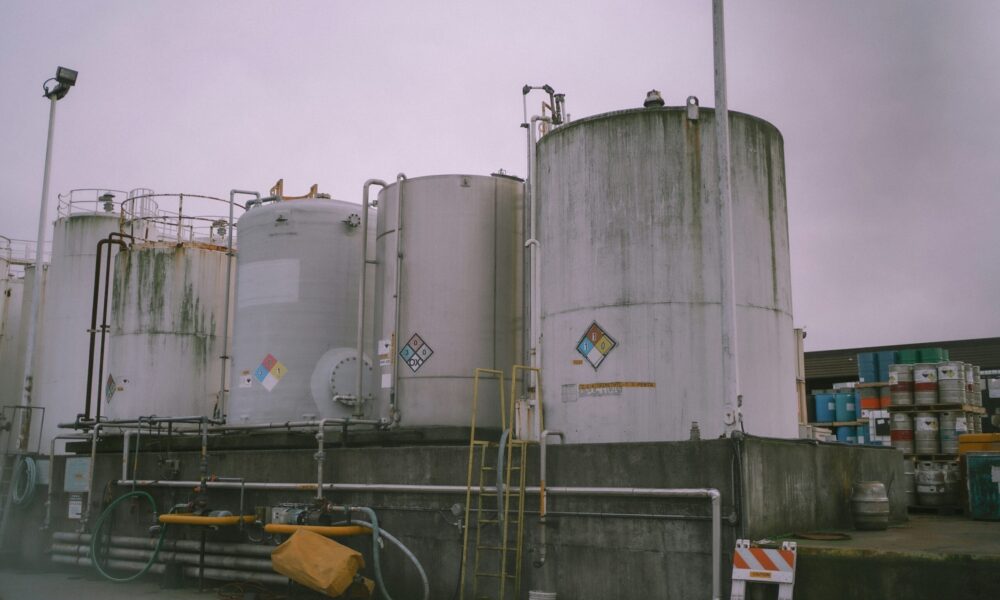

On Tuesday, March 10, I was the first person of many to provide testimony at a public hearing on the US Environmental Protection Agency’s (EPA) proposed rollback of the Risk Management Program (RMP). The RMP requires roughly 12,000 facilities across the US that use extremely hazardous substances to plan, prepare for, and prevent chemical disasters. I have advocated for stronger regulations under the RMP rule for six years now, a process that has felt like a frustrating, never-ending game of ping pong—with real human stakes.
During the Obama administration, efforts were made to strengthen the policy—but it went on to get gutted in 2019 under the Trump administration. Under President Biden, EPA finalized the Safer Communities by Chemical Accident Prevention (SCCAP) rule. While it wasn’t perfect, the rule put in place critical measures to not just respond to but prevent chemical disasters. These included explicit requirements for consideration of climate hazards, stronger worker protections, enhanced emergency response and information availability, and importantly, requiring a subset of facilities to evaluate and implement safer technologies and processes.
But soon after President Trump took office, it became clear that the SCCAP rule was on the chopping block. Within days, industry trade associations sent a letter to EPA Administrator Lee Zeldin calling for the rule to be rolled back, just one month after the agency denied a petition for reconsideration of the rule. Under Administrator Zeldin’s leadership, the EPA appeared to do the industry’s bidding, swiftly eliminating a hard-won public data tool with no notice (it has since been put back online). The following month, I, along with UCS partners, met with Steven Cook, appointed as Principal Deputy Assistant Administrator for the Office of Land and Emergency Management (OLEM)—which administers the rule—to share our concerns. We were asked repeatedly to provide proof for why the 2024 rule should not be rolled back. In reality, his own agency had already made that case, and EPA career staff reviewed numerous public comments (including ours) in developing the 2024 rule.
EPA published its so-called Common Sense Approach to Chemical Accident Prevention rule on February 24, 2026, eliminating and weakening much of the SCCAP rule. Unfortunately, it is no surprise that the proposed rollbacks align closely with the industry’s “wish list.” Unlike the last rulemaking process, marked by listening sessions and multiple public hearings during the 60-day review period, for the rollback, the public only has 45 days to comment, with only one public hearing. This may be due to a severely diminished agency staff or the Trump administration’s broader push to fast track deregulation. It is part of a pattern: federal agency leaders are cutting the public out of decisions that impact our health and wellbeing.
EPA is accepting written comments on the rule through April 10. For tips on writing a public comment of your own, see our guide for How To Participate in Federal Rulemaking.
Here’s my full testimony from yesterday’s public hearing:
Hello, my name is Darya Minovi and I’m a senior analyst at the Union of Concerned Scientists. Thank you for the opportunity to testify today.
I’m here to call on EPA to abandon this proposed rule that will eliminate and delay critical protections that were part of the 2024 SCCAP rule. This rule, if finalized, will weaken chemical disaster prevention requirements, putting workers, first responders, and fenceline communities in harm’s way.
First, I ask that the EPA maintain the requirement for RMP facilities to explicitly assess natural hazards. Floods, hurricanes, wildfires, and other extreme weather continue to catalyze disasters – just look at the aftermath of Hurricanes Harvey, Laura, and Helene. For example, the Arkema facility in Crosby, TX – which experienced a massive explosion during Harvey, identified hurricanes and power loss as major hazards in its 2014 emergency response plans, but failed to assess what the facility would do in either scenario. It’s not enough to assume that facilities will adequately plan and prepare for natural hazards, particularly as nearly one-third of RMP facilities are in areas at risk of natural hazards. For these reasons, we also oppose rescinding requirements related to power loss and backup power for pollution control and monitoring equipment.
Furthermore, we oppose weakening the Safer Technologies and Alternatives Analysis (STAA) requirements. The SCCAP rule STAA already applied to a small subset of highly hazardous facilities, and this proposal narrows it even further. EPA’s proposal does not provide adequate justification for rolling back the STAA, pointing to regulatory burdens while ignoring the benefits to communities and workers. One of the best ways to prevent accidental releases is to require RMP facilities to identify safer chemicals or technologies and implement those changes.
We also oppose weakening information availability requirements, including eliminating a provision that requires RMP information to be shared in locally spoken languages. While we urge the agency to maintain the public data tool, EPA is proposing to limit the usability, making it more difficult for the public to access information about RMP facilities and plans. We also oppose weakening community and emergency responder notification systems, which will hamper timely and coordinated response following a disaster, as well as the proposal to rescind or weaken third-party audits. One disaster is too many, and every effort should be made to independently investigate and address these incidents after they happen.
Finally, we stand with our labor union partners opposing the proposals to eliminate stop work authority, anonymous reporting, workers’ rights training, and consulting with workers. We strongly urge EPA to listen to the labor unions and workers who are most directly impacted by a weak Risk Management Program.
We are deeply disappointed in EPA’s decision to roll back this rule after multiple public hearings and nearly 28,000 public comments that informed the SCCAP rule. The EPA’s continued ping-ponging of the RMP program is putting communities – especially children – at risk of increased exposure to toxic chemicals, which is only exacerbated by the threats of a disaster. We strongly urge EPA to abandon this rollback and allow the 2024 rule to be implemented as finalized. Thank you.