

The permitting process that allows polluting facilities to operate doesn’t just exist for show. It’s designed to make sure that people are protected from potential hazards like air pollution. But too often, the people most impacted by these decisions, with some of these facilities in their backyard, have limited ability to offer their own input on these decisions.
Today, UCS published a new report, Community Access to Clean Air Decisionmaking: Analysis of State Engagement in Title V Permitting. The report investigates the degree to which US state agencies are meaningfully engaging the public in air permitting for so-called “major source” polluters like power plants, refineries, chemical plants, and solid waste incinerators. While some states have made significant strides to enhance public participation in Title V Clean Air Act permitting, this analysis finds substantial, inconsistent gaps in access, transparency, follow-up, and opportunities for meaningful input.
Public participation in air permitting
Giving people the opportunity to weigh in on decisions that affect them isn’t just the right thing to do. Numerous federal laws require that the government engage the public in decisionmaking. That can include accepting public comments on issuing new or updated regulations, as well as hosting town halls or community meetings on specific issues. The federal Clean Air Act (CAA) requires public participation in air permitting, the process by which industrial facilities like power plants must apply for a permit for their air pollution emissions before construction and operation. The permit specifies how much air pollution the facility is “allowed” to release, how those releases should be monitored, and any other measures the facility must take to control pollution. Air permits are one of the main ways in which the public can participate in decisions that impact air quality, especially if a facility is proposed in their own communities. They’re a big part of what makes the Clean Air Act effective.
One such program covers operating permits under Title V of the CAA. These permits cover what are generally described as “major sources” of air pollution. While overseen by the US Environmental Protection Agency (EPA), Title V permits are administered by state and local governments. Under the law, when a facility owner/operator applies for a Title V permit and a state or local agency drafts it, the public must be allowed to comment on that permit and request a public hearing, and the agency must review and respond to “significant comments.” The EPA must also give the public an opportunity to petition the agency regarding a permit decision, including challenging a permit that was approved.
But this is just the bare minimum required by law. State and local agencies can do more to enhance meaningful engagement. Furthermore, research suggests that the process is not often accessible to the public. For example, a focus group analysis of Title V permit notices in Michigan revealed that members of the public perceived the documents as “intentionally biased [toward industry], unnecessarily technical, and without clear directions on how and why to participate.” Furthermore, groups that represent communities overburdened by pollution have frequently submitted Title V petitions that call out state agencies for inadequate opportunities to meaningfully engage in the process and for failure to follow up once a decision is made.
Where states are doing well
For our analysis, we developed a survey tool informed by peer-reviewed literature, guidance and best practices developed by federal and state agencies, and calls to action integrating expertise from environmental justice leaders and organizations. The survey covers three categories of questions: information access; agency rules, guidance, and practices; and agency capacity. We received complete responses from 25 states and partial responses from three states; eight states indicated that they intended to provide responses but did not; six states declined to participate; and eight states did not respond at all (see map below).
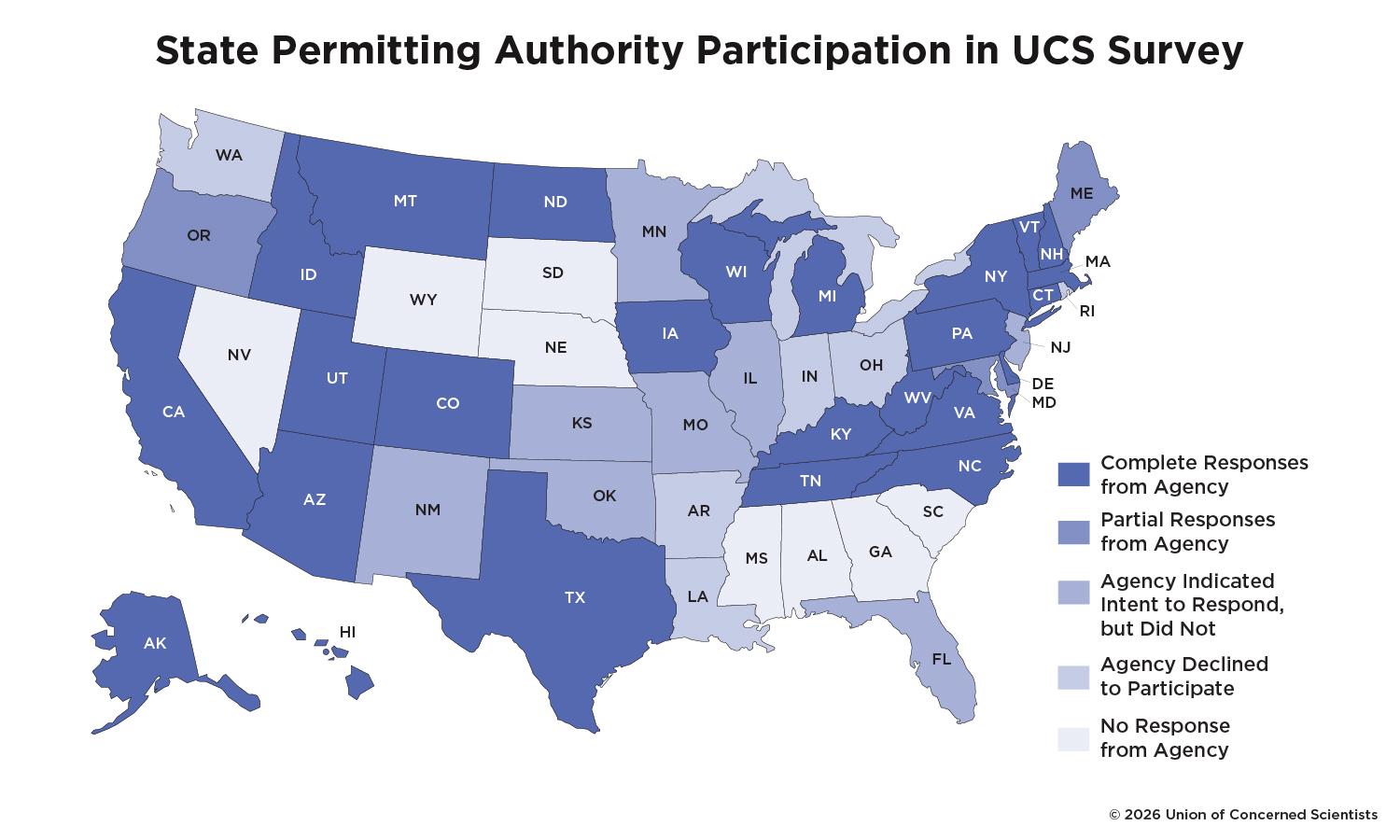
By and large, we found that states are performing best with respect to information access—namely, posting notices for draft Title V permits and providing opportunities for the public to comment (both of which are required by the CAA). Nearly all agencies provide information about approved and draft permits on their websites, including instructions for how to submit a public comment and request a public hearing. Most states also appear to provide accessibility services, like language translation and ASL interpretation, upon request.
Most states also have a webpage or document describing how the public can participate in the permitting process. For example, Arizona’s Department of Environmental Quality has a YouTube video describing the environmental permitting process, Minnesota’s Pollution Control Agency has an infographic describing how to make effective public comments, and North Dakota’s Department of Environmental Quality provides examples of “common comment mistakes.”
These findings suggest that states largely appear to be complying with the legal requirements of the CAA to ensure the public has an opportunity to participate. But beyond that, progress is mixed with major gaps.
Where states are falling short
Despite most states posting public notices online, our findings align with past research that suggests that Title V notices are posted without much effort to make them understandable. In our review of 87 public notices available across 35 states, most notices received a letter grade score of B or C for readability, and only one scored A. Furthermore, most notices did not widely integrate elements of plain language in notices, such as defining technical terms and using bullet points, headers, and white space.
Even though states are providing opportunities for the public to comment, it is not always clear whether and how public input is shaping the process. Of the 28 agencies that sent us complete or partial responses to our survey questions, 18 indicated that they publicly post online responses to public comments on draft permits. Among those, only 13 could provide an example of when public input led to at least one change to a final permit. These findings suggest that public comments may not have a great deal of influence on the final permit, and even if they do, that information may not be shared with the public. South Carolina’s Department of Environmental Services provides an instructive example of how such information can be made explicitly available. The department’s “Air Quality Department Decisions” web page includes its decision, responses to comments, the final permit, a letter to the public, and contact information for further questions.
We also observed significant differences across states in agency policies and practices. For example, at least 16 states have internal guidance for agency staff related to enhancing meaningful engagement, and an additional nine use health, socioeconomic, and/or pollution burden data (such as those found in an environmental justice screening tool) in Title V permit reviews. At least half of these states in each category also have laws in place that enhance public participation in air permitting, some of which are cumulative impacts laws that require additional screening/analysis and engagement in permitting decisions. Overall, we observed that states with these types of laws appear to generally have more policies and practices in place to enhance meaningful engagement.
Some states also have advisory boards and committees that members of the public can serve on, and provide input on agency decisions, including permitting. However, of the 28 states we received completed or partial responses from, only nine have a board or committee that has some degree of authority or influence in Title V permitting decisions. And among these, only six require that members represent the “public interest” rather than a specific field of expertise.
To adequately engage the public in permitting, agencies must also be adequately resourced to do so. Of the 28 agencies we received complete or partial responses from, 20 indicated they provide explicit training to staff on topics related to public participation and/or environmental justice. However, only 16 of the 28 have at least one full-time employee dedicated to enhancing public participation.
Taken together, these findings reveal that while some states are making strides to enhance meaningful engagement in air permitting, progress is mixed across states and significant gaps remain.
Broader federal efforts to sideline public participation in air permitting
Our findings must also be understood within the broader context of our federal government, which oversees Title V air permits. State agencies face funding shortfalls, bureaucratic hurdles, and political pressure from state lawmakers and the federal government. Many states also face threats from the Trump administration for work that advances environmental justice and meaningful engagement. And the Trump administration has demonstrated their hostility to transparency and accountability—even when it’s legally required, taking many steps to limit public input on a variety of decisionmaking processes.
Earlier this year, the EPA issued guidance urging states to expedite Title V permit review, focusing on rapid approval of permits over thoughtful consideration of public comments. The agency also proposed a rule to eliminate the minimum public-notice-and-comment requirements for New Source Review permits, a different type of air permit for certain new or modified facilities. The elimination of requirements would extend to applications for sources like data center electricity-generation facilities, landfills, and asphalt plants.
States can do more
Meaningful engagement requires investment at all levels, from elected officials (including governors) to agency leadership (and the culture they establish). Furthermore, public engagement requires time, funding, and a commitment to building trust with the people who state agencies serve. Permitting authorities, especially at the state level, can and should do more to expand opportunities for the public to engage in air permitting processes, to clearly communicate how the public can influence decisions, and to transparently report how those decisions were shaped by public input.
Read our report to see our full list of recommendations, which include urging state and local agencies to strengthen engagement by making participation information accessible and multilingual, using plain language, publishing responses to comments, proactively evaluating engagement efforts, and providing clear opportunities for continued community involvement. Governors and lawmakers can reinforce these practices through executive orders, agency-wide standards, stronger participation requirements, advisory bodies, community grant programs, and dedicated funding for staffing, training, translation, interpretation, accessibility, and outreach. Ultimately, state, local, and federal leaders need to understand their responsibility is to the people they serve, not polluters.