

Last year when Blake, an early-career computer scientist, counted the costs of publishing their latest peer-reviewed article, they had to add a calculation: the possibility of being detained and deported for their work in online safety. In their field, employers count international talks in hiring and promotion decisions. Yet the US State Department had just issued a policy threatening to bar researchers like them at the border or even detain and deport people like them. So despite planning to go on the job market that year, they stayed home and “shifted the focus of my research.” (Blake’s name has been changed to protect their identity.)
This week, Blake and computer scientists across the US were granted temporary relief when a federal court blocked the Trump administration from enforcing its unconstitutional policy of censorship at the border. The court’s decision in response to a legal case by the Coalition for Independent Technology Research (CITR) also came shortly after two international scholarly associations in computing stood up publicly for scientists like Blake.
In June, the Association for Computing Machinery (ACM), the world’s largest educational and scientific computing society, stated that “scientific progress depends on freedom of inquiry, communication, global mobility, and international collaboration… without undue political or institutional pressure.” The Association of Internet Researchers (AOIR) affirmed similar values the same month and expressed support for the legal case.
The lawsuit and public statements respond to the federal government’s attempts to control science by controlling the flow of researchers. In May 2025, the State Department announced a policy of excluding noncitizens who study misinformation, fact-checking, content moderation, and regulatory compliance in the technology industry. The policies were later expanded to include deportation. Such restrictions are similar in spirit to policies in China and other countries that selectively vet scholars for overseas travel based on the content of their research.
This censorship-by-visa scheme also affects the technology industry by preventing safety teams from international travel. Trust and safety workers at tech firms maintain a 24-hour watch over child sexual abuse, harmful scams, and human trafficking. According to industry leaders Charlotte Willner and David Sullivan, the State Department policy is “undermining the urgent fight against criminals who abuse online services to exploit everyone from children to the elderly.”
Why would the US threaten scientists who study the safety of AI and social media at a time when their expertise is in high demand worldwide? According to the State Department, these policies protect Americans from “encroachments” that “undermine the… right to free speech.”
Writing in Science this January, former White House official Alondra Nelson offered a different explanation: US promises of protection from burdensome rules are a cover for maximizing discretion in who the government punishes, rewards, and controls through ownership. By threatening officials and researchers, those in power can tip the digital scale in favor of firms and political actors who are closest to them in a hierarchy of patronage. In this system of punishment by discretion, people are incentivized to keep their heads down or say what they think the government wants to hear.
Censorship at the border rewires science
In an era where people can easily publish ideas and find an audience online, how much damage can a travel and immigration policy actually do to the integrity of science and industry? This kind of censorship achieves tectonic changes through three mechanisms: intimidation, peer influence, and the most consequential and invisible impact: the sortition carried out by selection committees and hiring managers who become unwitting accomplices.
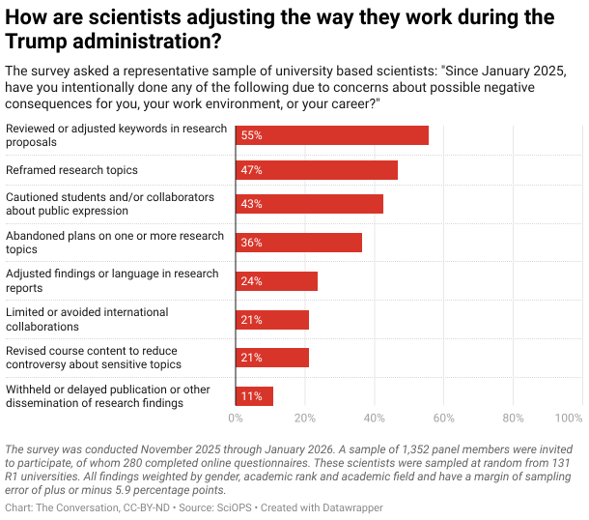
Censorship most directly works through intimidation when people worry that constitutionally-protected ideas might expose them to retaliation from the government. For example, an expert on social media and child safety might reasonably wonder if they or their family will be targeted if they speak at a professional conference. Faced with vague language from authorities and silence from their own institutions, they face tremendous pressure to self-censor—keeping quiet or changing their work entirely. A representative survey of scientists in the US in January found that 47% of researchers have reframed their work and 36% have abandoned plans for at least one project due to concerns about negative consequences.
Academic self-censorship rates are so high because intimidation also sends shock waves throughout a community through peer effects. When people see others hiding and changing their work, they update what psychologists call social norms—expectations about what others consider expected behavior. When each person backs down and there are no counter-examples, dozens of others see it and adjust accordingly. The chilling effect spreads further.
The most pervasive effects of censorship involve sortition: the hijacking fair institutional rules to enlist organizations as unwitting accomplices. Both academia and industry are hierarchies of scarcity that frequently review people’s records when deciding who to hire, promote, and recognize. When one person looks less productive on paper, they are sometimes passed over in favor of someone who has more grants, publications, or other accomplishments. Under systems of intimidation and fear, seemingly impartial processes will tend to reward whoever is least targeted by censorship. When cohorts of leaders are filled with people who were lucky, clueless, or compliers, the fruit of intimidation can last a generation.
I imagine Blake wonders if intimidation or sortition explains why they have been passed up for opportunities since the US censorship policy started, despite being a widely recognized leader in their field. In computing, the effects of censorship are most likely to impede women and underrepresented minorities, who systematically take on the most challenging social issues in our fields and already face reduced status as a result. If we’re not careful, the tech sector will face a cumulative, generational setback from government intimidation, undoing even the paltry gains that computing has made to engage more inclusively with society.
Since censorship exerts control through sortition, individual efforts to keep a low profile also make us into unwitting accomplices by increasing the risk for others. That’s why the best response is to stand together—something that the ACM, AOIR, and CITR have chosen to do in powerful ways.
Making science resilient to intimidation
What can individuals and institutions do in the face of government attempts to shape science and industry through intimidation?
Institutions can protect our people and our fields by standing up to intimidation. Direct, public support can take several forms. When successful, legal challenges from organizations like CITR can protect basic rights while shielding individuals from retaliation. Public statements from professional organizations like the AOIR and ACM can dampen the damage of censorship’s peer effects. Statements also provide a powerful signal to admissions, hiring, and promotion deciders to resist the censorship of sortition by acknowledging the courage of people who take on important, risky topics.
This leadership will come from small and medium-sized organizations that have less to lose. But even large organizations can help by offsetting the costs of censorship on targeted researchers and by supporting the organizations that fight to protect our rights.
Leaders can use our voices, our networks, resources, and power to redirect the inertia that turns us into unwitting accomplices. Often simple acts like speaking up in a hiring or promotion meeting can reorient key decisions away from the gravity of censorship into a better orbit. We can also organize our fields to enable people to contribute equitably even when they face government restrictions. When we design our teams and conferences for remote, secure participation at the core, our fields will also protect the environment and become more inclusive of people with disabilities.
Individuals can build resilience among our peers by educating ourselves and by championing the careers of people affected by government threats. Because censorship works through peer effects and field-level sortition, we are most effective when we work together. That’s why it’s especially important to support organizations like CITR that use collective power to stand up for our rights.
For Blake, the court decision and public statements from ACM and AOIR are a welcome, if temporary, change. With governments around the world rushing to regulate AI and social media, their research has never been more in demand. As Blake goes on the job market, it’s fair to ask: will the tech industry and scientific establishment account for these threats or let government intimidation succeed? The answer is up to us.