
We are now more than a year into President Trump’s second stint in the White House, establishing a grim and undeniable record of attacks on science. Every month that has passed since his inauguration day, there have been multiple actions that target science, scientists, and science-based policies. These aren’t just isolated incidents—seen together, they tell a story of a planned and intentional attack on our federal scientific infrastructure, causing real harm to people and the planet today and endangering all of us in the longer term.
Between January 20th, 2025 and March 6th, 2026, we have tracked and categorized 562 unique attacks on science. Some of the most common types of attacks we’ve documented include:
- Numerous anti-science rules or regulations and the rescinding of rules or regulations based in science—to take one example, the administration’s efforts to demolish the Endangerment Finding.
- The Trump administration withholding or dictating federal funding for research based on political ideology including halting federal research and knowledge development on LGBTQ+ health, climate science, and vaccine efficacy.
- The gutting of scientific capacity in federal agencies, threatening the ability of federal agencies to inform the public of dangerous weather patterns and toxic chemicals in the environment and respond quickly.
These are just a few of the tactics we’ve seen deployed so far, and we are still counting.
We now have 15 months’ worth of data to document patterns and to call out the harms of these attacks. I use the data below to highlight how the huge influx of targeted attacks early on in President Trump’s second administration has enabled subsequent attacks and harmful downstream effects over time.
A word before we get there: this content can understandably be difficult to read, because these are attacks on our democracy, minoritized groups, and systems built to facilitate environmental and public health. But to echo recent sentiments from my colleagues Gretchen Goldman and Rachel Cleetus, it’s critical to document these harms, not only to acknowledge what’s been destroyed and the work it took to build it, but also to galvanize those who want to protect what’s left and build better institutions and policies for the future.
When it all began
Visualizing how the number of attacks on science have increased and changed each month reveals the Trump administration’s strategy. The first few months were an onslaught of anti-science actions that made targeting, attacking, and dismantling inconvenient federal systems and safeguards easier. In practice, this has expanded the Trump administration’s power, advanced the interests of its powerful allies at the expense of everyone else, and constrained our ability to express dissent and seek accountability.
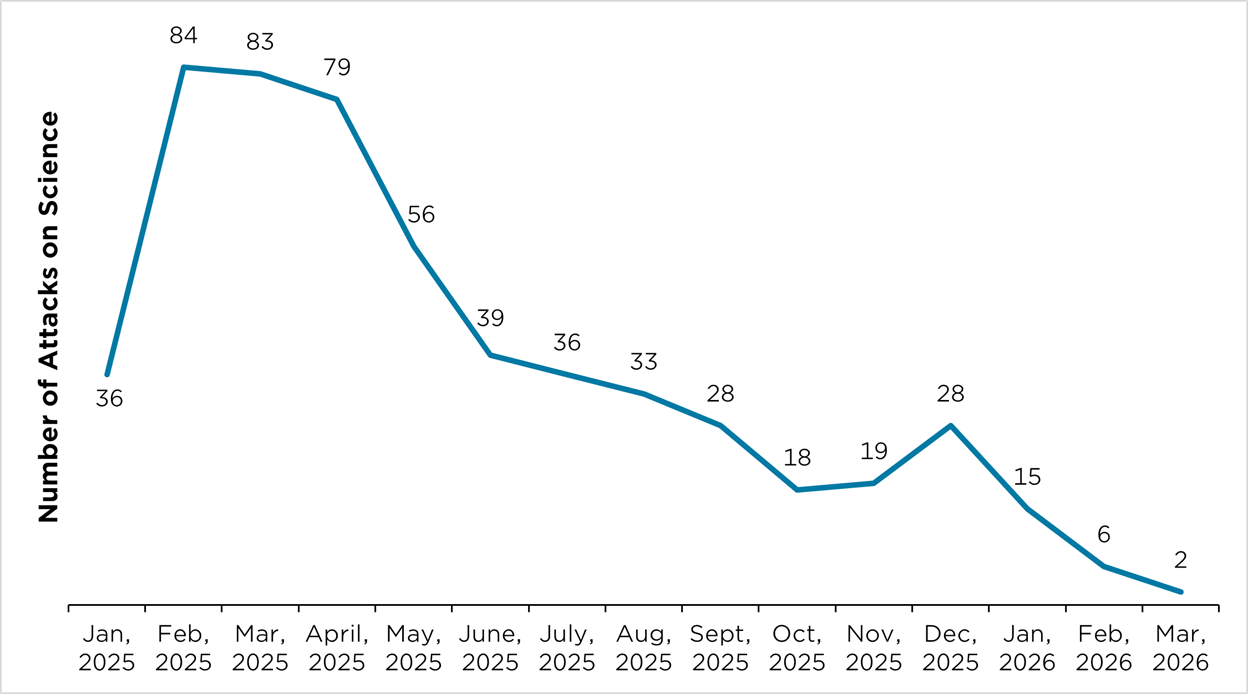
What I want you to take away from this graphic, showing the huge initial push of attacks on science at the outset of the second Trump administration, is not that the danger is fading, but that these attacks were designed to set up the Trump administration to act with impunity. These attacks laid the groundwork so that the administration could more easily make decisions based on ideology rather than evidence; remove staff, scientific findings, and regulations that could have been roadblocks to its agenda; and escalate its authoritarian tactics later on. By knocking out the scientific foundations from government, the Trump administration made it easier to carry out short-sighted and unjust actions like those outlined in Project 2025. And these first few months were a period of intense upheaval for federal scientific systems, the people that worked within them, and those they protected.
An eleven-day catalyst
Throughout January of 2025, President Trump and his staff were busy with this dismantling effort. The President signed multiple anti-science executive orders (EOs), including the EO that directed the erasure of gender identity from all spaces in the government’s influence, and limited recognized sex at birth to male and female. With it, he directed the erasure of the acknowledgement of intersex, transgender, and nonbinary people. He also rescinded previous orders that were backed by science, including the EOs that sought to provide fair access to historically underrepresented groups in government decision-making. To staff his administration, President Trump nominated people with a history of anti-science positions or decisions to lead multiple federal agencies (like Lee Zeldin, Sean Duffy, and Doug Burgum). With Project 2025 and the wish lists of industry allies as a guide, the Trump administration started from day one and did an enormous amount of damage by the end of January.
More than anything, these early days provided some of the initial foundation for the Trump administration to go on a year-long spree of tearing down the many protective systems that have underpinned our government and democracy.
The pattern continued in the following months, building on this foundation. The administration imposed freezes on grant reviews at the National Science Foundation due to President Trump’s executive orders aimed at diversity, equity, and inclusion (DEI) principles. These freezes were only the start of a series of chaotic events that unfolded across federal agencies. Research funding fluctuated between being paused, unfrozen, terminated, and forced back open in the courts.
As a result, new research couldn’t begin; ongoing research stopped in its tracks; data and resources were wasted and lost; universities cut enrollment and personnel. This translates to less innovation that could inform the best next cancer treatment, a better way to track hurricanes and severe weather events, or how best to protect people from exposure to toxicants like mercury. These deliberately destructive actions all fit within the ideological and political agendas that drive the administration, staffed by people deeply opposed to vaccines, environmental justice, and LGBTQ+ health, to name a few examples.
Fired scientists, fewer services
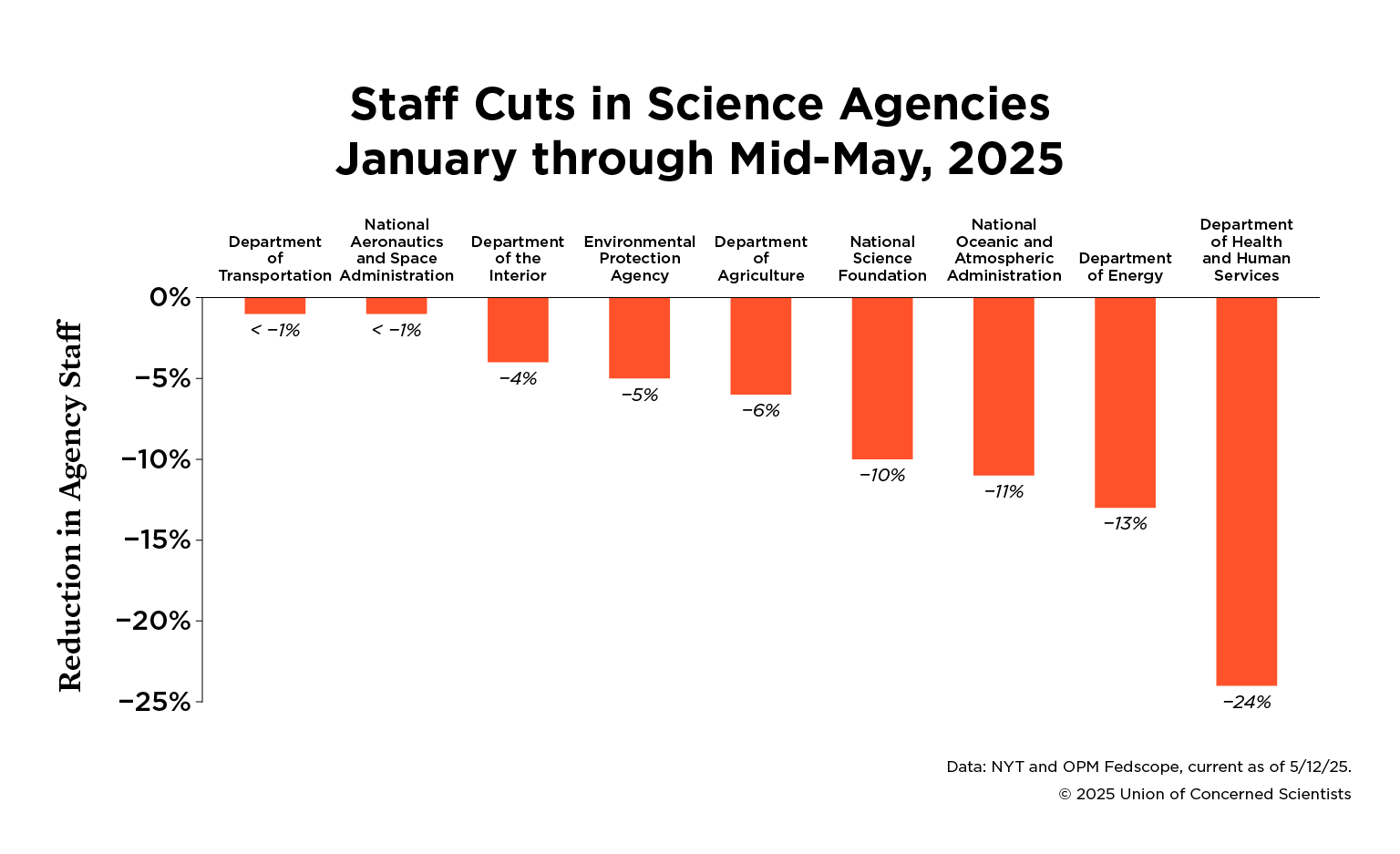
In February 2025, the administration began to threaten massive layoffs of federal staff. The deceptively-named Department of Government Efficiency started pressuring federal employees in February, and appointees announced plans to “restructure” their agencies in ways that undermined the agencies’ missions. Federal scientists and workers across the board lived in tangible fear that their programs, their departments, their projects, their life’s work and their livelihoods could be shut down or completely derailed.
But losing an immense amount of scientific capacity, expertise, and institutional knowledge in this first year didn’t just happen in isolation. The job instability and losses, both immediately and as more time passed, impacted the ability and the timeliness with which the federal government could track infectious disease spread, investigate and prevent lead poisoning, understand grade school enrollment and financial aid need in universities, or compile and use food quality/safety data or data on injuries or accidents. These aren’t just individuals losing their jobs—this is all of us in the US losing services established by law and paid for with our taxes.
Integrity at risk
The attacks continued in March, with agency scientific advisory boards high among the targets. But the end of March was also when the National Institutes of Health (NIH) rescinded its scientific integrity (SI) policy, a policy renowned for its transparency and public participation. Agency SI policies were created (and recently improved upon) with the intention of protecting federal scientists and their work from political interference. This rescission was the first SI domino that fell, effectively weakening safeguards against undue influence, censorship, and retaliation.
After the rescission of NIH’s policy, President Trump signed an EO directing agencies to revert all SI policies to what they were at the end of his first term, which weakened these safeguards and, in some cases, outright removed them. It also directed agencies replace them with new policies to enforce deceptively titled “gold standard science” (GSS) principles, instructing agencies to explicitly put scientists under the control of political appointees and constrain them to the President’s political agenda. As a result, more agency policies were reverted back or rescinded in the weeks that followed.
At his request, The Office of Science and Technology Policy (OSTP) released recommendations to agencies for how they can prioritize “GSS” tenets in their new SI policies that they’re supposed to eventually release. In the meantime, agencies were told to publish interim documents explaining what they already do in alignment with these principles and how they plan to implement them moving forward.
Some of the ideas and principles alluded to in these GSS tenets are well-established norms and practices in the scientific community. The administration pays lip service to ideas like minimizing conflicts of interest, encouraging transparency, and communicating methodological limitations. But its actual approach to science flies in the face of all the practices it claims to support.
Nowhere in this guidance does the administration acknowledge importance of keeping science independent from influence or maintaining safeguards and protections to facilitate scientific freedom. There’s no effort made to prevent scientists from being retaliated against for denouncing unethical practices or sharing information that counters the administration’s preferred narratives. Everything is seemingly secondary to the President’s priorities.
Since OSTP’s August 22nd deadline, federal agencies have started rolling out their GSS implementation plans, with a few publishing new SI policies. We’ll continue to monitor this situation as it unfolds.
It doesn’t stop there
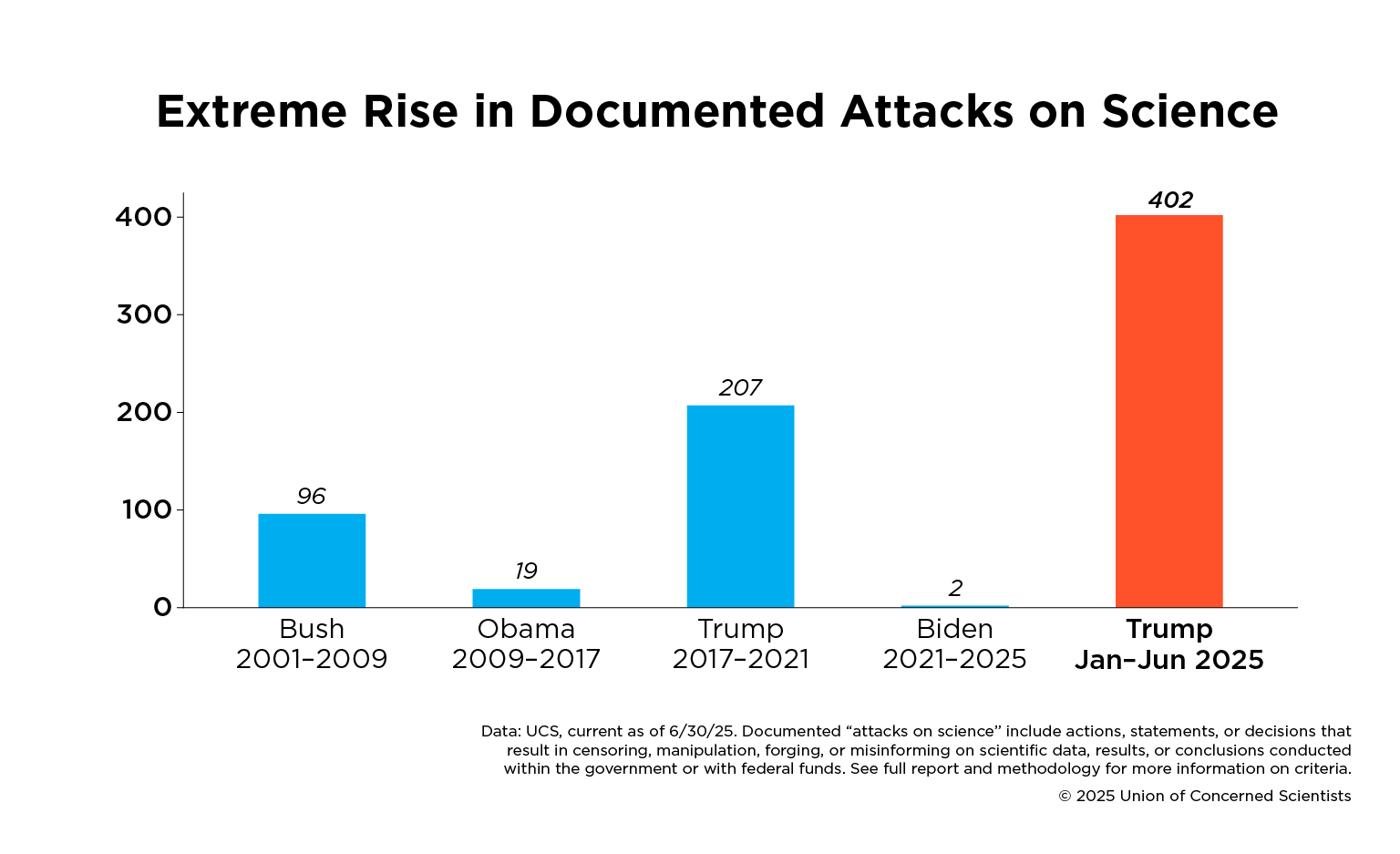
Here at the Union of Concerned Scientists, we were expecting this presidency to be marked by a high number of attacks on science. For one thing, we have the whole first term as an example—the first Trump administration launched an unprecedented number of attacks against science. And, despite the occasional denial by candidate Trump on the campaign trail, the administration already showed us their playbook in Project 2025. But even judged against those bleak standards, the Trump administration has escalated its campaign against science. This is a systematic, strategic attack on our federal scientific systems, on the notion of shared truth and a commitment to the public good, and on participatory democracy itself. We expect these attacks to continue.
By stopping at March, I don’t want to give the impression that the attacks that occurred since then are any less impactful, devastating, or important to review. But it shows us the pattern and offers a preview of what’s to come.
My colleagues and I have been hard at work to make the way we collect and tabulate attacks on science more efficient and standardized. And very soon, we’ll be able to share with you how we’ve made tracking and documenting different patterns of harm even easier and more accessible.
In the meantime, UCS will continue to be here to call out the harms and to advocate for evidence-based policy, especially with your support:
- You can join the fight by contacting your Senators and Representatives and urging them to co-sponsor the Scientific Integrity Act. This law would codify scientific integrity protections across federal agencies, making it much more difficult to politically interfere in scientific decisions.
- You can stay up to date on other scientific integrity related actions by using this link.
- You can follow the hard work of my UCS colleagues in calling out the Trump administration’s unjust and authoritarian actions. They often offer other ways that you can help and get involved.
- By signing up for email updates, you can stay updated on what we’re seeing.
The road ahead of us is challenging, but we need to stay aware and engaged. Together, we can contain the harm and make the case for science that works for all of us.