
On Sunday, the House Transportation & Infrastructure Committee unveiled its opening act for the future of transportation policy—the BUILD America 250 Act. This 1,005-page tome is the public’s first look into the state of negotiations around surface transportation reauthorization, which is the core of federal transportation policy—deciding if we will continue to invest in a car-dominated status quo or support more affordable and sustainable transportation options.
Unfortunately, committee leaders Rep. Graves and Rep. Larsen’s proposal does not steer our transportation system away from being the highest-emitting sector of heat-trapping emissions or the second-highest household expense. Here are the toplines:
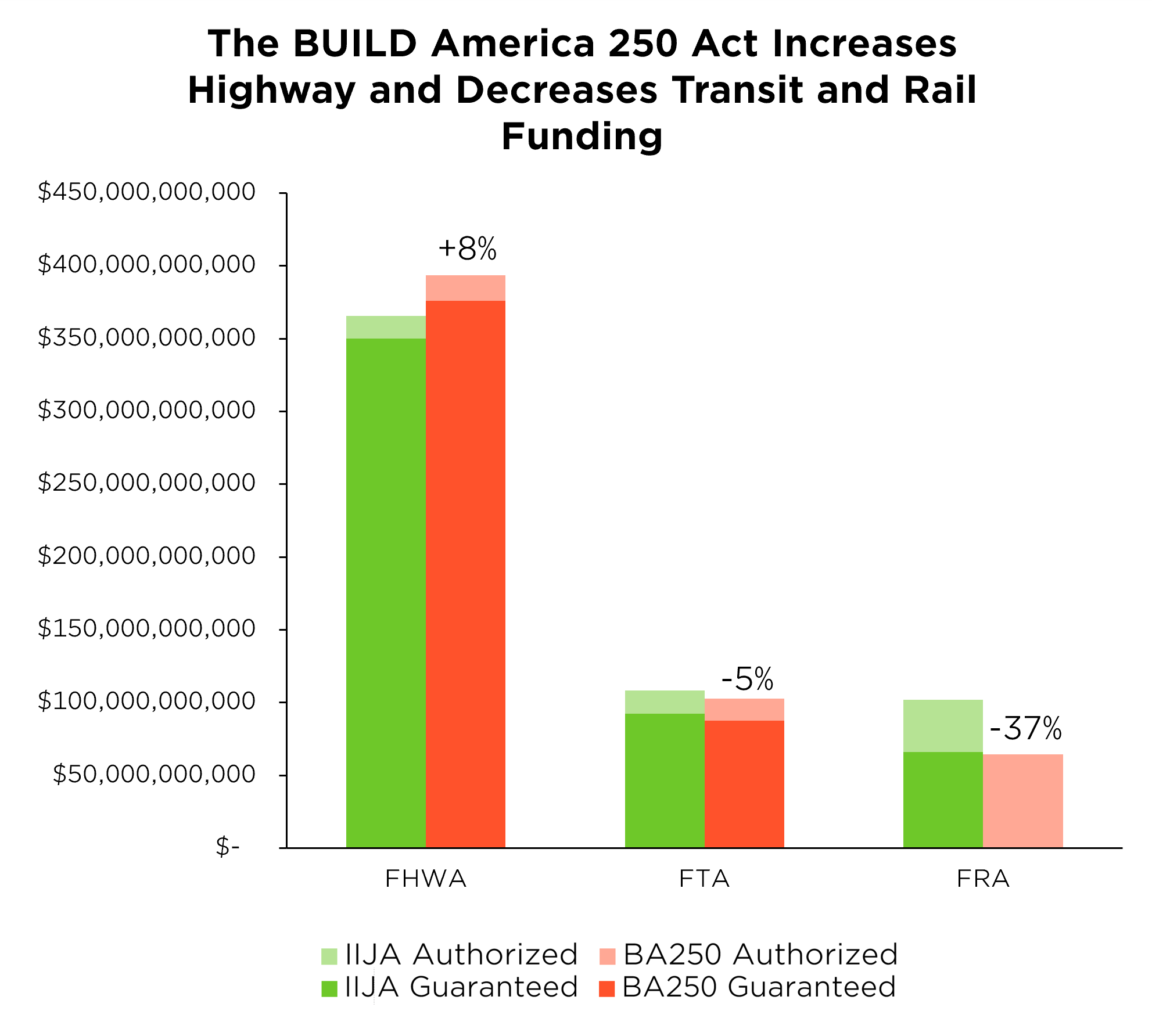
- Over the 5 years it covers, it increases highway funding by 8% (+$28 billion), while decreasing transit and rail funding by 20% (-$43 billion) compared to the Bipartisan Infrastructure Law (BIL).
- It cuts key programs that support electric vehicles, disaster resilience, and bike and pedestrian infrastructure. Other popular proposals, such as a new program for transit operations or to require maintenance before highway expansion, did not make it in.
- It proposes an additional fee on electric vehicles and plug-in hybrids (on top of the state and local fees owners already pay), despite evidence showing that this would not come close to meeting the structural deficit in the Highway Trust Fund due to the cost of roads. Meanwhile, heavy-duty trucks cause over 90% of damage to roads and will still pay far less than their fair share in this bill.
This is just the first step in what has historically been a drawn-out process to reach a final deal on the country’s surface transportation. But setting the BUILD America 250 Act as the starting point is worrying – let’s break it down.
The devil is in the bureaucratic funding mechanism details
The BUILD America 250 Act looks a lot like a highway contractor’s wishlist. Despite all the hubbub about Highway Trust Fund insolvency, the bill proposes highway funding increases. There’s $11 billion in new funds for bridges, at the expense of transit and rail funding. Instead of novel, targeted pilot programs like the Reconnecting Communities grants that supported undoing the harm of urban freeways, there’s $750 million for a new Truck Parking program, a priority of the American Trucking Associations in the highway lobby. Still, the total program amount of $583 billion falls short of asks by the highway lobby for BIL levels with inflation, and so they’ll have to debate asking for more.
This situation gets more stark when you take a look at funding mechanisms. Federal transportation dollars are not all equal. Some programs are tagged with the gold standard for funding security – contract authority from the Highway Trust Fund. For agencies who need to build large, multi-year infrastructure projects, this is a protected and secure pot of money for transportation projects. On the other side are programs that are merely authorized, subject to appropriations from the General Fund. What does this mean in practice? Legislators and transportation agencies have to fight for funding in the fray that is yearly budget negotiations, and often, funding comes in much less than initially authorized, as is the case for the Active Transportation Investment and Infrastructure Program (ATIIP). In the middle, the BIL was able to make use of a more novel funding mechanism called advance appropriations, which allowed for a similar guarantee to contract authority for $184 billion of programs that skewed towards those supporting more transportation options or climate-friendly investments.
This most recent proposal gets rid of advance appropriations. This hits rail funding the hardest – which received $66 billion in advance appropriations funding and $36 billion authorized but subject to appropriations under the BIL, but in this proposal is only reliant on $65 billion of funds completely subject to appropriations. Transit faced a similar fate – it received $21 billion of advanced appropriations funds under the BIL, giving the certainty needed to make capital investments in new train lines and electric buses, whereas this bill provides none. While the bill’s proposed transit funding is considerably more than the doomsday scenario of a full cut of federal transit support, in the end it proposes a 5% reduction in transit funding. This is all while inflation has increased costs considerably since the BIL was enacted in 2021.
If you remove the funding subject to appropriations (so only $475 billion total), the situation is clearer. Highways still get an increase of 7% (+$26 billion) of secure, stable funding. Transit and rail lose 45% (-$71 billion) of their guaranteed funding. In total? That’s an 81/19 split of guaranteed funding, a far cry from the BIL’s 70/30 split of the same numbers.
Where did these cuts come from? Successful programs from BIL that should have been built on were instead gutted:
- Carbon Reduction Program: repealed completely (-$6 billion compared to BIL)
- Promoting Resilient Operations for Transformative, Efficient, and Cost-Saving Transportation (PROTECT) Grants: cut the formula program, with some eligibilities added to the Surface Transportation Block Grant (-$6.2 billion, -71%)
- National Electric Vehicle Infrastructure Program and the Charging and Fueling Infrastructure Program: cut (-$5 billion and -$2.5 billion, respectively), with a +$1 billion set-aside in the Congestion Mitigation and Air Quality program.
- Neighborhood Access and Equity Program/Reconnecting Communities: cut, except for an eligibility in the new consolidated Surface Transportation Accelerator Grant Program (-$1 billion)
- Active Transportation Infrastructure Investment Program (ATIIP): cut completely (-$1 billion)
- Healthy Streets Program: repealed completely (-$400 million)
- Reduction of Truck Emissions at Port Facilities: repealed completely (-$400 million)
The BIL helped these programs make change across the country, and the BUILD America 250 Act’s funding numbers threaten the progress that was made on those fronts. And meanwhile on the flip side, the bill proposes a new $130/year registration fee for electric vehicles and $35/year for plug-in hybrids that will increase in the future, which both disincentivizes people adopting lower emission vehicles while also barely making a dent in the funding gap for federal transportation.
Mixed results on holding agencies accountable
Amid a tumultuous year of cancelled, delayed, and otherwise disrupted federal grants, there have been increasing calls by the public and legislators for Congress to ensure that the laws that are passed will be carried out by the administration. Some, like Sen. Whitehouse, a lead negotiator for the surface transportation reauthorization on the Senate side, have been clear that the administration’s funding cuts and project cancellations would shut down negotiations unless they’re addressed.
The BUILD America 250 Act has one small guardrail (Sec. 1101(f)) to prevent the administration from terminating, withholding, or delaying a grant agreement on the basis of non-statutory goals or agency priorities, but it remains uncertain how effective it would be amid the many routes the administration has been taking to slow down good projects.
Meanwhile, on the state side, there is a new dynamic with the Consolidated State Block Grant program in the transit title (Sec. 3006) and the Consolidated Funding Pilot program in the highways title (Sec. 1128). Both are optional programs for states to take the reins of multiple programs, throw the money into a lump sum pot, and distribute it to their liking. In essence, this is the American Association of State Highway and Transportation Officials’ (AASHTO) request for more discretion and less accountability for how they use transportation funds. The worrisome part is if this functionality is used by states to shift away the remaining funding for affordable and sustainable transportation options towards other purposes.
As for other venues of accountability? Every mile of new roadway comes with a $47,300 annual cost (per lane) to keep in good repair — on top of an existing $216 billion backlog over 5 years. But there are no requirements for state departments of transportation to prioritize repair over expansion (aka fix-it-first). This will burden both transit riders and drivers with added costs and travel delays due to poor roadway conditions. Lastly, legislators failed to take the opportunity to make transportation planning at metropolitan planning organizations (MPOs) more representative of the populations they serve, a key step the UCS recommends as a part of a democratic transportation system.
We need to BUILD something different
The bottom line is, the BUILD America 250 Act digs its heels into more roadways while robbing from the multitude of sustainable and affordable transportation options that the country needs. This means that people would be trapped in our current expensive, car-oriented system while giving away billions to the highway lobby for new highways without strong protections to ensure current infrastructure doesn’t crumble. With less support for transit and bike and pedestrian ways, in the end, we’ll spend more money and continue to pollute in order to get where we need to go.
This is just the first public draft, and UCS will continue to follow along as this bill develops. Coming up on the country’s 250th anniversary – we have a crucial choice. Do we want to stay stuck in the fossil-fueled and car-dominated past? Or do we want to look towards an affordable, sustainable, and just future?
CORRECTION -5/20/26- We have corrected a previous version of this blog which reflects revised funding interpretations, corrected figures, and minor typographical fixes.