

One data center proposal for Louisiana could eat up the equivalent of six New Orleans’ worth of energy. Who’s going to get stuck footing that bill?
While it may not feel like Louisiana is teeming with data centers just yet, the boom in energy-hungry artificial intelligence is poised to change the landscape. We’re talking about multiple cities’ worth of electricity demand being added to the grid over the coming decade.
New modeling by the Union of Concerned Scientists has found that data center growth could leave Louisianans paying for billions of dollars in additional electricity system costs over the next 15 years. And under current policies, the AI facilities in the state are set to be powered largely by fossil fuels, bringing potentially billions of dollars in public health costs and tens of billions in global climate damages.
Preparation for this type of massive, yet highly uncertain, load growth requires careful attention by regulators and policymakers tasked with protecting the public. In other parts of the country, data centers have brought risks of costly and dangerous power outages while also raising utility bills at a time when energy costs are already rising for several other reasons. And depending on how data centers are powered, they can bring significant harms to public health and the global climate. Unfortunately, Louisiana’s current policies and regulatory approaches are not well set up to address the wide array of risks posed by the data center boom.
Fortunately, there are steps that policymakers and regulators, particularly the staff and elected officials at the Louisiana Public Service Commission (LPSC), can take to protect their constituents from these risks and ensure that Big Tech’s burdens don’t fall on Louisiana residents and businesses. Let’s get into the details.
Data centers set to make Louisiana’s grid way more expensive
Depending on the extent of data center load growth, our findings show that over the next 15 years, Louisiana’s wholesale electricity system costs could be a cumulative $14 billion to $26 billion higher than they would be without data center growth. We call these the “Mid” and “High” data center growth scenarios, respectively. This analysis draws from state-level results from our Data Center Power Play report, a national-level study using the Regional Energy Deployment System (ReEDS) modeling framework that was released earlier this year.
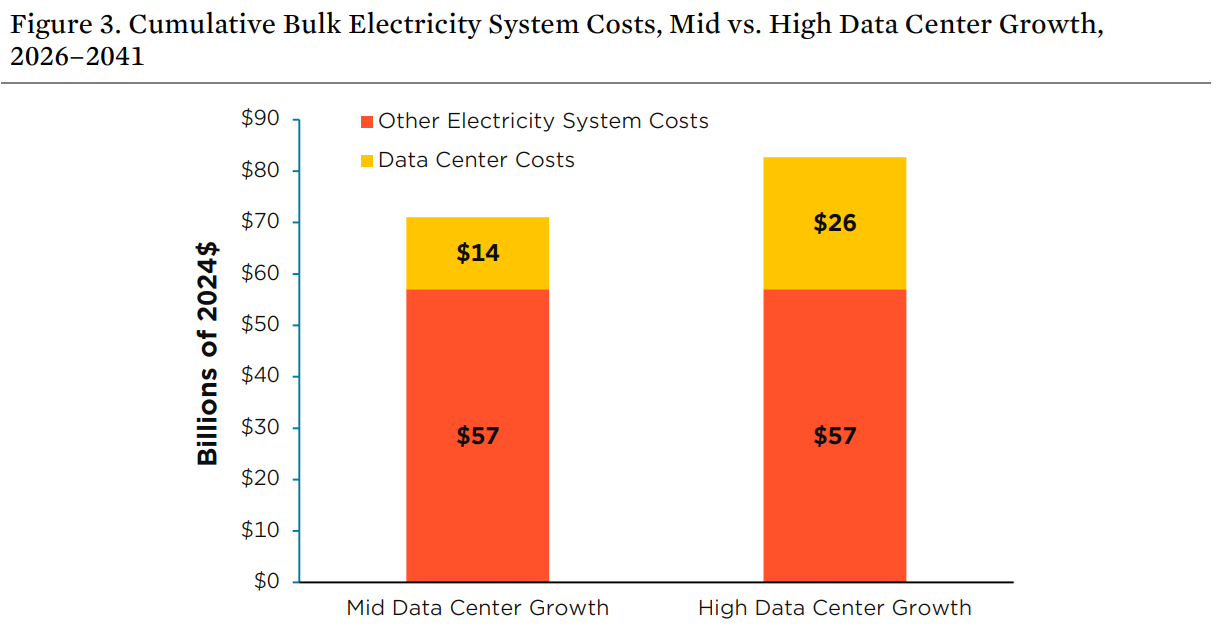
Louisiana ratepayers are at risk of paying substantial electricity system costs caused by data centers. “Bulk” electricity system costs are only at the wholesale level. Calculation was done by comparing the Mid and High Data Center Growth scenarios with a No Data Center Growth counterfactual scenario. Source: UCS
These costs are only at the wholesale level—essentially, the costs to build and operate large-scale power plants and transmission lines. It doesn’t reflect ”ratemaking” at the LPSC, the process whereby those wholesale costs are allocated to residents and other businesses.
However, the dollar amount reflected on energy bills includes other costs as well, such as the utility company’s profit margin. These additional costs are covered by retail ratepayers, like residents and businesses. And Louisiana does not have comprehensive protections to insulate ratepayers from data center-triggered costs. In fact, the LPSC’s recent fast-track approval pathway, established through the recent “Lightning Amendment,” clears the way for potentially more than half of such costs to be passed to other ratepayers.
Data centers’ projected impact on the average Louisiana utility bill is uncertain, because that depends so heavily on how the LPSC allocates the wholesale electricity system costs between different types of customers (e.g., residential, commercial, industrial). But with electricity system costs potentially $26 billion higher due to data center load, and without comprehensive protections in place for other ratepayers, Louisianans are at risk of substantially subsidizing—to the tune of billions of dollars—Big Tech’s AI ventures.
Status quo would keep Louisiana over-reliant on a single fossil fuel: gas
About 75% of Louisiana’s electricity generation is currently from fossil gas power plants, making it one of the most gas-reliant states in the nation. Our analysis shows that under current policies, the state will meet growing demand with even more gas. This includes demand from data center companies, which thus far have not made any attempt to plan for flexible operations (essentially reducing demand during times of grid stress) in an effort to reduce overall costs and the need for new fossil fuel plants.
Therefore, without policy changes, the Louisiana power grid’s overdependence on a single fossil fuel, gas, would sustain into at least the 2040s, making up roughly two-thirds of the electricity mix in our 2041 modeling results.
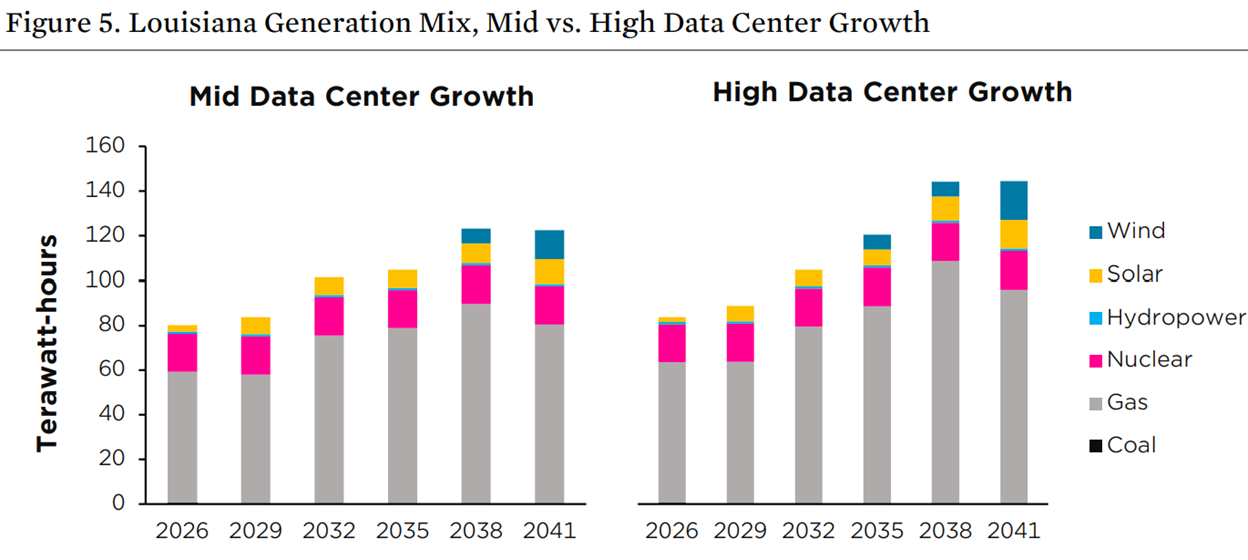
Under current policies, Louisiana is projected to stay overreliant on gas-fired electricity. Source: UCS
The unpredictable spikes in utility bills that Louisianans are all-too-familiar with would therefore continue, since utilities pass fuel cost increases directly to their customers. The latest spike was caused by Winter Storm Fern in January 2026, which sent gas prices soaring above $30 per million British Thermal Units (MMBtu)—the highest in at least 29 years. For perspective, the price was around $3 per MMBtu just a week earlier. Though the effect on utility bills is not yet clear, ratepayers will feel the impacts of those price increases in the coming months even if they use the same amount of power.
While short-term commodity price changes aren’t captured by long-term modeling frameworks like ReEDS, those spikes can still have significant real-world impacts on energy burdens. Some Louisianans were paying bills in 2025 that were 29% higher than the year before due to increases in gas prices. And during a 2022 price spike, some customers were paying double the fuel charges—these days roughly 20-30% of a total bill—than they were paying the year before.
Diversifying away from price-volatile fossil fuels and toward zero-marginal-cost resources like wind and solar can help protect ratepayers from these types of bill increases. Otherwise, Louisiana households will continue to be forced to fund the unpredictable costs of utilities’ overreliance on those fuels, whose price is sensitive to an increasing number of extreme weather events, and global conflicts such as the wars in Ukraine and Iran. While the US has thus far been insulated from the latter in terms of gas prices, that is not all guaranteed to be the case as the war continues.
Data centers set to bring higher public health and climate damages
Beyond utility bill increases, data centers are also set to trigger higher public health costs and climate damages from Louisiana’s gas plants. Our findings show that the public health damages could range from $1.5 billion to $3 billion from 2026-2041 due to increases in nitrogen oxides (NOx) and sulfur dioxide (SO2) emissions, two pollutants that can cause respiratory and cardiac issues. While these public health harms can cross state lines as pollutants flow downwind, the impacts are predominantly local.
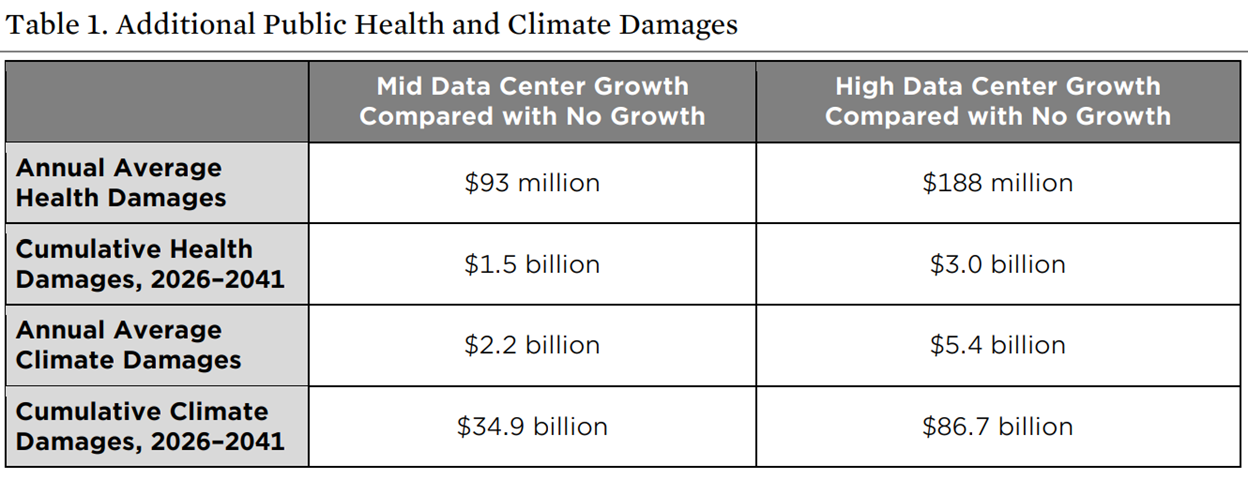
Data centers drive billions of dollars in public health and climate damages as Louisiana relies on gas plants to meet growing electricity demand. Calculation was done by comparing the Mid and High Data Center Growth scenarios with a No Data Center Growth counterfactual scenario. Source: UCS
Over the same period, data center-driven increases in heat-trapping emissions from Louisiana fossil fuel plants could trigger $35 billion to $87 billion in global climate damages. While these damages are felt globally, Louisiana already experiences a number of impacts that scientists expect to worsen as climate change continues, including hurricanes, heat waves, and sea level rise. It is therefore imperative that the state make concerted efforts to reduce both toxic air pollution like NOx and SO2, as well as heat-trapping emissions like carbon dioxide and methane.
But how much data center demand will actually come online?
One big question remains: how much data center growth is actually coming to Louisiana? The short answer: no one knows.
Regulated utilities have financial incentives to overestimate demand and overbuild, because they earn ratepayer-funded profits on capital infrastructure spending. We therefore have to take data center demand estimates from utilities with a skeptical eye.
To account for the uncertainty, UCS ran multiple data center demand scenarios at the national level. Our “Mid Growth” scenario is in the range of other national-level studies. (See this blog for more on our latest national data center analysis.) However, in Louisiana specifically, looking at recent announcements in a vacuum makes the “High Growth” scenario seem far more likely, and maybe even conservative.
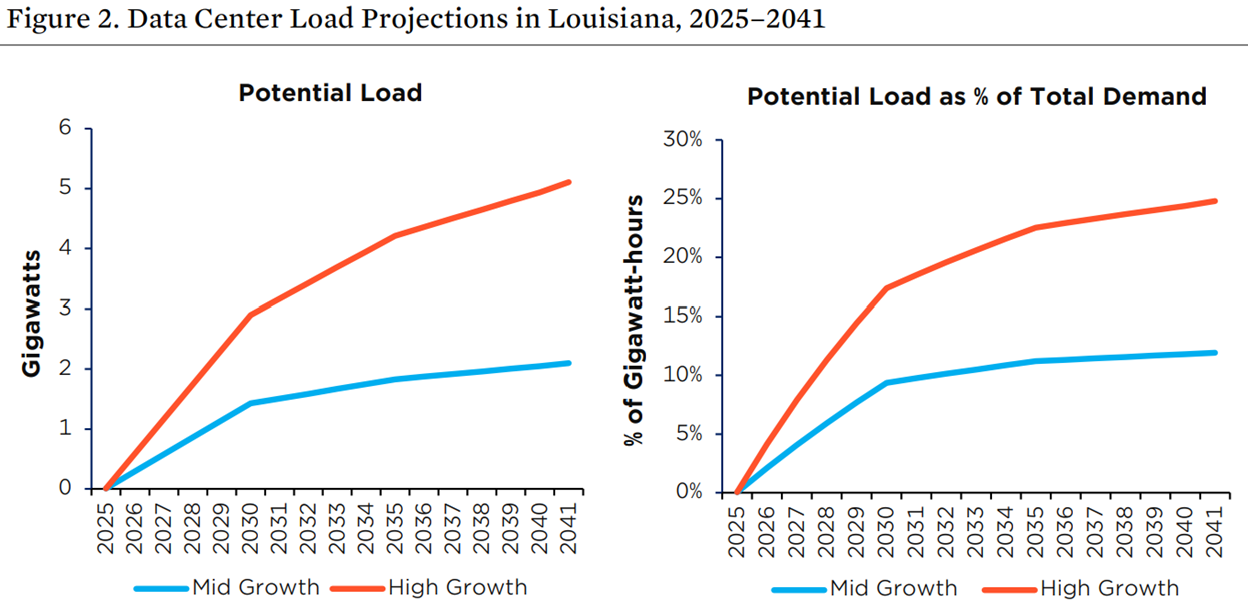
Our High Growth scenario projects about 5 GW of data center load added to Louisiana’s grid by 2041. Let’s compare this to Meta Platform’s plans for a new data center near Rayville, LA. The size of the data center expansion is thus far confidential, but Mark Zuckerburg said last year that the facility could grow to 5 GW, which would consume roughly six times the electricity as the entire city of New Orleans on an annual basis. Last year, the LPSC approved Entergy Louisiana’s application to build 2.3 gigawatts (GW) of gas capacity for this data center. And Entergy recently filed another LPSC application to build seven new gas plants totaling 5.2 GW on top of the already approved 2.3 GW, all for the expansion of Meta’s data center.
There’s much more to be said about this new application and who will end up covering the costs. But for now, I want to underscore the significant remaining uncertainty with the data center landscape in Louisiana and beyond, even as the press releases and LPSC applications make it all seem like a foregone conclusion.
To understand the uncertainty, we don’t have to look any farther than Meta itself. Right after Entergy got approval to build the first 2.3 GW of gas capacity for the data center, the tech giant fundamentally changed the financial structure of the planned AI facility. Meta offloaded 80% of the data center project ownership onto Blue Owl Capital—a much riskier company—and gave itself the option to exit the data center lease after just four years. The electricity infrastructure being built, meanwhile, will last for decades. Meta has financially shielded itself greatly, in no small part by getting a ratepayer guarantee of this long-lasting infrastructure.
Worries about an AI bubble bursting have only grown since UCS conducted this modeling in late 2025. These worries are due to a number of factors, including circular financing, lack of AI profitability in comparison to massive capital expenditures, private credit scares (of which Blue Owl is at the center), and now, Donald Trump’s war in Iran.
If the AI bubble isn’t bursting in the way some warn, and our High Growth scenario proves to be on the conservative side, then the need for safeguards is even more urgent, because the impacts will be that much greater. Policymakers at the LPSC should act now to protect communities from the wide array of risks stemming from the growth in data centers.
Looking ahead: better protections from data center threats are needed
As discussed above, we estimate that the growth in data centers could cause up to $26 billion in additional Louisiana electricity system costs between 2026 and 2041. The state would remain alarmingly overdependent on gas for its power sector needs, leaving ratepayers highly vulnerable to unpredictable price shocks. The additional pollution from these fossil fuel power plants specifically to serve data centers would trigger up to $3 billion in public health damages and up to $87 billion in global climate damages.
Fortunately, the commissioners at the LPSC have the ability to stave off a situation which is untenable for many of their constituents, particularly since an estimated 50% of households in the state are already financially struggling.
We recommend several reforms in our issue brief that would begin to put the state on a path toward a cleaner, more affordable, and more reliable electricity system. Included in these recommendations is an improved process for long-term utility resource planning, as well as comprehensive, mandatory ratepayer protections from data center-triggered costs.
We also recommend that the state take advantage of its significant clean resource potential, including by embracing long-range transmission planning by regional transmission grid operators MISO and SPP. Further, reforms are needed to enable a wider set of stakeholder voices to inform decisionmaking at the LPSC. For far too long, utilities have had disproportionate influence at the agency, and that is being perpetuated in part by low transparency and arbitrary barriers to participation.
The time is now for Louisiana utility regulators to protect their constituents from data center threats, and you can urge them to do so at this link. They should not continue to cater to Big Tech and utility company interests at communities’ expense.