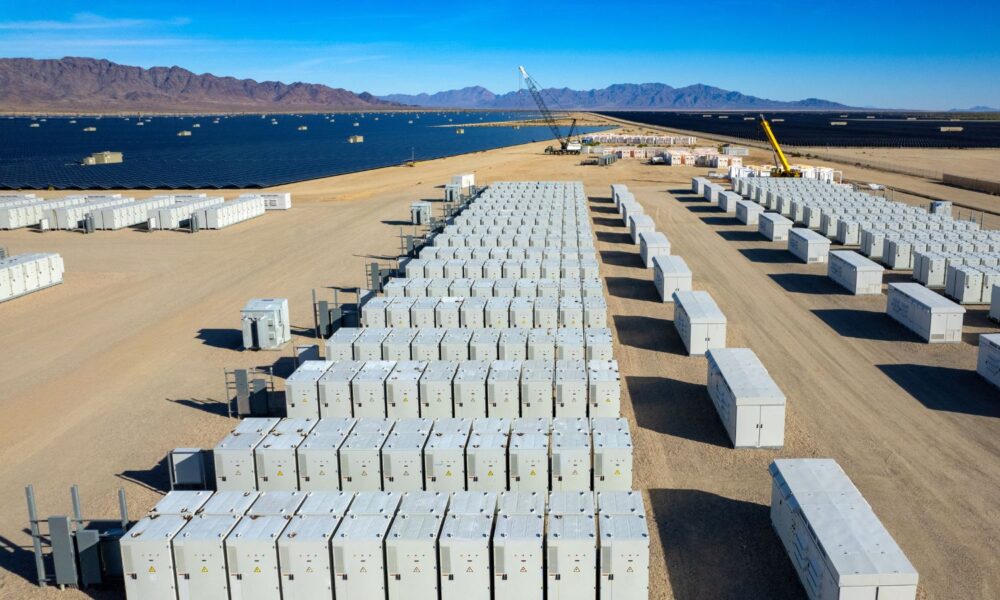

Thousands of data centers are popping up across the country, fueled by the boom of AI—and ratepayers could get stuck with the bill to make Big Tech’s dream a reality.
Electricity demand is increasing, and so are electricity costs for households and businesses across the United States. After more than two decades of relatively flat electricity demand growth, the near-term surge in new demand from “hyperscale” AI data centers is poised to send electricity prices through the roof without strong ratepayer protections and other policy interventions.
Addressing these new threats from data centers—alongside existing price drivers such as increasing fossil gas prices and the high upfront cost of necessary infrastructure upgrades in the face of climate-fueled extreme weather—will require concerted efforts to address both electricity demand and supply. Unfortunately, actions taken during the first year of the Trump administration are moving us in the wrong direction and could result in much greater increases in electricity costs, while also risking more outages, more pollution, and more climate-damaging emissions. A new analysis from the Union of Concerned Scientists (UCS), Data Center Power Play, makes clear just how much is at stake, finding that:
- Data center demand is highly uncertain, but will be the greatest near-term driver of load growth
- Current policies risk putting the United States on a path to meet much of this demand with fossil fuels
- Stronger policies can shift our path to running primarily on renewables without sacrificing reliability, while also bringing important health and climate benefits
- The looming data center-driven demand surge comes with significant costs across all scenarios, and policymakers must take steps to ensure that these costs are not passed on to consumers
Overall, our modeling demonstrates that clean and renewable energy can meet the challenge of load growth from data centers, but policymakers must be proactive to protect our health, environment, and financial interests.
Trump admin sidelines clean energy amid rising electricity demand
Even as the Trump administration boasts of leading the global AI race, it is sidelining the clean, plentiful, affordable, and efficient energy technologies that are best poised to power such a future.
Even with investments in energy efficiency—which the Trump administration is aggressively undermining—we will still need to significantly increase electricity generation to meet surging demand growth from data centers and electrification. This will require building as much new, low-cost capacity as quickly as possible, and making it as clean as possible to avoid negative climate, health, and environmental impacts. Here, renewable energy technologies, especially solar and wind combined with energy storage, check all the boxes. They have a distinct advantage over fossil fuels and low carbon technologies such as new nuclear and carbon capture and storage (CCS), which have long lead times, high costs, and are largely unproven technologies.
Combining wind and solar with battery storage, while requiring greater data center flexibility, offers a promising solution for powering data centers and meeting overall electricity demand. Over the past few years, the vast majority of new capacity additions in the United States, and globally, have been wind, solar, and battery storage. These technologies also dominate new capacity waiting to be developed in transmission interconnection queues.
Further, the costs for wind and solar have fallen 70 to 90% over the last 15 years, making them cheaper in many cases than new gas and existing coal plants, even without subsidies and before factoring in environmental and health benefits. The lead time to plan and build wind and solar projects is also much shorter than it is for new gas or nuclear plants. In addition, recent studies have identified demand-side flexibility at data centers as an important strategy for reducing peak demand and lowering costs.
In striking contrast to this forward momentum is the Trump administration’s stated preference for using dirty, outdated fossil fuel generation to power emerging technology. At the same time, it has created significant headwinds for wind, solar, and storage, including rolling back federal tax credits, illegally rescinding clean energy grants and financing approved by Congress and under contract, illegally halting offshore wind and other renewable energy projects that are either under construction or fully permitted after lengthy reviews, blocking new wind and solar permitting from moving forward, and more.
The stakes are high. The path that states and the nation choose on how to power data centers has wide-ranging implications for energy affordability, reliability, public health, the climate, and the economy as a whole.
Powering data centers with clean energy vs. fossil fuels
To better understand the potential impacts of meeting US electricity demand growth from AI data centers, UCS’s new analysis highlights the consequences of data centers’ growing electricity demand on the US power grid and how decisionmakers can mitigate harmful economic, climate, and health impacts through clean energy deployment and strong ratepayer protections.
Using the National Renewable Energy Laboratory’s (which the Trump Administration recently renamed the National Laboratory of the Rockies) open-source Regional Energy Deployment System’s (ReEDS) power sector model, we analyzed the impacts of meeting electricity demand growth from AI data centers on electricity generation, electricity costs, and the health and climate costs of emissions from using fossil fuels—as well as the avoided health and climate costs of emissions from using clean energy instead. Since future data center demand growth and the policy landscape are highly uncertain, we modeled multiple demand growth and energy policy scenarios.
Data center demand is surging—and highly uncertain
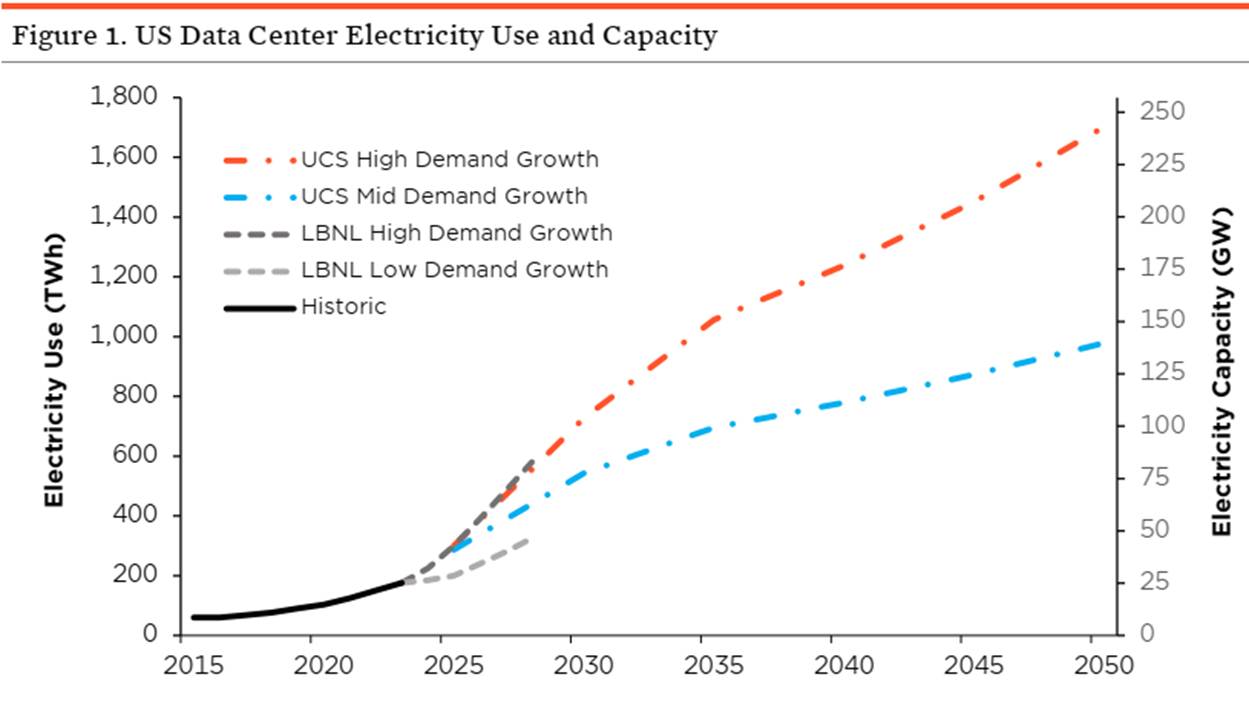
We project overall US electricity demand to increase 62% between 2025 and 2050 under a “mid-level” data center demand growth scenario, and as much as 79% under a “high” data center demand growth scenario (Figure 1). Data centers account for about half of total demand growth over the next five years, but this share falls over time as electrification increases in other sectors (especially transportation). While we vary the amount of data center demand growth, we assumed the same level of demand growth in other sectors under all scenarios. Studies by UCS and others show that higher levels of electrification of other sectors would likely be needed to achieve economy-wide net zero emissions by 2050.
The number of data centers anticipated to be built in the United States and how much
electricity they will need are both highly uncertain. Recent actions by electric
utilities and regional transmission organizations indicate that many proposals to build data centers are redundant. In addition, utilities, which earn a guaranteed return on investment, have an incentive to overestimate future demand. This could lead to overbuilding the electricity system, higher costs, and stranded assets. A lack of transparency compounds the uncertainties, as proposals to build data centers and the power plants to serve them, are typically confidential.
Current policies increase reliance on fossil fuels
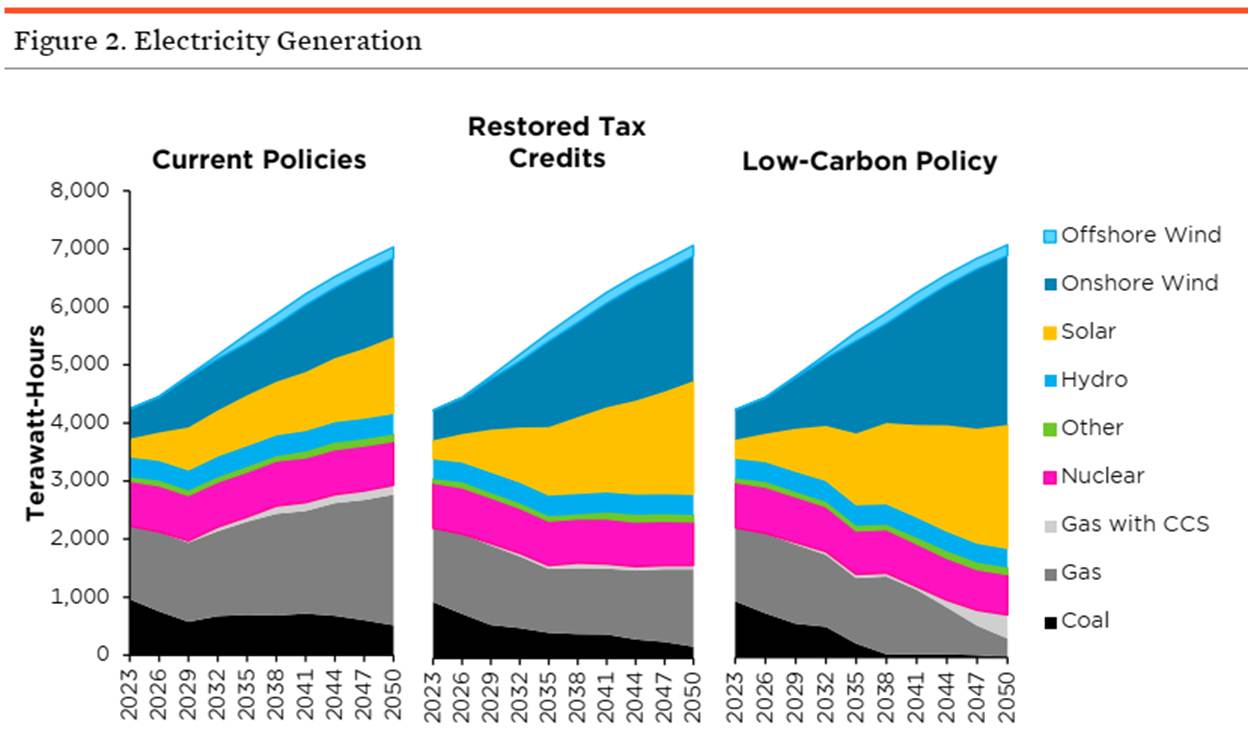
Under current state and federal climate and energy policies, our analysis finds that the United States is likely to increase its reliance on fossil fuels as electricity demand grows due to data centers and electrification of other sectors. We found that gas generation could increase 23% between 2026 and 2035 and 77% by 2050, with 90 gigawatts (GW) of new gas capacity added by 2035 and a whopping 335 GW by 2050. (One gigawatt is enough to power about 750,000 average US homes per year and could be supplied by 294 utility-scale land based wind turbines, according to DOE)
While our analysis projects coal generation to continue to decline in response to planned retirements, remaining coal plants are dispatched more to help meet the growth in demand. While the model includes the Trump administration’s rollbacks of EPA power plant carbon standards, we didn’t account for other regulatory rollbacks and subsidies that could further boost coal generation. For example, we didn’t model recent Trump Administration actions to use emergency powers to prevent at least six uneconomic coal plants from retiring, which are expected to increase electricity costs for consumers.
Even with these caveats, we found that the additional fossil fuels burned to power data centers could increase power plant carbon dioxide (CO2) emissions by 19% and result in $1.6 trillion in climate and health damages over the next decade, growing to $4.5 trillion by 2050, under our mid-level data center demand growth scenario. We expect that recent actions not included in the model would only increase these costs compared to our results.
Stronger policies ensure that clean energy powers data centers
Restoring federal clean energy tax credits accelerates the deployment of wind and solar to power data centers. It also reduces reliance on gas and coal generation to meet the growth in electricity demand.
Adopting policies to reduce US power sector emissions of CO2 would go even further, facilitating the clean energy transition to help meet economywide emission reduction targets. With a target of a 95% reduction in CO2 below 2026 levels by 2050, wind and solar generation nearly triple between 2026 and 2035 and increase five-fold by 2050 to replace coal and gas. Combined, all renewable energy sources provide more than 60% of total US electricity generation by 2035 and 81% by 2050.
Data centers put ratepayers at risk of higher electricity costs
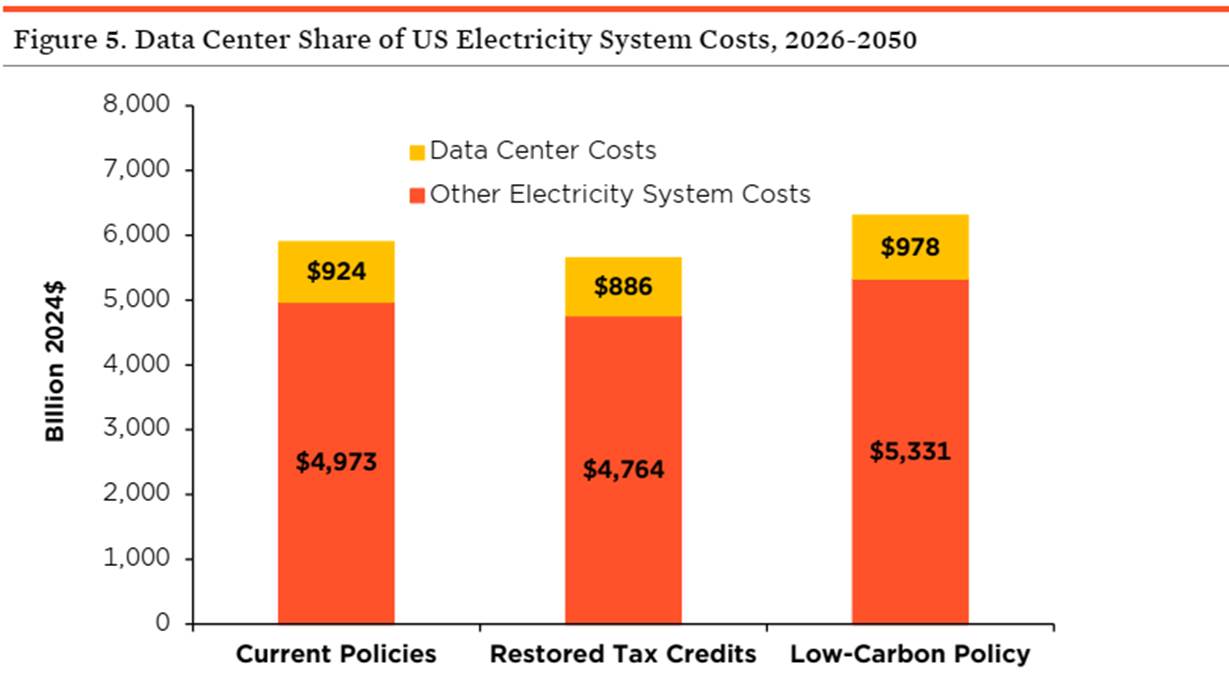
Rapid data center growth results in more than $500 billion in cumulative electricity costs nationally by 2035 and nearly $1 trillion by 2050 across our three policy scenarios and assuming mid-level demand growth. This represents 18-24 percent of total US wholesale electricity costs over the same period (see Figure 5). Without strong ratepayer protections requiring Big Tech companies to pay their fair share, these costs could get passed onto households and other businesses.
Restoring federal clean energy tax credits to the timelines and phaseouts that were included in the Inflation Reduction Act results in cumulative savings of $248 billion (4 percent) through 2050 compared with the “Current Policies” scenario. This underscores that recent actions by Congress and President Trump to rollback tax credits for solar and wind as part of the One Big Beautiful Bill Act (OBBBA) will make electricity less affordable, which is consistent with other recent studies.
Restoring the tax credits and adopting more ambitious climate and clean energy policies that nearly decarbonize the power sector by 2050 (the Low-Carbon Policy scenario) results in higher costs of $291 billion (12 percent) from 2026 to 2035 and $412 billion (7 percent) through 2050 compared with Current Policies. But these costs of transitioning to clean, low carbon energy sources are far outweighed by the avoided climate and health damages from burning fossil fuels, reaching more than $1.6 trillion between 2026 and 2035 and $13.3 trillion by 2050. Additional interventions, such as using clean electricity to replace fossil fuel use in other sectors, investing in energy efficiency, and increasing data center flexibility, could significantly lower overall energy bills.
We can avoid the health and environmental harms associated with unmitigated growth of data centers
Ensuring that data centers are efficient, flexible, and powered with clean energy requires stronger state and federal policies. Policymakers and regulators should require utilities and data center developers to be more transparent and accountable, improve long-term planning for meeting data center demand, and protect other customers from cost increases and negative health impacts.
They should also require utilities and data center developers to meet demand growth with new low carbon or zero carbon generation and use energy storage instead of diesel or gas generation for back-up power. Policies supporting the development of data centers should include standards and guardrails that protect public health while reducing emissions, energy and water use, and other environmental impacts.
Only bold action will ensure that the nation meets electricity demand growth with clean energy, achieves its climate goals, and protects consumers from added costs brought on by the growth of data centers. Unmitigated data center growth should not continue in the absence of stronger policies and guardrails, given that the consequences for energy affordability, reliability, public health and the climate are so high. The path for the United States to achieve these benefits is clear.