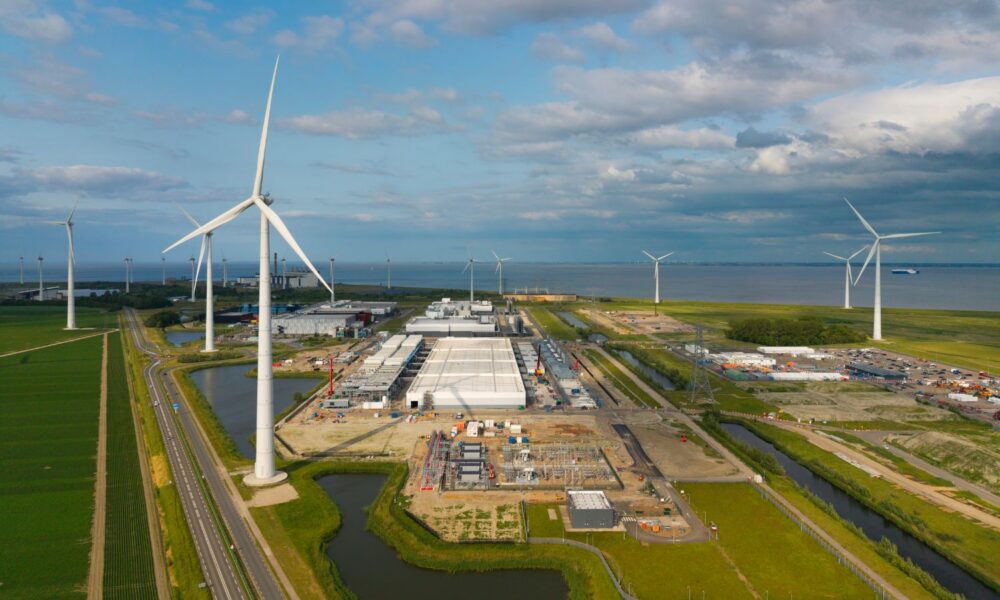

Data centers for AI are driving huge increases in electrical load, and there’s currently not enough power on the grid to match the projected growth. The Trump administration, having hamstrung solar and wind, is now trying to promote new fossil gas generation as the solution.
There is no shortage of reasons to be concerned about this pro-fossil preference—the toxic pollution, the costs of unreliability, and the deadly climate impacts—but I’m going to focus on one of the more technical reasons: conventional power plants are poorly matched to the fast, highly variable electronic loads inside hyperscale data centers. Wind, solar, and batteries, with modern inverters, are a better fit to meet the load growth while keeping the grid stable and reliable.
The grid is changing, and it’s more than just growth
Estimates indicate that load growth from data centers may account for 12% of US electricity use by 2028, and individual data centers can increase a utility’s total demand by 25%. While the scale takes the headlines here, it’s important to note that this is not just more load, but a fundamentally different kind of load.
For over a century, the grid has been dominated by two different types of electric machines: motors and generators. Both are essentially the same device—the only difference is which direction they’re running. On the load side, motors (things like fans, pumps, and compressors) convert electric energy into motion, while on the supply side, generators (like those used in fossil fuel, hydroelectric, and nuclear power plants) convert motion into electric energy.
In fact, if you spin a motor it will generate electricity, and if you run electricity through a generator, it will spin like a motor. The pairing and symmetry between these electric machines on both the supply and demand side has led to an elegantly simple aspect of how the grid stays stable: inertia.
The inertia of electric machines keeps the grid spinning—literally
Both motors and generators have inertia due to the mass of their metal rotors that spin in sync with the grid. In a motor, when the electricity is shut off, inertia keeps the rotor spinning for a few moments, meaning less work is required to get it back up to speed if the power comes back on quickly. On the supply side, generators share inertia like a bicycle built for two (or more): if one rider stops pedaling for a moment, the inertia of the other pedalers keeps providing power to the wheels.
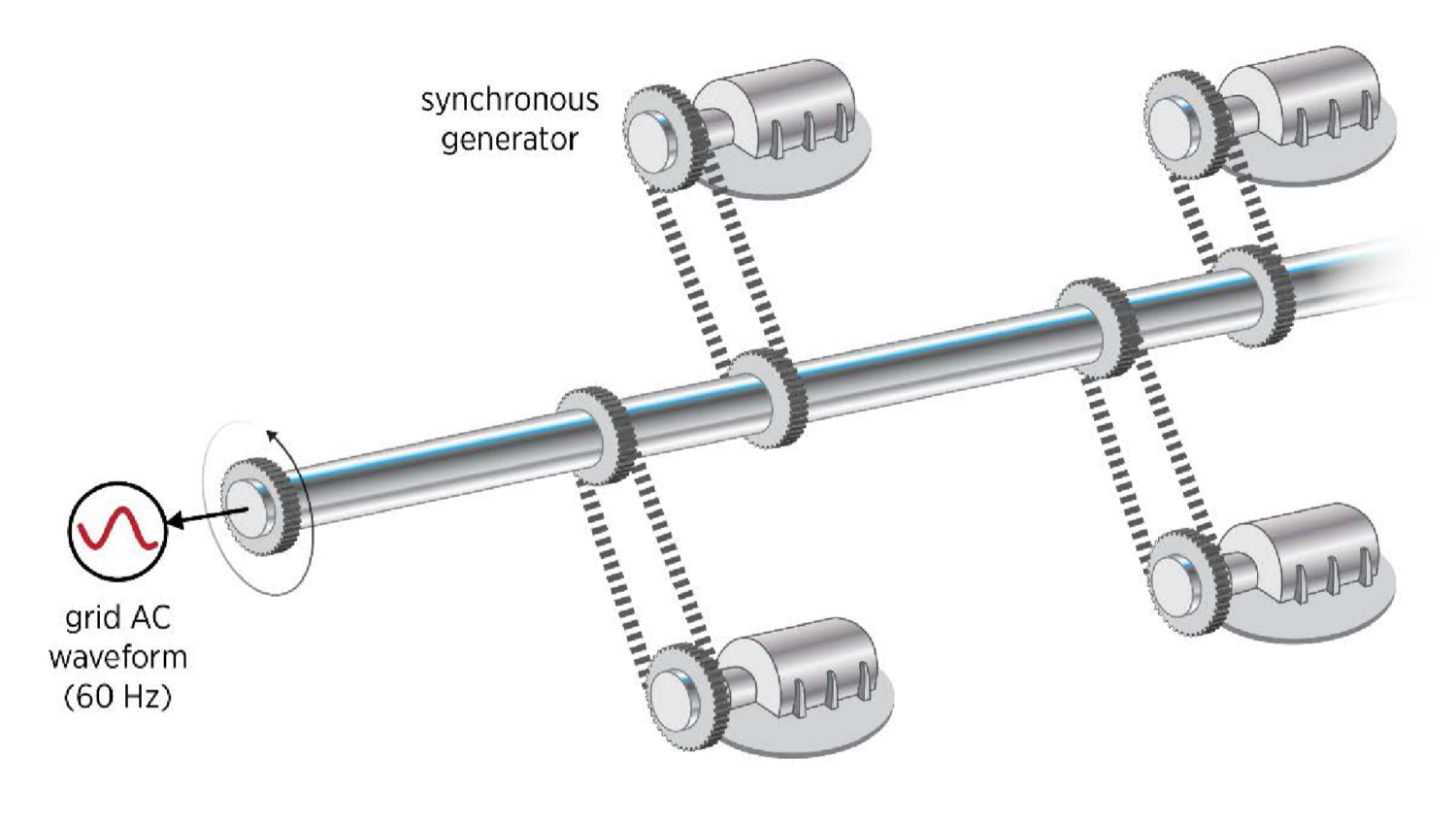
On a grid dominated by motors and generators (especially very large ones), inertia is important because it takes a few moments to change the speed of these machines. Inertia keeps things humming along, absorbing any sudden changes in load or supply while generators adjust their output. This function of inertia is the first component of frequency response, the system which keeps the grid’s frequency at a stable 60 Hz.
Enter nimble inverter-based resources: grid supplies without inertia
When wind, solar, and batteries began to take an increasing share of grid supply, some experts worried about declining inertia. Solar and batteries have no moving parts, and while wind turbines do have rotors, these are almost exclusively connected to the grid through inverters (just like solar and batteries). This enables them to produce more energy, but doesn’t sync their inertia with the grid. Collectively, these are referred to as “inverter-based resources,” or IBRs.
IBRs are built with solid-state power electronics, components that don’t have any moving parts, meaning they don’t have any inertia. While this was initially seen as a liability, it actually means they can do something conventional generators can’t: change their power output nearly instantaneously.
Because conventional generators can’t do this, they rely on inertia to handle sudden changes in power supply or demand on the grid. Then, inertia has to be supplemented with primary frequency response (PFR) to handle larger or sustained deviations in frequency. PFR has historically been provided by mechanical controls—valves and levers—which have their own inertia that must be overcome (and can’t always be counted on).
In contrast, IBRs can respond to grid disturbances instantly and continuously, providing fast frequency response (FFR), which is faster than inertia and long-lasting like PFR. For this reason, some in the industry refer to FFR as “synthetic inertia,” though this is a bit of a misnomer, as there is no kinetic energy involved.
Grid symmetry—what’s old is new again
As IBRs start to take a larger share of generation, the symmetry that once existed between the supply and demand sides of the grid—both previously dominated by electric machines—has begun to fade. The load side has evolved slowly to date, while the generation side is changing dramatically.
But the load side is catching up. In a data center, up to 95% of energy is used to run computing equipment, which is based on the same solid state power electronics as inverters. In fact, the similarities are so close that the Australian grid operator has started referring to data centers as “large inverter-based loads” in its latest system security plan.
Thus with the growth of AI data centers, things are moving toward symmetry again—as inverter-based resources grow rapidly on the supply side, growing demand is also dominated by the inverter-based loads in data centers.
Faster sources are a better match for faster loads
This leads to an obvious question: if the symmetry of electric machines on both sides of the grid once contributed to grid stability, are there benefits to the new symmetry of inverters?
There are several. First, when loads no longer have inertia, energy sources without inertia are better. On the old grid, inertia resisted changes in grid frequency and kept things stable. In the new grid, loads change much faster, and resources that have inertia struggle to keep up.
Second, while data centers’ operations can shift load by hundreds of megawatts (MW) in seconds, new fossil gas power plants can only do 75 MW per minute at best, while older plants are limited to as little as 19 MW per minute. In contrast, batteries and solar can shift their output by 100% in less than a second. Wind output is a bit slower since there’s still some inertia behind the inverter, but all IBRs are more than capable of matching the power swings caused by data centers.
The challenges of faster loads
We’ve known for decades that batteries are really good at responding to rapid changes in power demand, as they’ve long been central to uninterruptible power supply (UPS) systems. Data centers employ UPS systems to instantly transfer power to backup supplies when there are problems on the grid. As one recent data center market overview explains, “Power interruptions over 20 milliseconds can cause data-center IT systems to crash, so UPS transfer time must be faster than this threshold. Batteries are the only widely used technology capable of ramping fast enough” (emphasis added).
But AI presents a new challenge. When a data center is training an AI model, the processors cycle rapidly between performing calculations and sharing results with each other. These cycles are synchronized across all processors in a data center by design, so that each processor has the latest data from all the others for each new set of calculations. During these cycles, processors can swing from 10% of their maximum power demand up to 100% in milliseconds. At the scale of a large data center, this means the total load can swing by dozens of megawatts, equivalent to thousands of homes coming on and off the grid simultaneously.
In addition to the challenge of simply matching this rapidly shifting demand, these massive power fluctuations can also create frequencies which resonate with generator turbine shafts, leading to stress, aging, and even premature failure. The impact isn’t limited to generator rotors and can also affect voltage and frequency regulation, further destabilizing the grid.
Without changes to how the grid is built and operated, these impacts of the growth in data centers create risks to grid reliability and could result in outages or damage to grid equipment and connected loads. If we’re not careful, this could translate to more frequent and longer power outages, affecting everyone who uses the grid.
Are IBRs up for the challenge?
The short answer: yes. A recent research paper from Microsoft, OpenAI, and NVIDIA summarizes the problems caused by this massive, rapid cycling, and recommends three potential solutions. The first two give processors busywork during the low-power phases of the training cycle, essentially wasting energy to reduce the power fluctuations.
The more elegant solution uses energy storage in the form of batteries, an inverter-based resource. Comparing the three solutions, the researchers give energy storage the best rating across six different categories: reliability, performance, energy usage, ability to meet requirements, ease of integration, and lifetime. The other two solutions only out-perform storage in terms of cost. Looking ahead, the researchers note that “for even larger AI training deployments in the future, long storage BESS (battery energy storage system) should also be considered.”
Does it scale?
The bigger question is whether this logic scales—if batteries can address these issues at individual data centers, can we extrapolate the same benefits up to grid scale across IBRs? And if so, can a grid without inertia really be stable?
We’ve already discussed how wind and solar outperform conventional generators when it comes to the speed that data center loads demand, and recent evidence indicates that better integration of IBRs generally can provide the voltage and frequency regulation needed to keep the grid stable better than conventional generators.
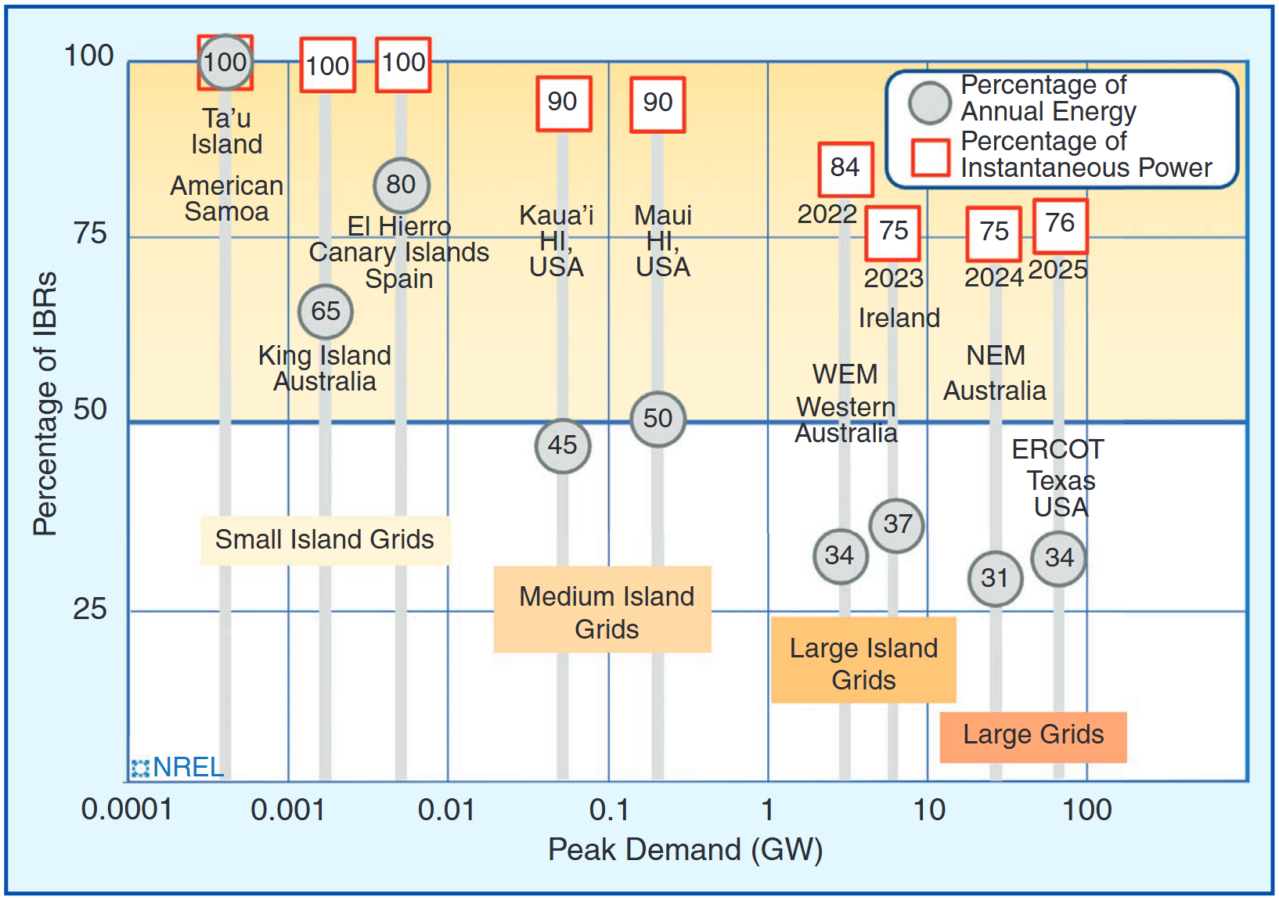
The figure below shows that several grids around the world are already integrating large shares of IBRs; large grids like ERCOT in Texas and NEM in Australia can operate stably with instantaneous IBR penetration up to 75%. The article the figure is drawn from concludes: “These examples show that it is possible to operate very large power grids with very high penetration levels of IBRs. By relying on sufficiently many GFM inverters, operation with IBR penetration levels up to 100% is feasible.”
“GFM” refers to grid forming inverters. Whereas traditional grid following inverters (GFL) only work in a grid with synchronous generators (relying on their inertia), grid forming inverters, as the name implies, can create their own grid, and go it alone without inertia.
More points in favor of IBRs
Beyond technical alignment, inverter-based resources offer other advantages during this period of rapid load growth:
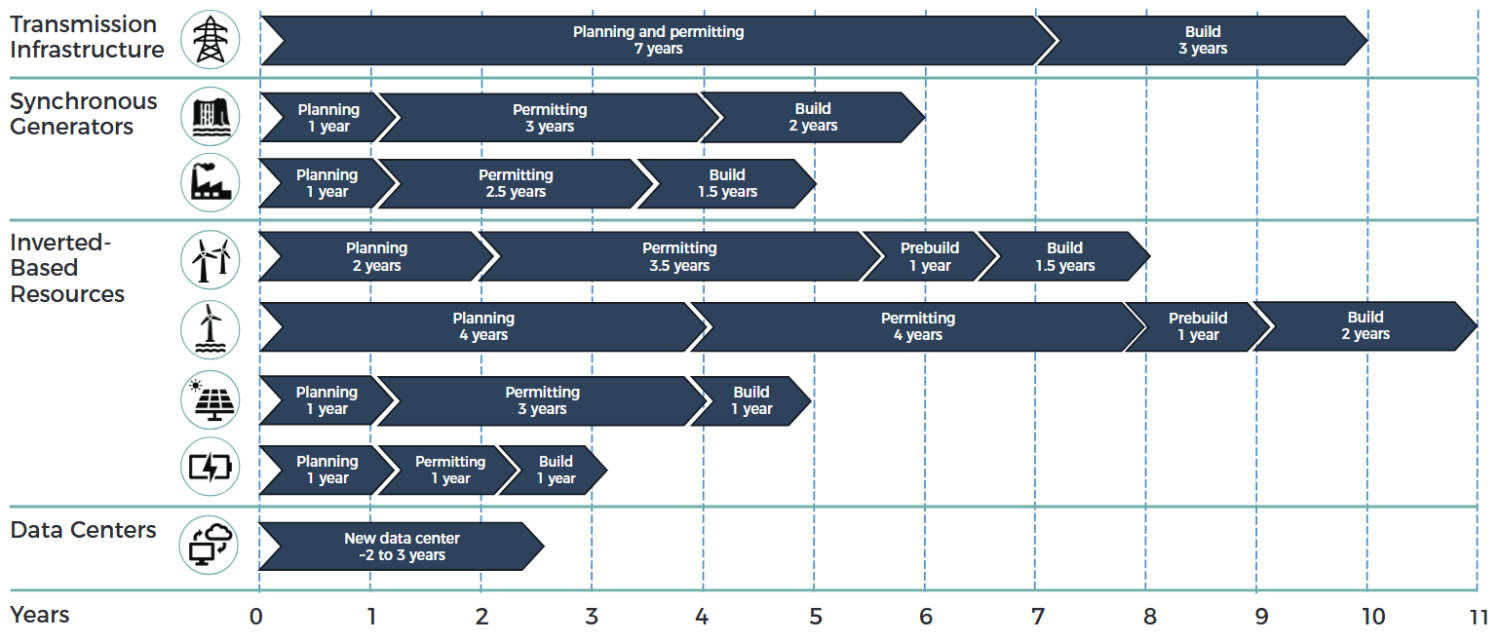
IBRs can be built quickly. The figure below illustrates how long it takes different grid projects to be built. Data centers come online in two to three years, which narrows viable supply options in the near term to batteries, solar, and fossil gas, with batteries being the fastest to deploy. And while solar and gas plants can be built on similar timelines, gas faces severe supply bottlenecks that can add up to seven years before construction even begins.
IBRs are cheaper. New wind and solar are cheaper than new fossil gas generation, and batteries are a cost-effective alternative to fossil gas peaking plants, in addition to their role in managing data center load discussed above.
IBRs are cleaner. As our recent analysis shows, data center load growth is expected to be most rapid over the next five to ten years, meaning it’s critical to make the right energy supply choices now. Under current policies which favor fossil fuels, the expected growth in data centers would lead to $1.5 trillion in climate damages and $32 billion in health damages by 2035 due to air pollution and emissions from fossil fuel power plants.
Real power system actors already understand these advantages. Google recently struck a power supply deal to power a new data center in Minnesota with 1,900 MW of IBRs.
Looking forward
For over a century, the grid has been stabilized by spinning metal—large synchronous generators whose inertia helped keep frequency stable. That approach made sense when both sides of the grid were dominated by electric machines. But AI data centers are fundamentally different: inverter-based loads that draw massive amounts of power with rapid fluctuations. As inverter-based resources expand on the supply side and inverter-based loads grow on the demand side, the grid is evolving into something fundamentally different: a system managed less by inertia and more by fast, precise, electronic control.
However, none of this suggests inertia is obsolete. Existing synchronous generators will remain on the grid for decades, and there are still challenges to implementing 100% IBR-based grids that must be worked out in practice. But as inverter-based loads and resources grow, stability will depend increasingly on fast electronic control rather than rotating mass.
The question, then, isn’t just whether wind, solar, and batteries are cleaner or cheaper. It’s whether they are a better technical match for the loads we’re building. Powering 21st-century, inverter-based loads with more 20th-century, mechanically constrained generators risks locking in a mismatch that makes the grid harder to operate. As the grid is evolving, our supply choices should evolve with it.