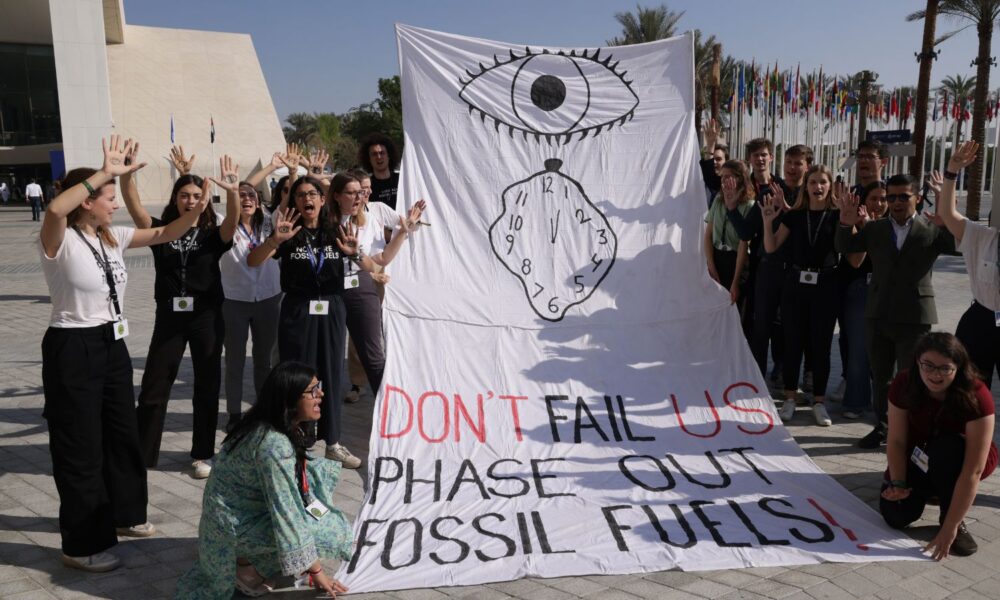

For decades, global climate negotiations have revolved around heat-trapping emissions, including how fast they rise, when they peak, and how sharply they fall. Beneath those numbers is a more fundamental question that world leaders have faced massive political and economic pressure to avoid: How can the world transition away from its toxic dependence on fossil fuels, which are the primary source of the emissions driving global climate change? This is exactly what will be discussed next week in Santa Marta, Colombia.
The science is clear that continued business-as-usual fossil fuel production and use is totally incompatible with a livable climate. The impacts of prolonged fossil fuel dependence have led to daily realities of deadly heat, intensifying floods, worsening wildfires, rising seas, deepening public health harms, water scarcity, and environmental degradation. Many of us have felt these changes personally. And yet, even as governments acknowledge the urgency of the climate crisis, the political system has struggled to say plainly what many people have known and the science demands: fossil fuels must be phased out.
Despite the science, international climate talks have struggled to directly address the role of fossil fuels, like coal, oil, and gas. At COP28 in 2023, nations for the first time agreed on transitioning away from fossil fuels but since then have struggled to implement that hard-won consensus. The most recent round of global climate negotiations, COP30, ended without agreement on a roadmap for transitioning away from fossil fuels.
Some governments chose not to treat that omission as acceptable. A group of countries, led by Colombia and the Netherlands, stepped forward to create a separate international space, complementing but explicitly not meant to replace the United Nations Framework Convention on Climate Change (UNFCCC), focused explicitly on sharing practical measures on how to move away from fossil fuels. (Here’s a description on what the conference is about, and not about). After decades of delay and political obstruction, this decision reflects a shift toward confronting the economic, social, and legal realities of fossil fuel dependence head on, and signals that leadership is emerging and progress is possible in different venues.
At the same time, COP30 President André Corrêa do Lago has also launched a process to create a Roadmap for Transitioning Away from Fossil Fuels in a Just, Orderly and Equitable Manner and opened a process to solicit input from all parties on this. At the upcoming UNFCCC intersessional talks in June leading up to COP31, it will be critical to find avenues of progress toward an agreement on this contentious issue. The Santa Marta conference could provide valuable practical insights for that purpose.
From avoidance to acknowledgment and back again
For much of the history of the United Nations (UN) climate talks known as COP, countries have failed to address fossil fuels explicitly. Negotiators focused on emissions targets and temperature goals while sidestepping the sources of those emissions. This avoidance was by design. Coal, oil, and gas sit at the center of powerful economic and political interests, and the fossil fuel industry has worked hard to ensure they aren’t directly named or held accountable.
That is why the climate agreement reached in 2023 during Dubai’s COP28 marked a turning point. While fossil fuels had edged into the negotiations a couple years earlier in Glasgow (where for the first time the decision called for a phasedown of coal), Dubai went further. For the first time in nearly three decades of climate negotiations, the outcome text explicitly called for transitioning away from fossil fuels in energy systems. The language was imperfect and lacked firm timelines and full clarity, but it nonetheless represented a clear break from decades of avoidance.
But progress at COP28 also exposed the fragility of consensus-based negotiations. As last year’s COP30 negotiations concluded in Belém, Brazil, the latest text contained no mention of fossil fuels at all. The omission was striking, not because the science had changed, but because more than 80 countries had called for a roadmap to end fossil fuels, yet, political resistance reasserted itself, again.
Fossil Fuel influence at climate talks
The repeated failure to explicitly address fossil fuels in climate agreements reflects the sustained influence of the fossil fuel industry within the climate negotiations themselves including the presence of ExxonMobil’s Darren Woods at the climate talks in Dubai and Shell’s claims to have influenced the Paris agreement. It also reflects the continued failure of Global North countries to provide climate finance to enable lower income countries to make the transition away from fossil fuels in a fair and equitable way.
At COP30 in Belém, more than 1,600 fossil fuel lobbyists were granted access to the talks, making up roughly one in every twenty five attendees. This was the largest concentration of fossil fuel industry representatives ever recorded at a UN climate summit. Industry lobbyists outnumbered the official delegations of nearly every country.
This matters because it shapes what language survives the negotiating process. Proposals that would commit governments to phasing out fossil fuels are routinely weakened or removed, while voluntary and ambiguous formulations remain. When fossil fuels are named at all, as they were in Dubai, the pushback is immediate and well coordinated.
The result is a persistent mismatch between climate science, finance, and climate action. The science calls for a rapid and managed decline in fossil fuel production coupled with a just, funded transition. The negotiations, influenced by those with a financial stake in delay, struggle even to say the words.
When consensus fails, leadership matters
The UNFCCC’s consensus-based approach is vital to ensure that every country—no matter how small or large—has a voice in global climate agreements. Unfortunately, fossil fuel entities and some countries also have a track record of using that as a cover to dilute or obstruct ambitious outcomes.
As the COP30 text dropped, the governments of Colombia and the Netherlands announced that they would co-host the first International Conference on the Just Transition Away from Fossil Fuels, to be held in April 2026 in Santa Marta, Colombia. The announcement was a clear statement that there are governments are no longer willing to compromise ambition at the expense of people around the world.
History shows that this kind of leadership is often how change happens. When multilateral forums stall, smaller groups of committed governments have stepped in to redefine what is possible. These efforts do not replace established intergovernmental processes. They create pressure, ideas, and political space that eventually reshape them.
By initiating a process focused explicitly on fossil fuel phaseout, Colombia and the Netherlands are responding to long standing calls from frontline communities, Indigenous peoples, climate vulnerable nations, and experts who have argued that climate action must confront fossil fuel production itself, not only emissions at the tailpipe or smokestack.
What this conference is designed to do
The first International Conference on the Transition Away from Fossil Fuels is intended to move the global conversation from recognition to implementation. Its purpose is to develop practical pathways for ending fossil fuel expansion and managing a fair and orderly transition away from fossil fuels.
The conference is structured to address gaps that have remained unresolved in global climate talks. Over several days, participants will engage directly with the technical, economic, fiscal, labor, governance challenges of fossil fuel decline, and opportunities for transitioning to clean energy. This includes how to manage public revenues and jobs in fossil fuel dependent economies, how to expand access to clean and affordable energy, and how to halt new fossil fuel projects while addressing existing harms.
The meeting is also oriented toward shared outcomes. Participants are working toward the foundations of a global roadmap for fossil fuel phaseout, alongside principles and financing frameworks for a just transition.
Equally important is how the conference is organized. Scientists, workers, subnational governments, Indigenous and Afro descendant communities, and civil society are all part of the process, ensuring that transition pathways are informed by evidence, lived experience, and public participation.
The conference represents the first giant step in an effort to turn fossil fuel phaseout from a contested demand into a coordinated global project, grounded in responsibility, fairness, and shared leadership.
What a fast, fair fossil fuel phaseout really means
A fossil fuel phaseout is often misrepresented by fossil fuel interests as an abrupt shutdown or an unrealistic ideal. In practice, it is a structured process that is already underway.
Phaseout means a rapid and sustained decline in the production and use of coal, oil, and gas, with the goal of reaching near-zero use. While some limited applications may remain difficult to eliminate entirely, most fossil fuel use can, and must, be replaced through direct electrification, renewable energy, efficiency, energy storage, and demand-side solutions.
Fast means acting on responsible timelines consistent with climate science and technological feasibility, prioritizing deep emissions cuts in this decade rather than deferring action. Technologies needed to drive these reductions already exist and are increasingly cost-competitive and more efficient.
Fair means centering people. It requires addressing the disproportionate pollution burdens borne by low-income communities and communities of color, supporting workers and regions affected by the transition, and ensuring universal and democratic access to affordable, reliable, and clean energy. It also means that wealthy nations and fossil fuel producers, which bear the greatest historical responsibility for emissions, must move first and provide financial support to enable transitions elsewhere.
A just phaseout does not rely on unproven or marginal solutions to excuse continued fossil fuel expansion. While technologies like carbon capture or carbon removal can play limited roles, they cannot reduce environmental injustices and public health harms of fossil fuels and are not substitutes for immediate and sharp reductions in fossil fuel production and use.
Achieving a just fossil fuel phaseout is requires more than a technological shift
Moving away from fossil fuels requires a coordinated process that combines proven clean energy solutions, deliberate planning, and sustained public investment to ensure that people and communities benefit rather than bear the costs of change. Many studies show that a rapid shift to clean energy is good for the economy and public health, even as it helps address the climate crisis. Fossil fuel price volatility is also a significant challenge for people’s pocketbooks, especially for those with the lowest incomes. Meanwhile, renewable energy resources like wind and solar, coupled with battery storage, are quickly becoming the cheapest sources of new power in most places across the world.
But technology alone does not deliver a just transition. Phasing out fossil fuels affects real people whose livelihoods and community services have long been tied to extraction and combustion. That is why a fast and fair phaseout requires proactive policies to support workers and communities before disruption occurs. Evidence-based transition plans include wage replacement, continued health coverage, pension protections, retraining, and job placement assistance for displaced workers. These investments are modest compared to the overall cost of the energy transition and are essential to ensuring that workers who powered the economy for generations are not left behind. Communities also need targeted support to diversify their economies, stabilize public budgets, and plan for a future beyond fossil fuels.
A just transition to clean energy also needs to ensure that the benefits reach everyone, especially the most vulnerable communities. Renewable energy can reduce energy costs and pollution overall, but without intentional design, they risk reproducing existing inequities. When designing a roadmap we must ensure that Black, Brown, Indigenous, immigrant, and low-income communities have full access to the new jobs, economic development, and entrepreneurship initiatives that accelerated commitments to clean energy will yield. While renewable energy will likely lower costs overall, low- and moderate-income households should be particularly supported in accessing clean energy technologies and reducing their energy burdens. And through it all, frontline communities directly affected by changes in energy policy and practice should have power in decision-making processes.
Drawing the roadmap
The fight for a fossil fuel phaseout is, at its core, a fight for honesty and a question of political will. Honesty about what is driving climate change. Honesty about who bears its costs. And honesty about what it will take to build a safer, healthier, and more just world.
The absence of fossil fuels from COP30’s text is a reminder that progress is not guaranteed and powerful interests don’t give up easily. But the leadership shown by countries stepping forward, and by communities demanding change, makes clear that silence is no longer acceptable.
A global phaseout of fossil fuels is necessary and achievable. The task now is to accelerate it—fairly, deliberately, and together—and to ensure that the roadmap we build leaves no one behind.