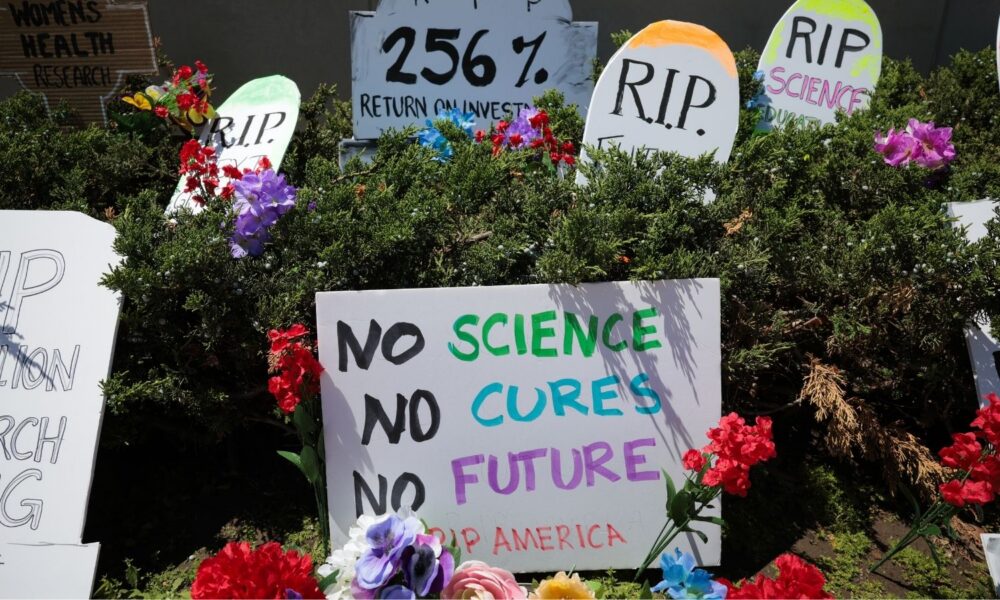

September is early-career scientists and experts’ month! It’s a time for us to celebrate the curiosity, ideas, and expertise that the next generation of scientists and experts bring to their fields, and their communities. Starting a new career as a scientist should be a time filled with possibility… new questions to pursue, and new skills and expertise to build.
But this year, it would be disingenuous to celebrate without also acknowledging the uncertainty many early-career experts are facing. Over the past year and a half, thousands of federally funded research grants have been terminated or frozen, some universities have reduced or paused some Ph.D. admissions, some labs have undergone indefinite hiring freezes, and research in politically targeted areas has faced increased restriction and scrutiny. The National Science Foundation is on track to award its fewest research grants in over 40 years. This is limiting opportunities for early-career scientists especially.
This isn’t normal
The scientific enterprise once seemed unstoppable. The past several decades have shown consistent growth and discovery across medicine, technology, climate science, public health, space exploration, and countless other fields. We’ve been able to map the human genome, develop vaccines in record time, dramatically improve weather forecasting, and build technologies that once only belonged in science fiction. None of this progress happened overnight: it was made possible by generations of scientists and technical experts, sustained public investment, strong and well-resourced scientific institutions, and a scientific ecosystem that allowed new experts to learn, experiment, and eventually, lead.
For an expert who is already established in their field, these disruptions can be devastating. For an early-career expert trying to enter their field, these disruptions can change whether the opportunity exists at all. When we dismantle the systems that make scientific progress possible, we aren’t just cutting today’s research, we’re disrupting how tomorrow’s experts become experts.
Science can’t afford to lose its next generation
Unfortunately, we’re already seeing signs of what that disruption could mean. A study published over the summer examining how early-career researchers are responding to federal science funding disruptions found widespread concern about what comes next. Among the 30 researchers that were surveyed, 90% of them were concerned about long-term job prospects, more than 50% of them were considering leaving academic research, and about 60% were considering pursuing research opportunities outside of the United States. They described interrupted research, uncertainty about completing their work, and concerns about whether the careers they had spent so many years training for would still exist in the near future.
While this was a small study and isn’t representative of all early-career researchers, the experiences captured illustrate a bigger risk: a funding cut that happens today doesn’t just affect what research gets done today. It can shape who stays in science, who leaves, and who gets the chance to become one of the experts we depend on years from now.
Stay with me—this isn’t meant to be a grim piece. Science and scientists have faced political interference, funding threats, censorship, and efforts to sideline scientific evidence before. But scientists and technical experts haven’t simply stood by and watched it happen. They have organized with their colleagues, spoken publicly, worked alongside communities, engaged decisionmakers, defended threatened programs and institutions, and used their expertise to push for change.
These efforts don’t always produce immediate wins, and they haven’t made every threat disappear. But history gives us plenty of reminders that the trajectory of science isn’t always predetermined. Policies can change. Funding can be restored. And when scientists join their expertise with collective action, they can help shape what happens next.
We don’t have to look too far for examples
We’ve seen what progress we can make when scientists and experts act together. In 2025, more than 3,300 scientists and experts signed a UCS-organized letter calling for NOAA’s staffing, funding, and scientific independence to be protected. After sustained pressure from UCS and other groups, the Trump administration backed away from threats to close NOAA’s regional climate centers.
We have seen scientists turn communication into action, too. Last year, about 200 scientists (including grad students, senior professors, broadcast meteorologists, and UCS Climate Fellow Dr. Marc Alessi) participated in a 100-hour livestream explaining what weather and climate scientists do and why federal funding for their work matters. More than 180,000 people tuned into the livestream, generating more than 15,000 calls to Congress.
Direct pressure on decisionmakers can also be an effective strategy. In July 2025, as the administration slowed the disbursement of congressionally appropriated NIH funding, a group of 14 senators urged the Office of Management and Budget (OMB) to release the funds. Days later, OMB directed NIH to pause the issuing of research grants, contracts, and training awards. After pushback from members of Congress and patient advocacy groups, the administration reversed the pause later that same day.
So, what does this moment call for?
Political priorities can change. Harmful policies can be challenged, delayed, reversed, or replaced. Funding can return. Institutions can recover. But waiting for better conditions isn’t the strategy to get us there. Some of the damage being done to science now can outlast the policies that caused it. What we do now matters more than ever.
The is no one right way to advocate, and different moments call for different tactics. Sometimes progress comes through relationships with decisionmakers, educating the public, community engagement, or organizing your fellow experts. Other moments may call for greater urgency and pressure from the public. Peaceful demonstrations, coordinated days of action, and other forms of non-violent direct action can draw attention to an issue, create pressure, and make it harder to ignore what’s at stake. If traditional approaches to advocacy aren’t moving those with the power to act, we shouldn’t be afraid to ask if other forms of collective pressure might.
Of course, not everyone can (or should) take on the same level of risk. For some early-career experts, speaking publicly could have real consequences. You may be trying to protect a new or precarious position, dependent on a particular institution or supervisor for funding, navigating an immigration process, or facing other circumstances that make visibility feel especially risky. Those realities matter. Understand the potential risks, and choose the forms of advocacy that feel right for you.
But that also means those who have more flexibility to speak and act can use it. If your position is relatively secure, you have institutional support, or you simply feel comfortable taking a more visible role, consider where you might stretch beyond what you’ve done before. That could mean speaking publicly, organizing colleagues, attending a demonstration, or participating in peaceful actions when it is strategic and safe to do so.
Find your lane
If you’re early in your career, you may not feel like the most powerful person in your institution or your field. You might not have tenure, a large professional network, or a title that gets you invited into every room where decisions are made. But that doesn’t mean you don’t have power. You have expertise. You have a story about what this moment is doing to the future of your field. You have colleagues, communities, professional networks, and people who care about the same things you do.
The researchers in the 2026 study mentioned above were already finding their own ways to respond. Some contacted their elected representatives. Some participated in protests or organized events. Others focused on educating the public, talking with their professional networks, or simply learning how to become better advocates. The important thing is finding your lane—and knowing you don’t have to stand in it alone.
Early career scientists and experts have a major stake in what that future becomes. You shouldn’t have to spend the beginning of your career fighting to preserve the opportunities that allowed generations before you to build theirs. But you also don’t have to simply watch those opportunities disappear.
Whatever your lane looks like, there is a place for you in shaping what comes next.