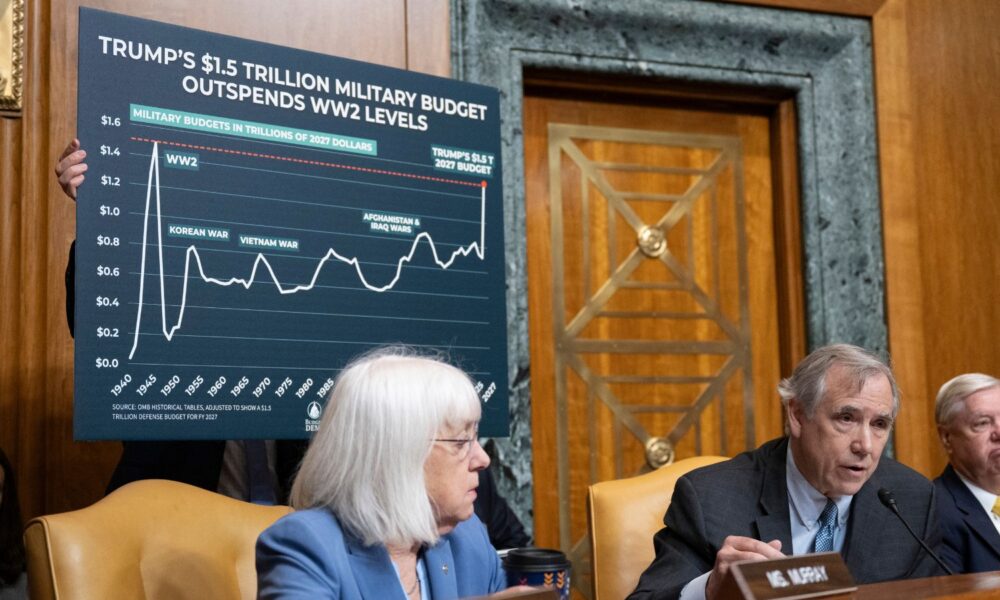

As part of the annual federal budget cycle, members of the Trump administration appeared before House and Senate budget committees during April to present the President’s budget request for fiscal year 2027. As it proposed in FY26, the White House intends to decimate non-defense spending by 10% from last year’s Congressional appropriation, while requesting a 47% increase for the Pentagon.
Agencies and programs supporting science would be particularly hard hit. In the proposed budget:
- The National Oceanic and Atmospheric Administration would be reduced by 28%, and its research lab and cooperative institutes would be eliminated;
- More than 50 NASA science missions would be cancelled, including most of the agency’s atmospheric sciences and space weather research, and its science budget reduced by 42%;
- The National Science Foundation’s science and research are reduced by 53%;
- The Environmental Protection Agency’s overall budget is cut by 52%;
- The National Institute of Standards and Technology is cut by 54%;
- The US Geological Survey’s by 37%;
- The Department of Energy’s Office of Energy Efficiency and Renewable Energy would be eliminated;
- The HHS agency supporting transformative biomedical and health research would be cut by 37%; and
- The US Department of Agriculture’s institute for agriculture-related science is facing a reduction of 38%.
The proposed cuts, and the administration’s ongoing assault on science, have ramifications far beyond harming federal programs and their workforce. Last year, nearly $30B in grants from the NIH, NSF, and EPA alone were delayed or terminated. Combined with other threats to universities for “woke programs,” mass student visa revocations, and a misinformation campaign over pressing research topics such as climate, infectious diseases, and gender health, higher education is seeing lower student enrollment, a brain drain of scientists, and the shutdown of vital research studies. And this sudden cancelling of research grants has disproportionately affected women, minorities, and early-career investigators.
The administration’s weak justification that their proposed cuts in discretionary programs are critical to managing the nation’s debt is a non-starter; the proposed savings from federal research and development ($33.7B of $73B for all domestic discretionary cuts) pales in comparison to the $445B increase for the Department of Defense.
The federal budget calendar
The federal fiscal year starts October 1 and ends September 30 the following year. But well before this, agencies begin assembling their desired budgets. They include funds to maintain daily operations and maintenance, research, and staffing, as well as selective initiatives for new programs. In addition, agencies request resources for large capital expenses such as research vessels, satellites, and laboratories. A significant portion of the budgets for federal science agencies are dispersed to universities, states and communities, and private businesses for R&D or projects to improve public health, safety, prosperity, and well-being. For example, over 80% of the NIH budget is awarded in grants for external institutions.
These budgets are submitted in the previous calendar year to the White House Office of Management and Budget (OMB), who uses them to prepare a budget proposal based on the administration’s policies and priorities that the President submits to Congress, typically early in the calendar year. The FY27 version was released in April.
As the US Constitution gives it the “power of the purse,” Congress has the exclusive authority to authorize spending. It holds hearings to review and subsequently “markup” or amend the President’s budget, aggregating the appropriations into 12 spending bills. This is what is currently happening in Congress.
They must budget for mandatory spending required by law, such as Social Security, Medicare, and veterans’ benefits; interest on the national debt; and discretionary spending. This last category is where the greatest contention arises about balancing the budget versus growing the debt, taxes versus expenditures, defense versus non-defense spending, and funding “kitchen table” issues. Individual members insert “earmarks” that direct federal funds to special projects or localities. Importantly, this is the step where Congress decided not to implement many of the administration’s proposed cuts to science and research in FY26.
During this budget resolution process, the House and Senate ultimately agree upon and pass the joint spending bills, which are sent to the President for signature or veto. Once funding is enacted, OMB allocates funds to agencies for their budget execution. All this is to be done under the review and audit of the Government Accountability Office and independent agency Inspectors General (although notably the Trump administration has illegally fired many of them). Although the law sets a specific calendar for each step in the budget process, including its passage before October 1, Congress often misses these deadlines, requiring a continuing resolution or CR to keep the government operating. Failure to do so may result in a partial or total government shutdown.
The FY27 budget hearings
The first round of hearings on the President’s FY27 budget request with the House (4/15/26) and Senate (4/16/26) Budget Committees included testimony from OMB Director Russell Vought. Not coincidentally, much of his language was lifted directly from Project 2025. There was no effort to inform Congress or address their questions or concerns. Instead, Vought hyped the greatness of the administration; avoided transparency; claimed they are rooting out waste, fraud, and abuse; deflected, denied, and misled; became combative when pressed for details; and blamed previous President Joe Biden. As though that weren’t enough, Vought avoided specifics and refused to answer questions about ongoing expenses, supplementals, and deficit projections. When challenged about delaying, impounding, or repurposing FY26 funds already appropriated, he denied the administration did it, claimed that what they did was within the law, or noted that they wrote a memo stating that the law was unconstitutional. Other Trump officials appearing at subsequent department and agency budget hearings took the same evasive, pugnacious, and mendacious approach.
Science was not a dominant theme of the hearings, although specific programs that protect public safety, human health, the economy, and the environment received bipartisan support. Congress justified investments in R&D as a means to maintain “America’s competitive edge” and “support everyday Americans”. Members are acutely aware of the importance of the science agencies, programs, and staff in their communities, and often cited issues or programs impacting their own state or district. Many also recognize the importance of maintaining the US as a world leader in basic research and innovation. In their questioning, senators and representatives on both sides of the aisle pressed administration officials about the effects of budget cuts on a variety of science-based topics, including preventing and treating disease; wildfire fighting and severe weather warnings; environmental monitoring and offshore wind development; and AI. Here are some key takeaways from the April budget hearings and the initial House appropriation bills.
The administration’s playbook is Project 2025
Much of the text in the FY27 budget is lifted directly from the Project 2025 mandate. Both refer repeatedly to “failed leadership of the Biden administration”, ending the Green New Deal, eliminating “wasteful and ineffective spending”, and “fraud, waste, and abuse in foreign assistance funding”. They attack science for its so-called “radical climate agenda” and “woke activities.” And the recommended actions and cuts in President Trump’s budget mirror those suggested in Project 2025. Independent science advisory boards must be reset; green subsidies for infrastructure and energy-efficient appliances ended. Climate science funding is eliminated. Data collection and observing systems, the task of agencies like NOAA and the EPA, should be moved to the private sector. Federal functions and coordination should be transitioned to states, and research to universities, without additional capacity, and administrative offices and research labs dispersed from Washington, DC.
Specifically, Project 2025 directs the government to dismantle NOAA, reorganize and streamline EPA, consolidate NSF, and eliminate DOI and DOE energy efficiency and renewable energy programs. It calls for the “management” of national forests through increased timber harvests and consolidating and streamlining the regulatory oversight of the Endangered Species Act and Marine Mammal Protection Act. All of these are included in the FY27 budget narrative or have been accomplished in recent months through OMB-directed shifts and freezes in funding. But this goes far beyond appropriations and budget cuts. From these hearings, it is clear this administration desires to implement Project 2025 with minimal Congressional approval or oversight.
Watch what they do, not what they say
In both its FY26 and FY27 proposed budgets the Trump administration has shown it is willing to run through constitutional and congressionally mandated guardrails, and to ignore or misinterpret the law. It has impounded or dragged its feet in executing appropriated funds. For example, through the end of March, NOAA has executed only 718 grant actions, compared to 2696 for the same time last year. The administration attempted to dismantle NCAR, in part because it “informs regulations on emissions that the administration does not support.” And it abruptly fired the entire NSF National Science Board without cause in April. Many of their destructive actions have been reversed, but only after they were challenged in court. We can expect this behavior to continue in future budget cycles.
The power of the purse abides
Congress takes their constitutional authority over government spending seriously. There is true bipartisan pushback in the budget review and markup process. Initial House markups for most science agencies are similar to their FY26 funding levels, and the Senate is generally even more charitable toward R&D budgets.
The May House markup restores a little over half of the proposed cut to NSF. NASA exploration gets a $1.1B increase compared with 2026, but its science funding would still be cut by $1.25B (vs the $3.3B President’s request). Congress also is protecting several science missions proposed for cancellation and is reining in attempts to shift crewed deep space exploration to commercial providers. Over 90% of NOAA research funds have been restored in their markup.
Resistance is NOT futile: you have a role
Because of the science that our federal agencies conduct and support, lives are saved, property is protected, businesses are vibrant, communities are safer, and ecosystems are healthier. But the proposed cuts to the federal budget threaten these benefits, and the consequences are long-term. The loss of skilled researchers and their programs and institutional knowledge will be lasting.
While Republicans were not as vocal or critical in the budget hearings as their minority counterparts, both parties understand the significance of federal science to our nation and will—as in 2025—defend it against White House attacks. They have staved off much of the proposed degradation to science, but there’s hardly a science-forward atmosphere on the Hill, and we can fully expect the administration will try to slash science again for as long as they are in power. There is still much to be done to repair the DOGE damage to our nation’s science capacity, and to sustain and accelerate funding for critical existing and new R&D programs. Here are some things you can do.
Contact your elected officials
Call or message your representatives and remind them about how you and your community rely on federal science agencies and the work they do and fund. Ask them to fight for the necessary funding for research and to support legislation like the Scientific Integrity Act that protects science independence. Don’t forget to talk to your state, county, and municipal officials as well; their actions have an impact, and trickle up to the federal level.
Engage locally
Contact your local news media; ask them to report on how this administration’s actions harm science and how it will impact your community. Share your story as a scientist or how their work benefits you through LTEs and commentaries, and on social media. Attend local council and board meetings to voice your support for local research labs, offices, and universities, and the federal resources they depend upon.
Support scientific organizations
Many professional organizations and science advocacy groups, such as UCS, are speaking out and urging Congress to reject the administration’s harmful cuts and actions against science. Sign their letters and petitions.
Stay informed about the budget
Follow Congressional budget deliberations and actions, and make sure your representatives act to support and adequately fund science. You can track the status of federal science budgets. Here are the schedules for upcoming House markups and Senate appropriations.
Think long-term
Project 2025 set the stage for this administration’s remaking of our government. Our nation needs a new vision, one prepared with and backed by thought and logic, to repair the damage it has caused. We must start thinking about an alternative to Project 2025 that will advise the next administration, including how it will restore science to its proper critical place in society. How will those engaged in and benefiting from science inform future executive and legislative branches? What will your role be in designing and creating the future of science? Now is the time to begin these conversations with your colleagues and science supporters. It will be up to us to work collectively and thoughtfully to not only rebuild but build back better a federal science enterprise that benefits our health, safety, security, and well-being.