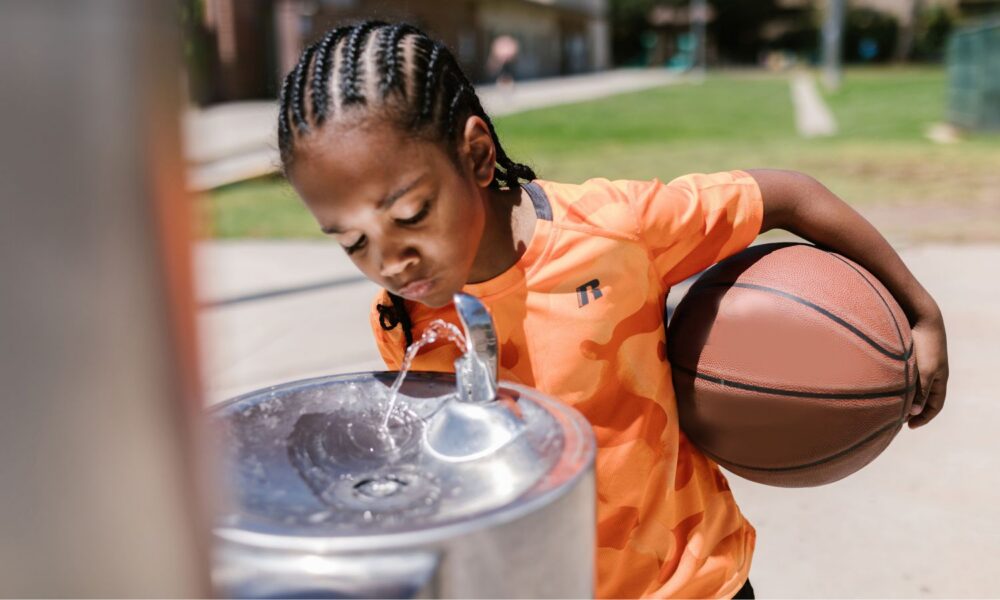

Today is Children’s Environmental Health Day: a day dedicated to raising awareness and bringing people together to create a “healthier, safer, and more equitable world for all children—where fewer children suffer from preventable health issues.”
Environmental health researchers like me often think about how exposures to different toxic substances and chemicals impact groups of people differently, including what we call “sensitive populations,” like kids, who may be more susceptible to harm. Kids are not just small adults. Their bodies are different: they grow rapidly, and they breathe faster, eat more food, and drink more water relative to their body weights than adults. They also interact with the world differently, by playing in dirt and dust, and exploring new things by putting them in their mouths. Children also do not get to choose where they live or control their home and school environments.
Taken together, these factors can make children more susceptible to exposure to toxic substances and, as a result, more harm from these exposures. The issues I navigate as a scientist are the same ones I navigate as a parent, while also expecting another child. What is best for my toddler’s and growing baby’s health is a reel constantly running in the back of my mind.
My concern for my children is not unique. Every parent wants to know that the air their child breathes, the water they drink, and the products they are around are safe. That is why we rely on a strong public health system grounded in independent science. When that science is sidelined by the federal government, it becomes harder to identify risks, prevent harm, and protect the families who depend on those safeguards.
President Trump’s empty promises to “Make Our Children Healthy Again”
The White House’s “Make Our Children Healthy Again” (MOCHA) Strategy Report pledges to prioritize children’s health. But the Trump administration’s actions have not only failed to provide substantive actions that safeguard our nation’s kids, but have endangered their health.
In addition to the Trump administration cutting funding for scientific research aimed at understanding and preventing environmental hazards, they also undermined access to and trust in life-saving vaccines, rolled back or delayed environmental protections, and stopped calculating the financial value of the public health benefits of regulations.
For one example, last year the US Environmental Protection Agency (EPA) weakened screening levels for the neurotoxicant lead in soil, as well as the level above which a site will be cleaned up. This means that kids could potentially be exposed to more lead in soil before the government intervenes. I referenced this guideline for my own home when we were tackling lead remediation. Lead exposure harms children’s brains, and there has not been a safe level of exposure demonstrated. However, it is preventable with the right measures and information.
The Trump administration has also sidelined the only federal advisory committee committed to protecting children’s health at the EPA, the Children’s Health Protection Advisory Committee (CHPAC). It is impossible to imagine how the agency will prioritize kids’ health without this network of scientists to advise it.
Science-informed protections for kids
The EPA’s CHPAC is composed of independent experts, including academics, clinicians, and state and Tribal government officials that advise the agency on science and policy matters related to children’s health. The committee was formed nearly 30 years ago following Executive Order 13045, and has provided science-informed guidance to EPA on matters like childhood lead poisoning prevention, asthma disparities, and prenatal chemical exposures, among much more.
For decades the EPA has issued “charge” questions that the committee must address, investigating scientific and policy issues related to protecting children’s health that they summarize for public input, and for agency scientists and leadership to consider and respond to. For example, in 2009, the EPA convened a “School Siting Task Group” within CHPAC that provided recommendations that were then implemented in the agency’s subsequent school siting guidelines. These guidelines urge consideration of environmental health and safety hazards when siting new schools.
But under the Trump administration, CHPAC is not currently operating.
Trump’s EPA has blocked CHPAC from performing its duties to keep kids safe
Earlier this year, several CHPAC members reached the end of their committee terms. In August 2025—ahead of their terms ending—EPA issued a request for nominations for new members, with a goal of filling vacancies by March 1, 2026. But so far, the positions have not been filled, and the committee has not met since August 2025. CHPAC has also yet to receive a charge related to the MOCHA report, which stated that the EPA administrator would direct the committee to “focus on advancing research and communication recommendations that align with the implementation of the MAHA strategy elements.”
No meetings and no charge means no CHPAC mission. And as a result, the EPA is unable to receive or implement advice from the committee to keep kids safe.
Moreover, last year, CHPAC published a “Plastics and Children’s Health Charge Response Letter” documenting the ways in which exposure to plastic pollution can increase the risk of developmental disabilities, birth defects, cancer, and other health harms in children. A majority of the committee members reached the same conclusions regarding the scientific literature on plastics and children’s health. However, one member, an employee of Bayer Crop Science, did not agree with the group’s conclusions and wrote a dissenting letter that contradicted the scientific conclusions of the first letter. This divergence resulted in an unprecedented decision to publish two separate letters—Letter A and Letter B—despite CHPAC operating procedures that urge the committee to “reach consensus on all recommendations wherever possible.” The EPA has yet to respond to these letters or implement any actions to address the risks of plastic pollution (in fact, EPA has rolled back protections, or punted regulations).
Pattern of attacks on independent science advice
CHPAC is one of hundreds of federal advisory committees that have been terminated or disrupted since President Trump began his second term. As of July of this year, federal agencies had terminated nearly 200 federal advisory committees, most of which were in science agencies like EPA and the Department of Health and Human Services (HHS). Many more, including CHPAC, do not have enough members, have been prevented from meeting, or reconstituted with many members who have financial conflicts of interest. Without these committees, federal agencies—many of which are already operating with far fewer staff and resources—do not have access to rigorous, independent science advice that shapes policies that protect public health and our planet.
How we’re fighting back and how you can, too
Last week, UCS co-led a group of more than 70 children’s health organizations and experts, many of whom are former CHPAC members, in sending a letter to EPA Administrator Lee Zeldin and HHS Secretary Robert F. Kennedy calling on the EPA to:
- Set a clear timeline for appointing and convening a “scientifically credible, varied and balanced CHPAC.”
- Provide a written response to the aforementioned plastics letter and associated recommendations.
- Convene EPA leadership and health experts to discuss alignment between CHPAC’s goals and the administration’s children’s health priorities.
UCS is working to support and uplift efforts to convene independent advisory committees and shine a light on what is lost when these committees are silenced. The Trump administration is failing the American public—especially kids—and we must hold elected officials accountable to following through on their promises and protect children from exposure to harmful toxic chemicals.
Get involved by checking out our toolkit for convening independent science advisory committees or share our letter to the Trump administration with your Members of Congress, urging them to call for CHPAC to be allowed to meet with its full membership.