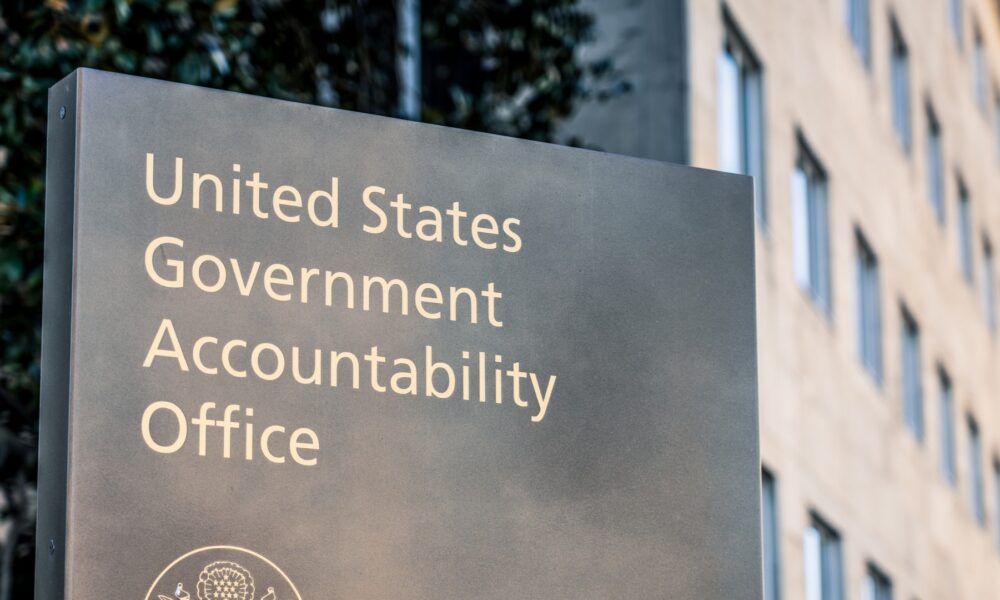

Most Americans have never heard of the US Government Accountability Office (GAO), but this nonpartisan federal agency is part of the legislative branch of government that holds the executive branch accountable. It’s one of Washington’s most trusted watchdogs, and for good reason.
For over a century, the GAO has conducted rigorous, fact-based, and transparent audits and investigations of government programs and agencies to improve government efficiency and expose waste, fraud, and abuse—saving taxpayers billions of dollars every year. GAO’s work has long helped underscore, enforce, and advance scientific integrity across the government and provides a key accountability function for the role of science in federal policy decisions, through its investigations and recommendations for executive branch agencies, especially on scientific integrity issues that involve waste, fraud, and abuse allegations.
I should know because I used to work there and helped compile the receipts to prove it.
Now the GAO is at risk of becoming a lapdog if the lame duck US Senate rams through the nomination of Eric Euland, Russ Vought’s right-hand man and the Trump administration’s choice to serve as the head of the GAO for the next 15 years, without following the established Congressional process.
The GAO helps Congress make science-informed decisions
Congress needs scientists to better understand complex scientific and technical issues. For over two decades they relied on the Office of Technology Assessment (OTA) for this objective advice, but that independent agency was killed in the 1990s by former House Speaker Newt Gingrich. Since then, Congress has increasingly relied on the GAO for science advice and over time tasked it with assessing new technologies.
In 2019 the GAO established a Science, Technology Assessment and Analytics (STAA) team to perform its science-focused work, including providing technical assistance to Congress, evaluating scientific and technology-related programs in the federal government, and establishing an audit innovation lab. Importantly, this group of experts was housed in a nonpartisan agency with broad bipartisan support, a world-renowned methodology for government auditing standards, and dedicated and competent staff who carry out their mission to serve Congress.
From 2021 to 2023, I served on the STAA team as a biological scientist and provided technical guidance and policy advice for Congress on emerging science and technology issues—from NIH biomedical research and regenerative medicine to advanced batteries and generative AI. Working on highly collaborative and dynamic teams with other subject matter experts, I provided Congress and other decisionmakers with federal policy recommendations built on evidence and backed by science.
During my time there, it was clear that the GAO’s robust methodologies and process ensured that the work we did was fact-based, rigorous, thorough, and remained nonpartisan to serve policymakers and the public. That process still matters, and it starts with its leadership at the top—the Comptroller General.
President Trump is trying to hijack the GAO to evade accountability
Remember DOGE, Elon Musk’s so-called “Department of Government Efficiency?” It claimed to provide the same kind of oversight as the GAO but in contrast was operated carelessly and in secrecy by a bunch of amateurs instead of experts. And instead of saving us money, Musk and his operatives ended up costing us a fortune. DOGE wasn’t about efficiency. It was a partisan effort to weaken our federal institutions, hollow out our civil service, and evade accountability for those in power. Musk actually tried to infiltrate the GAO, but GAO officials blocked him. Now, the Trump administration is taking a different approach: installing its own hand-picked nominee to lead the GAO for the next 15 years.
After the retirement of Gene Dodaro, who holds a background in accounting and served at the GAO for 35 years before leading it, the Trump administration is trying to ram through Eric Euland to serve as its personal agent at a time when we need rigorous objective oversight of the executive branch. Euland currently serves as the Deputy Director of the Office of Management and Budget under his close ally Russ Vought. Yes, that Russ Vought—the anti-science bureaucrat who has publicly smeared the GAO and accused it of bias for challenging the administration’s actions for violating the Impoundment Act by withholding Congressionally-appropriated funding. Euland has only ever worked in political roles and lacks a record of impartial leadership on GAO issues, stating as recently as March that his number one priority is to shrink the federal government and its workforce. Birds of a feather, as they say.
If this nomination goes through, it will be DOGE 2.0, only this time the administration would be capturing a legislative branch agency to weaken a critical check on executive power and insulate itself from accountability for years to come. We can’t let that happen.
This is a rushed political installation, not a nomination
The process of nominating Euland has violated the established protocol for selecting a Comptroller General.
According to the GAO, here’s what it should look like: A 10-member commission of senior lawmakers from both parties in the House and Senate is supposed to make a public call for interested parties, who then apply and go through interviews before being recommended by the commission to the president. In 2010, this vetting process took over a year and continued the tradition of being a bipartisan decision.
Here’s what it actually looked like: Last week, members of the commission were apparently given only 24-hours’ notice over a federal holiday to come up with candidates. Then, just six Republican members on the commission sent a letter to the White House recommending three candidates for the nomination.
They are trying to jam this through, undermining Congress’ authority and the public’s right to a transparent process.
The Senate should reject Euland to lead the GAO
On Thursday morning, the Senate Committee on Homeland Security and Governmental Affairs (HSGAC) is scheduled to vote on advancing Eric Euland’s nomination.
We urge Senators to reject this nomination and its threat to science-based decision making and the ability to hold this administration accountable for its harmful and anti-science actions. We also urge Chairman Rand Paul to follow the law and its longstanding, statutory process for recommending and screening candidates for the US Comptroller General.
GAO’s independence is critical to its ability to function and uphold its mission of serving Congress. It’s imperative that nominees for this appointment are chosen in a bipartisan manner and are committed to impartiality. Any nominee who is unable to commit to independence should not be trusted with the GAO’s vital work on the front lines of government spending, auditing, and accountability for the next 15 years.
The GAO is a nonpartisan and independent watchdog agency, and it should stay that way.