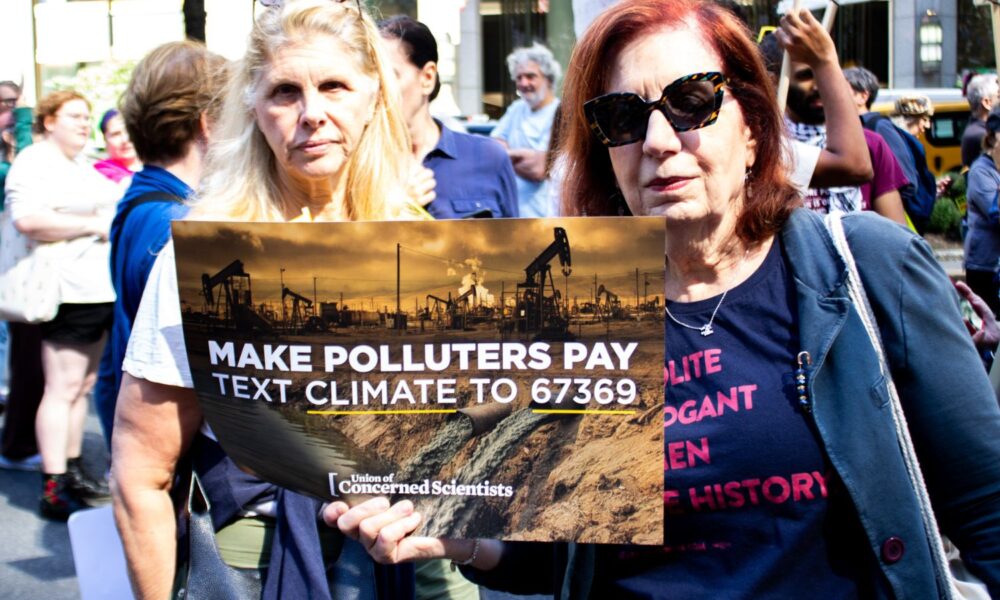

This week, communities across the country are asking their state legislators for a common-sense solution—using a practice that’s been around for decades—to make polluters pay.
In 1980, following decades of high-profile disasters from toxic pollution, Congress passed the Comprehensive Environmental Response, Compensation, and Liability Act (CERCLA), more commonly known as “Superfund.” On a basic level, Superfund mandated that companies that created toxic pollution were responsible for cleaning it up.
So, it’s not surprising, given the inescapability of climate-supercharged extreme weather events, that today state and federal legislatures are working to create a similar mechanism to deal with carbon dioxide pollution and its consequences. In other words, working to make climate polluters pay.
These so-called “Climate Superfund” bills are already law in Vermont (since May 2024) and New York (since December 2024), with several other states, including New Jersey and Maine, considering similar legislation. After catching a whiff of accountability, Republican Attorneys General and the Trump administration moved quickly to challenge these laws in court. Despite this backlash, state representatives continue to introduce new legislation. And on the federal level, Senator Chris Van Hollen and Representatives Jerry Nadler and Judy Chu have repeatedly introduced the Polluters Pay Climate Fund Act, but the odds of the bill being put up for a vote this Congress are arguably zero.
The details of each bill differ, but they share a basic design by:
- Creating a dedicated fund for climate damages;
- Requiring major polluters, in this case fossil fuel producers, to pay into this fund, proportional to their relative contribution of greenhouse gasses to the atmosphere over an established time period (roughly 2000-2019); and
- Using those contributions to fund climate mitigation and/or adaptation.
It’s worth noting that a sometimes overlooked feature of these bills is the inclusion of savings clauses. These provisions make clear that C
Climate Superfund laws are designed to operate alongside existing legal rights and remedies. In practical terms, savings clauses ensure that creating a funding mechanism for climate damages does not limit the ability of states, communities, or individuals to pursue other forms of accountability through the courts.
While legislatures and courts continue to consider these bills, some opposition has relied on misleading claims that do not engage seriously with the underlying science or structure of the legislation. In this post, I am focusing on the science forming the basis of these bills—both the dataset that inventories the contributions of major emitters, and attribution research that quantifies the contribution of climate change and emissions from specific sources to climate impacts.
Fossil fuel producers have contributed an outsized amount to global emissions
Only the largest polluters are subject to Climate Superfund laws. In New York and Vermont’s laws, that translates to companies to which 1 billion metric tons of greenhouse gas emissions can be attributed over an established time period, generally the last two to three decades. This timeframe is key, as it covers a period when many major fossil fuel companies had already understood the dangerous consequences of their products for decades, and during which the companies and their front groups seeded and amplified doubt in the public conversation about climate change.
The best available data to inform these calculations comes from the Carbon Majors dataset, which inventories annual and cumulative carbon dioxide and methane emissions between 1854 and 2024 traced to the world’s largest fossil fuel producers and cement manufacturers. The recently released update of the dataset, which now incorporates emissions data from 2024, shows that half of CO2 emissions that year can be traced to just 32 entities and that 70% of all global fossil fuel and cement emissions since 1854 can be traced to just 178 entities. The entities in the dataset include investor-owned corporations like ExxonMobil and Chevron, state-owned corporations like Saudi Aramco and Petrobras, and several current or former nation states, like China and the former Soviet Union.
The dataset relies on scope analysis, an emissions accounting framework that classifies and quantifies emissions into three categories. Scope 1 includes operational emissions that are owned or controlled by a given entity. Scope 2 includes emissions that come from energy purchased by an entity. Scope 3 includes emissions throughout an entity’s supply chain, which for fossil fuel producers means emissions from the intended use of their products (that is, burning fossil fuels for everyday functions). The Carbon Majors dataset includes both Scope 1 and Scope 3 emissions, the latter of which comprises roughly 90% of the included companies’ total emissions.
Attribution science quantifies the contribution of climate change to extreme events
Attribution science, particularly the subfield of source attribution, is the intellectual backbone of Climate Superfund bills. By comparing climate models with and without human influence, or with and without emissions from specific sources, this type of research identifies and quantifies the contribution of climate change to trends and extreme events and can show how climate change has driven a slow-onset process like sea level rise or increased the frequency or intensity of an extreme event like a major storm.
Source attribution takes this research a step further and quantifies the contribution of specific emission sources, typically companies, countries, or high-income individuals. In the past decade, UCS-led research has shown that roughly 40% of the increase in global mean surface temperature, 55% of ocean acidification, and 37% of total area burned by forest fires in western North America can be attributed to emissions traced to the Carbon Majors.
Attribution science is a robust field of research, as evidenced by the range of peer-reviewed studies that use its methodology and by its inclusion throughout reports produced by the Intergovernmental Panel on Climate Change (IPCC), an authoritative body on the science of climate change (from which the Trump administration recently withdrew the United States from). Their most recent synthesis report explicitly addressed results from attribution science as part of their main findings, noting that climate change is “already affecting many weather and climate extremes in every region across the globe.” The report goes on to describe the pattern of extreme events globally, explores differences region by region, and includes levels of confidence in those conclusions.
While the wording of some Superfund bills, like Vermont’s, suggest a direct role for new attribution research in parsing damages and liability, other bills use attribution as a conceptual framework to support the logic and scientific grounding of the bill.
Make polluters pay
The best available science makes clear that major fossil fuel producers have contributed an outsized amount of carbon pollution to the atmosphere, and Climate Superfund bills are using that science to ensure polluters, not communities, shoulder the costs of this pollution and resulting damages.
This week, January 26th to 30th, marks a national week of action, organized by the Make Polluters Pay campaign, when communities across the country are demanding action from their representatives to make sure that fossil fuel companies pay their fair share of the damage their products have caused.
Join the movement by writing an op-ed, attending a rally, or sharing content on social media to make sure your legislators know that you too support making polluters pay.