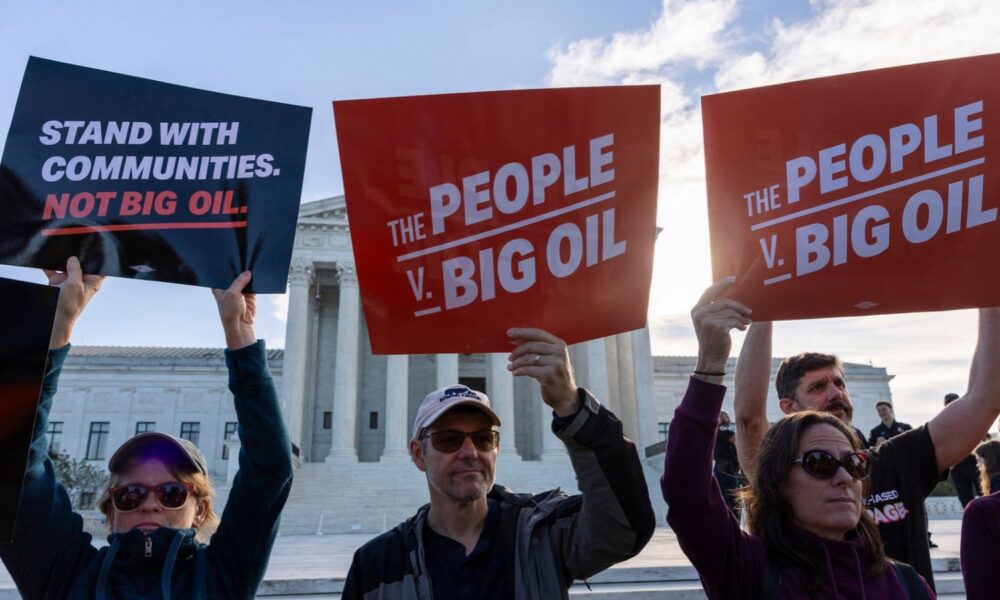

Last week marked a watershed moment for climate accountability in two country’s highest courtrooms. In a landmark decision, the High Court of Australia ruled in favor of climate action in MACH Energy Australia v. Denman. Simultaneously, across the Pacific, the United States Supreme Court convened to hear oral arguments in Suncor Energy (USA) Inc. v. County Commissioners of Boulder County. For those of us working at the intersection of science, law, and policy, this convergence is not a coincidence, but evidence of a maturing field. Since 2015, over 215 climate cases against governments have reached these apex courts, with more than half resulting in outcomes positive for climate action.
Together, these cases illustrate two increasingly important fronts in climate accountability: whether decision-makers must confront the full emissions consequences of fossil fuel extraction, and whether fossil fuel companies can be held responsible for the financial costs of climate harms linked to their conduct. For each of these, scientific evidence is helping define the questions courts can meaningfully answer.
Importantly, the Australian case also holds some lessons for other high courts and shows that courts do have the skills and capacity to grapple with scientific evidence to help make informed decisions for our world.
The Australian victory: Scope 3 emissions and legal duty
The High Court of Australia’s decision is particularly significant because it is the first climate case to reach that nation’s highest court, and the first to acknowledge that all heat-trapping gas emissions, including those from combustion, must be assessed as part of efforts to minimize emissions. The Union of Concerned Scientists intervened in this proceeding to ensure the court had access to the best available science regarding heat-trapping gas emissions and attribution science.
At the heart of the case was the Mount Pleasant coal mine expansion in New South Wales. The Independent Planning Commission had granted development consent, but the New South Wales Court of Appeal subsequently invalidated that consent. The Court of Appeal found that the Commission failed to comply with its statutory duty to consider whether conditions should be imposed to ensure heat-trapping gas emissions were “minimised to the greatest extent practicable.”
The critical issue was Scope 3 emissions—the indirect emissions that occur when the coal extracted from the mine is burned, for example when the product is used as intended. These emissions represent 98% of the project’s total greenhouse gas footprint. The Commission had previously reasoned that because these emissions would be accounted for in the countries where the coal was consumed (under the Paris Agreement), they did not need to consider minimizing them in the approval process.
The High Court, in a 3-2 majority decision, dismissed the mining company’s appeal, upholding the invalidation of the consent. The majority opinion clarified that the statutory requirement to consider minimizing emissions applies to all heat-trapping gas emissions, including Scope 3. A decisionmaker cannot simply defer responsibility to international accounting frameworks; they must actively consider how to minimize the full climate impact of a project to the greatest extent practicable.
This ruling shows courts have the capacity to explore and engage with the complexities of climate science, and that science can inform better, safer decisions.
The US context: liability and preemption
While Australia was deciding a case about permitting and emissions assessment, the US Supreme Court began its new term last Monday hearing a different climate case: Suncor Energy v. Boulder County.
The legal questions addressed in these two cases differ in key ways. Unlike the Australian case, which focused on administrative law and the duty to consider emissions during the approval process, the underlying issue in the Suncor case is a “polluter pays” liability suit based on whether fossil fuel companies misled the public about the risks of their products while knowingly profiting from activities that drive climate change. Local governments in Colorado are seeking compensation from fossil fuel companies for the costs of adapting to climate impacts—wildfires, floods, and heatwaves—alleging that these companies deceived the public about the risks of their products. This is really important to understand: fundamentally this case is about fraud, not emissions.
During oral arguments, some of the justices did not seem focused on the central question before SCOTUS: whether state courts have jurisdiction to hear these claims. The preemption argument advanced by fossil fuel companies rests on a misrepresentation of the case’s subject matter—one that, if accepted, would bar communities from bringing fraud cases in state courts regardless of the merits.
Based on the oral arguments, several justices expressed skepticism toward the oil industry’s position, while others appeared to accept the premise that the case was primarily about reducing emissions. Justice Elena Kagan pressed the industry’s lawyers on where their preemption argument was grounded in law. Justice Sonia Sotomayor noted that the Clean Air Act does not regulate marketing or advertising. Chief Justice John Roberts pointed out that state courts have long allowed people to file suits for injuries occurring in their state. Justice Amy Coney Barrett characterized one of the oil companies’ arguments as “a little slippery.”
Some justices also questioned whether the Supreme Court should even be hearing this case yet. Justice Ketanji Brown Jackson asked why the Court shouldn’t wait for state courts to finish their work before stepping in. These questions suggest the Court may be hesitant to shut the door on climate accountability lawsuits before they’ve had a chance to be heard and adjudicated on the merits.
If these cases move forward, the courts will have the opportunity to examine two distinct bodies of evidence. First, social science research documenting fossil fuel industry deception campaigns. Second, physical climate attribution science. As Jeff Goodell recently wrote in the New York Times, this science has oil companies “running scared” because it can inform questions about foreseeability, causation, and damages. When courts allow these cases to proceed, science can help inform judicial decision-making, like we saw in the Australian case.
Courts as venues for science
While the Australia case did show one way science can help to inform the courts, there is still room for improvement. When I was preparing the Union of Concerned Scientists’ intervention in the Australian case, I was struck by how much the attribution science had advanced between the initial planning commission decision and the High Court hearing. What we can say with confidence in 2026 is far more precise than what was available when the case first entered the court system.
This pattern isn’t unique to Australia. Cases filed by Boulder and other communities and states in the United States have similarly moved through the courts while the underlying science has developed. Methods that connect emissions to specific climate impacts and quantify damages have evolved and improved. Yet our legal processes don’t always have built-in mechanisms to ensure judges have access to the most current science as cases progress.
For scientists, this presents an opportunity. The legal questions being asked—about the minimization of emissions, the foreseeability of harm, and the allocation of costs—are fundamentally scientific questions wrapped in legal doctrine. When courts ask, “Did the decisionmaker consider the full scope of emissions?” or “Can we trace these damages to these actions?”, they are inviting the scientific community to provide the evidence needed to answer them and to help to intervene in cases to ensure the courts have access to the best science.
What comes next?
The outcomes of these cases will ripple far beyond their specific jurisdictions. The High Court of Australia’s ruling on considering Scope 3 emissions sets a powerful precedent for how projects are assessed globally. It informs litigators and policymakers that ignoring the downstream impacts of fossil fuel extraction is not legally tenable.
Now, states and communities across the United States are awaiting the Supreme Court judgment in the Boulder case. But these lawsuits aren’t happening in a vacuum. As fossil fuel companies argue in court that they should be shielded from liability, their allies are simultaneously pushing state legislation to grant the industry blanket immunity—attempting to close courthouse doors through multiple channels.
As Jeff Goodell noted, even an unfavorable ruling on the Boulder case won’t slam the door shut on climate accountability. The science informing these cases remains compelling. The communities seeking resources for damages will continue to fight for justice, and the need for climate accountability will outlast any single decision.