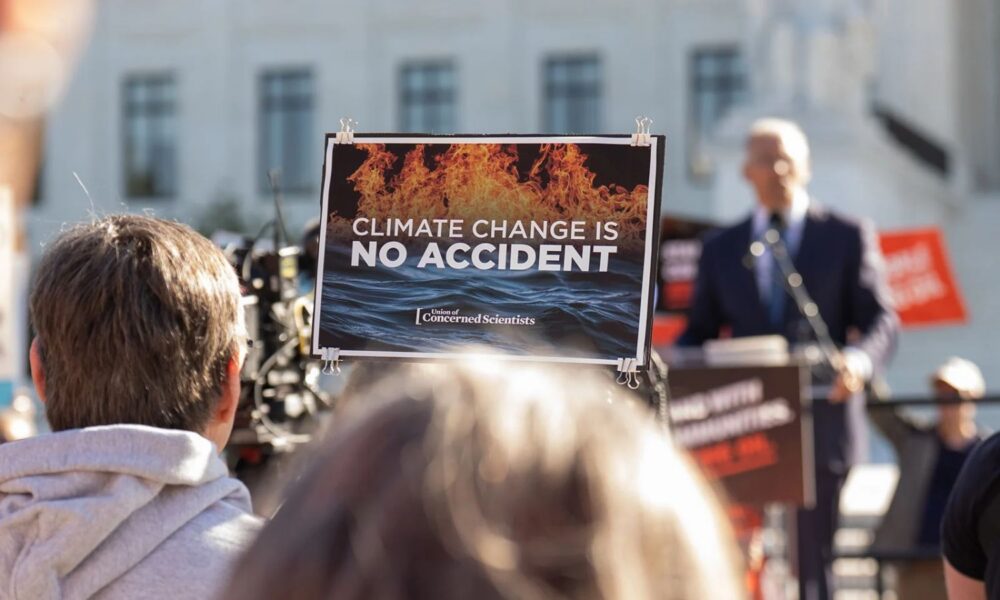

As the US Supreme Court considers Suncor v. Boulder—a key climate accountability case—documents obtained by the Union of Concerned Scientists reveal that some groups involved in the climate disinformation campaign at the heart of Boulder’s lawsuit are shopping legislation to shield the fossil fuel industry from liability.
According to emails obtained through a state open records request, the American Legislative Exchange Council (ALEC) actively recruited sponsors this year for draft legislation that would not only bar future lawsuits against fossil fuel corporations and polluter-pays bills but also nullify ongoing suits representing millions of people harmed by climate change.
The emails show that ALEC representatives contacted nine Utah lawmakers in May and June 2026 to solicit support for three model bills at the organization’s annual meeting, when bills are discussed and approved for circulation to state lawmakers. ALEC is a lobbying group that brings together state lawmakers and companies to draft model legislation that can be introduced in state legislatures across the country. ALEC claims dedication to “principles of limited government, free markets and federalism,” but in practice provides corporations access to the political system. That ALEC reached out to lawmakers in a state where immunity legislation passed only months earlier shows how far the group is willing to go for big oil.
The emails also show that past tactics of the fossil fuel industry—a major ALEC supporter—are still in play. A recent Senate report lays out how decades of disinformation and political obstruction by the fossil fuel industry and its political enablers has culminated in the Trump administration’s attacks on climate science and the legal process. As UCS President Gretchen Goldman testified at a congressional “spotlight” hearing on attacks on science, “the administration is delivering on promises it has made to special interests who profit from the suppression of science—and in the case of climate science, that special interest is the fossil fuel industry.” Concerns about fossil fuel industry influence and conflicts of interest extend to the Supreme Court, where Justice Samuel Alito recused himself from Suncor v. Boulder just a week before oral arguments.
Start in the states: the industry’s current scheme
The emails were sent by fossil fuel apologists and propagandists including Frank Lasee, a former Wisconsin state senator who now helms an organization called Truth in Energy and Climate. Lasee was briefly president of the Heartland Institute, a climate-denier think tank and beneficiary of oil industry funding, but was reportedly let go after one year for tanking the budget. Lasee names Craig Rucker, co-founder of the Committee for a Constructive Tomorrow (CFACT), as his partner in supporting the bills for ALEC. Founded in 1985, CFACT was among the groups named in 1998 by a task force of the American Petroleum Institute—the largest US oil and gas trade association—as a potential “fund allocator” for a disinformation strategy that aimed to sow doubt about the science behind climate change.
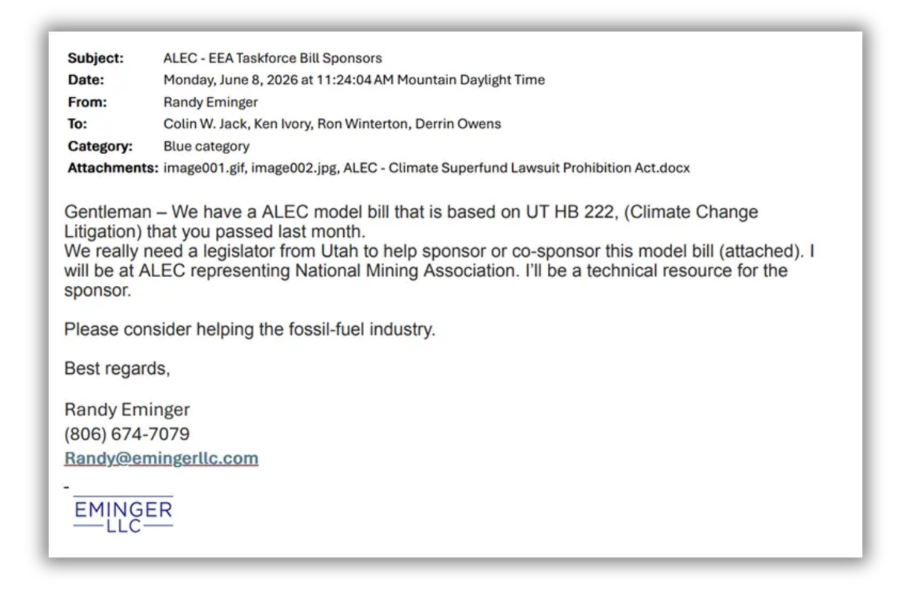
Separate emails were sent by Randy Eminger, a longtime coal industry lobbyist with a history of creating front groups claiming to represent the public. Eminger wrote that he was coordinating with other organizations to pass the bill, concluding with a plea to “consider helping the fossil fuel industry.”
In March, Utah’s governor signed HB222, one of five state bills passed this year preventing litigation against oil and gas companies (bills were also passed in Tennessee, Louisiana, Oklahoma, and Iowa). Where HB222 allowed litigation in the case of regulatory violation, ALEC’s supercharged immunity bill deploys a scorched-earth approach. Among other attacks, the Act would prevent state and local governments from suing oil companies or anyone associated with them; prohibit lawsuits based on state laws such as fraud; block climate superfund laws; stop plaintiffs from collecting liabilities; and force those with adverse rulings to pay the industry’s legal fees. It would also retroactively apply to suits filed years ago.
The two other bills use a similarly punitive strategy. One would prevent any state entity–including cities, counties and schools—from adopting net-zero policies by threatening to withhold their funding. Another would force federal energy regulators and state utilities—including those owned by ratepayers—to adopt pricing schemes benefitting fossil energy companies.
The link to Suncor v. Boulder
It’s pertinent that the lawsuit before the Supreme Court is based on fraud and deception perpetrated by the very groups pushing these measures. The Court is hearing oral arguments in Suncor v. Boulder, a petition by fossil fuel companies named in a 2018 climate accountability lawsuit. That lawsuit, Board of County Commissioners of Boulder County v. Suncor Energy, seeks to hold ExxonMobil and Suncor Energy accountable for concealing and misleading the public about the climate harms of their fossil fuel products while continuing to produce them.
The Colorado Supreme Court ruled in May 2025 that Boulder’s case could move to discovery and proceed toward trial, but defendants asked the US Supreme Court to review that decision. Big Oil has fought for years to keep climate accountability lawsuits from being heard on their merits and unearthing more of its dirty secrets. Those lawsuits are numerous: Climate accountability suits filed by eleven U.S. states, the District of Columbia, two Tribal governments, and dozens of municipal governments are currently making their way through the courts, representing one-fourth of people in the United States.
An amicus brief filed in the Boulder case by UCS and other experts states that defendants “directed substantial financial support to organizations that publicly questioned or rejected the scientific consensus regarding anthropogenic climate change.” For example, ExxonMobil provided at least $37 million to dozens of climate-denial organizations between 1998 and 2019 according to the company’s own grantmaking reports, including CFACT and ALEC (except for Chevron, most major oil companies have left the organization after pressure from investors and advocates).
The empire strikes back at science
Fossil-fuel companies and their political proxies have sought to thwart accountability and intimidate advocates with a barrage of Strategic Lawsuits Against Public Participation (SLAPPs), counter-suits, attacks on climate science and scientists, and legislation like Utah’s that would provide blanket immunity from legal accountability—unheard of for such a large industry. The American Petroleum Institute named immunity as a top 2026 priority, and a ProPublica investigation revealed that immunity bills introduced in a handful of Republican-controlled state houses across the country have stemmed from a network of groups connected to prominent right-wing operative Leonard Leo, including ALEC. At the federal level, Representative Harriet Hageman and Senator Ted Cruz introduced a bill earlier this year essentially immunizing the fossil fuel industry from liability in an attempt to subvert the legal system.
These machinations show the fear that accountability strikes in the fossil fuel industry. Recent polling shows nearly two-thirds of voters oppose shielding oil and gas companies from being held accountable for climate damages, a figure that will likely increase as climate damages mount.
The Supreme Court, Congress, and state legislatures must resist Big Oil’s full-court press to avoid accountability and give Boulder—and others harmed by climate change—their day in court.