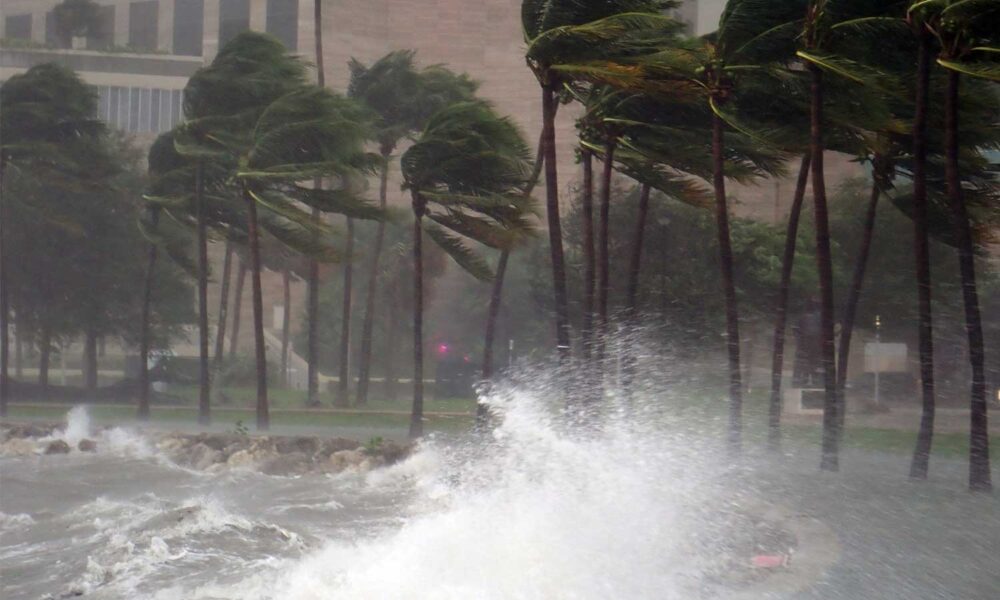

The 2025 Atlantic hurricane season came to an end on November 30, and while no hurricanes made landfall in the United States or its territories, the season was one for the record books.
Three Category 5 hurricanes—the strongest type of hurricane according to the Saffir Simpson Scale—formed, making it only the second year in recorded history we’ve seen at least three Category 5 hurricanes in the Atlantic basin.
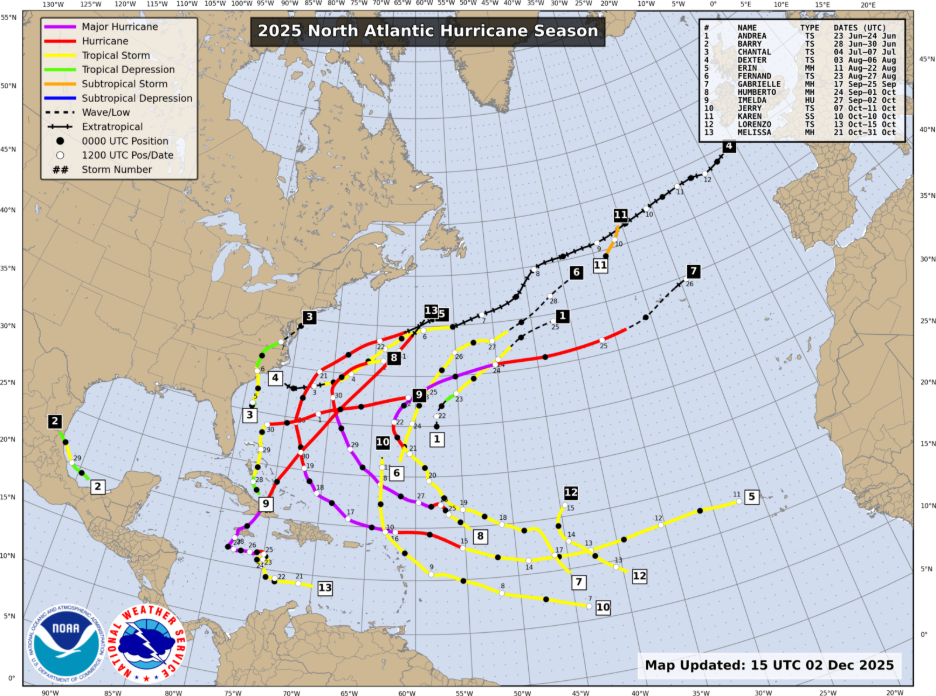
The last hurricane of the season, Hurricane Melissa, was especially powerful. It tied the 1935 Labor Day Hurricane for the third most intense hurricane ever recorded and most intense hurricane ever to make landfall in Atlantic basin history. Perhaps most striking, a dropsonde, a device used to measure pressure and wind inside a hurricane, recorded an official wind gust of 252 mph in Melissa’s eyewall, which is only 1 mph shy of the fastest wind gust ever recorded on Earth (recorded on Barrow Island, Australia during the landfall of Tropical Cyclone Olivia in 1996).
While we saw a historic number of the most powerful type of hurricane in 2025, the season actually ended with fewer hurricanes than normal. Only five hurricanes formed in 2025; in a typical year, we usually observe seven.
So why were there fewer hurricanes than usual in 2025? And why did the hurricanes that did form become so strong? Could 2025 be just an abnormal year in terms of intensity and frequency of hurricanes, or was 2025 a glimpse of future hurricane seasons more significantly influenced by fossil fuel-caused climate change? I break down the answers to these questions in this blog.
Warmer waters, stronger hurricanes
At this point, the influence of fossil fuel-caused climate change in creating more powerful hurricanes is undeniable.
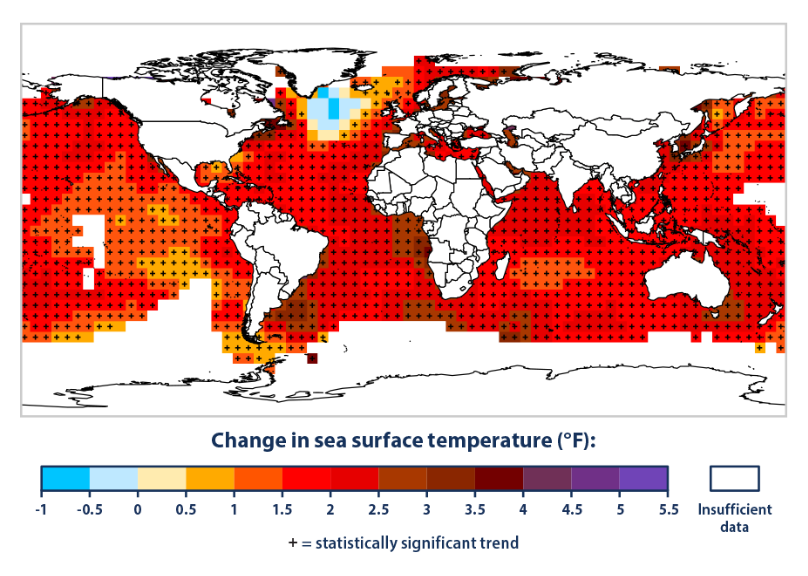
This is mainly because of ocean temperature. The world’s oceans have absorbed more than 90% of the added heat to the climate system from global warming, and this has manifested as warmer sea surface temperatures at nearly every location on Earth (see figure).
Why do ocean temperatures matter for hurricanes? Warm waters act as fuel for hurricanes: the warmer the water, the more fuel a hurricane has to strengthen into a powerful hurricane. Hurricanes are basically massive heat engines: they transport warm water to the cooler upper atmosphere, attempting to establish equilibrium. When the waters are warmer than usual, the temperature difference between the atmosphere and ocean is greater, and the heat engine, or the hurricane, becomes more intense.
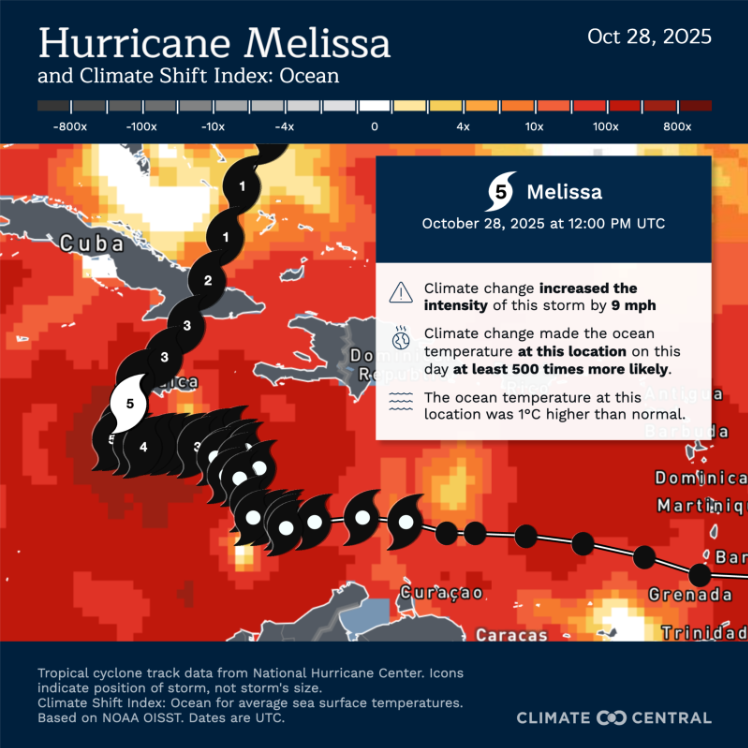
This year, Atlantic Ocean temperatures were significantly warmer than a typical year, which helped Erin, Humberto, and Melissa all strengthen into Category 5 hurricanes. In fact, according to an analysis by Climate Central, fossil fuel-caused climate change made the warmer ocean temperatures beneath Hurricane Melissa 500 to 800 times more likely, which allowed Melissa to become one of the strongest hurricanes on record.
As waters continue to warm due to climate change, hurricanes will be able to tap into that extra fuel to strengthen and become a more destructive storm should it approach land. For decades, scientists have used climate models to predict that hurricanes would become more intense due to warmer waters. But now, not only do we think hurricanes will get more intense, we have also observed this hypothesis to be true. For example, a study in 2020 found that more tropical cyclones (note that hurricanes are a type of tropical cyclone that forms in the Atlantic) globally were becoming major storms (the equivalent of a Category 3-5 hurricane).
The 2025 hurricane season, with its extremely warm waters helping to intensify three hurricanes into Category 5 strength, is undoubtedly a part of this broader fossil fuel-caused climate change trend of more intense hurricanes. Although Hurricane Melissa probably would have been a Category 5 hurricane in a world without climate change, an analysis by Climate Central showed that Hurricane Humberto would have only reached Category 4 strength in a world without human-caused climate change.
Are hurricanes becoming less frequent?
If a hurricane forms, it’s more likely to develop into a powerful hurricane thanks to warmer waters. But what if hurricanes are becoming less frequent to begin with?
Waters are becoming warmer, yes, but hurricanes need other environmental ingredients to be present in order to form. Specifically, a group of storms moving across the Atlantic needs both a moist mid-level atmosphere and low levels of wind shear to develop into a hurricane. The former is self-explanatory: the atmosphere must be moist in order to support hurricane development. The latter, low levels of wind shear, means that hurricanes can only form in areas where there is little change in wind direction and wind speed as you go up in the atmosphere. Having all three of these ingredients (warm water, moist atmosphere, low wind shear) present is actually quite difficult, even during peak hurricane season.
These ingredients are precisely why hurricanes may actually become less frequent in the future. According to multiple climate modeling studies, both wind shear and atmospheric dryness are likely to increase under fossil fuel-caused climate change. Because of this, the tropical environment will become much less conducive to hurricane development. In fact, a recent study found that tropical cyclone frequency has decreased globally over the course of the 20th century due to climate change.
While most modeling studies predict a decrease in hurricane frequency (some predict no change at all), most of them predict an increase in very intense (Category 4 or 5) hurricanes. Why? If environmental conditions do become favorable for hurricane development, a hurricane will form, and it will have an ample fuel supply (from hot waters) to strengthen into a powerful hurricane. So while there may be fewer hurricanes in the future, the ones that do form will become powerful, potentially destructive storms.
Was 2025 a glimpse of future hurricane seasons?
This brings me back to one of my original questions at the start of this blog: was 2025 a glimpse of a future where fossil fuel-caused climate change produces fewer but more intense hurricanes? The number of hurricanes was below average in 2025, yet we had three Category 5 hurricanes, something that has only happened one other year in recorded history, 2005.
We can’t say for sure if the behavior of hurricane frequency in 2025 was due to climate change, but it could be a part of a trend toward fewer—but more intense—hurricanes.
Something important to note is that, while climate change will affect hurricane frequency and intensity, natural variability in our climate system still plays a crucial role in hurricane development. Things like the El Niño oscillation, the Atlantic Multidecadal Oscillation, the West African monsoon, and other features of our climate system, all influence hurricane development in the Atlantic basin.
And while these natural processes are important, long-term trends of hurricane statistics will be important to update and follow in the coming years as fossil fuel-caused climate change continues to worsen, perhaps leading to less frequent and more powerful hurricanes in the long-term average.