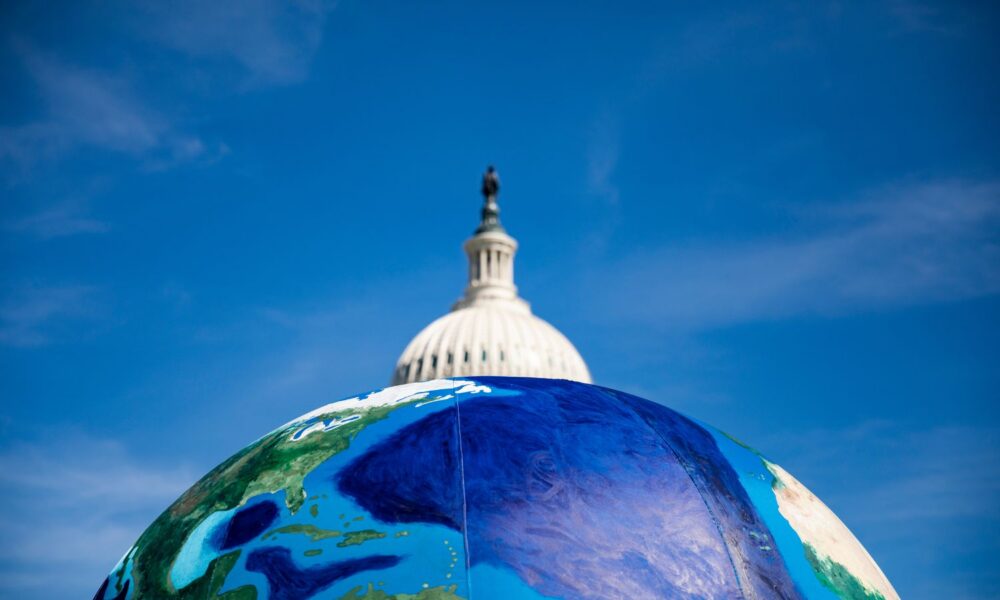

People across the United States voted in record numbers in last week’s incredibly consequential election, which has completely changed the makeup of Congress for its new term beginning in January 2027. The success of our electoral processes—still underway—should not be taken for granted. It’s a win for democracy when millions of citizens peacefully claim their right to a government of, by, and for the people.
Will the Trump administration acknowledge voters’ repudiation of its destructive agenda and work in cooperation with this new Congress? That remains to be seen, and I’m not holding my breath. But there’s no question that the shift in Congress has significant implications for the administration’s ability to continue to ram through its anti-science, authoritarian agenda—including on climate and clean energy issues.
Climate change and clean energy are pocketbook issues
Energy affordability concerns, opposition to proliferating data centers, and anger at corruption and extreme economic inequality were undoubtedly driving forces in how people voted. While not everyone explicitly named climate change as a top issue (although many did put it in their top three), its fingerprints are all over the issues a majority of voters did name in polls.
If you care about addressing the high costs of electricity and gas, then you must reckon with the fact that this current fossil energy crisis, unleashed by the Trump administration’s war against Iran, is an extreme manifestation of the risks of fossil fuel dependence. The benefits of a transition away from fossil fuels to renewable energy—renewable energy that the Trump administration has relentlessly attacked, further driving up costs for consumers— are tremendous. If you are deeply concerned about the rapid, unregulated build-out of data centers, you know that it comes with huge risks for communities related to climate, water, pollution, health and electricity cost burdens. And it’s so clear that the Trump administration’s corruption, lies about climate science, and massive giveaways to fossil fuel polluters are leaving us all bearing the high costs of climate damages while large corporations and the President’s inner circle are raking in enormous profits.

Here’s another reality: regardless of politics, climate change is here, and science shows it’s rapidly worsening with the world’s imminent overshoot of 1.5°C of global warming. Communities are already experiencing deadly and costly climate impacts, including extreme heatwaves, catastrophic wildfires, record-breaking flooding, drought, accelerating sea level rise, intense ocean heat, irreversible loss of glaciers and ice sheets, stresses to critical ecosystems and more. These impacts are showing up in people’s daily lives—harming their health, destroying homes, livelihoods and critical infrastructure, raising insurance premiums, hammering businesses, stressing water supplies, and threatening food security and affordability.
Climate change and clean energy are pocketbook issues. They are a lot more than that, of course. And climate change does not care if you live in a red state or a blue state. (One can ask if that is that even a relevant frame after an election that scrambled all conventional wisdom about “red” and “blue” dichotomies.)
What the 120th Congress can do on climate action
Importantly, we will soon have a Congress where a majority accepts the scientific evidence on climate change. (Yes, I also wish we could take that for granted in 2026, but not in US politics, sadly.) That’s an important start and means we can advocate for policymakers to legislate based on the facts, instead of being stuck fighting disinformation and lies.
Here’s what this seismic “change election” could mean for action on climate change, some cautions about what likely won’t change right away, and what we’ll have to keep fighting for.
- Congress must exercise its authority over budget appropriations. That includes ensuring robust funding for climate science, clean energy and climate resilience, federal agencies including NOAA, FEMA and EPA, data and tools, as well as research grants. Instead of rubber stamping the Trump administration’s harmful budget and staffing cuts, as the last Congress did, it’s time for Congress to stand up for the life-saving science people need and that taxpayers have invested in.
- Congress should get back to legislating to prioritize the public good. It should reverse the Trump administration’s damaging attacks on climate and clean energy policies, including its undermining of investments made through the Bipartisan Infrastructure act and the Inflation Reduction Act and its illegal attacks on offshore wind projects.
- Congress must exercise its oversight authority to hold the Trump administration accountable. It must hold hearings, investigate and gather information on the many attacks on science from the Trump administration—including its mass firings of federal scientists, canceling of science grants, distortion of facts and evidence and the incredible harms that has caused to people’s health, lives, and the economy. A transparent accounting of these destructive actions is a crucial step toward renewal and progress on science and science-based policies, which many scientists and science organizations like UCS are fighting for. Oversight should include examining whether Trump administration officials have violated the law or failed to uphold the mission of the agencies they have been entrusted to lead—and if so, if they should be impeached.
- Congress should halt the Trump administration’s efforts to prop up polluting fossil fuels, including its refusal to implement and enforce health-based pollution standards and outright giveaways to polluting industries. Accelerating US clean energy momentum and rapidly transitioning away from fossil fuels, alongside similar actions from other countries, is essential to limit overshoot of 1.5°C. My colleague Jeff Deyette will have a blogpost soon on how state election outcomes will also help drive forward clean energy progress.
- Congress must help communities reeling from climate-fueled disasters. It must push back on the Trump administration’s attacks on FEMA and ensure that disaster preparedness and recovery are well funded and that FEMA is committed to fulfilling its responsibilities to work alongside states in responding to major disasters. And it’s no longer sufficient to just react to disasters after the fact, when the science is clear that we are living in a dangerously altered climate regime. It’s time for investments in true, proactive climate resilience, available to all communities in an equitable way. Climate resilience must be an integral part of Congressional priorities, to help safeguard people, ecosystems and the economy from rapidly worsening climate realities.
- Congress must hold the fossil fuel industry accountable for its longstanding obstruction of climate action and deception, which are a primary reason that we are in the dire situation we face now. The Trump administration’s continued propagation of fossil fuel industry disinformation must also be held in check by Congress. My colleague Kathy Mulvey will have a blogpost soon on what is urgently needed on this front.
The fight ahead
We will have to keep fighting back in courts to hold the Trump administration accountable for egregiously flouting the law. We’ve already had a major win in lawsuit where the administration was found to be violating the Federal Advisory Committee Act in secretly setting up a ‘Climate Working Group’ stacked with climate contrarians to draft a sham science report which the EPA then used to justify its proposal to gut the Endangerment Finding. We’ve also filed suit against the administration for repealing the Endangerment Finding, contrary to law, science and the public interest.
On the international front, the Trump administration has shamefully exited the bedrock UNFCCC and the Paris Agreement and that won’t change as long as it is in power. As I write from COP31 in Türkiye, the administration’s abandonment of global climate cooperation is very much on my mind; it’s crucial for the rest of the world to forge ahead regardless given the high stakes. There is a real risk that a beleaguered Trump administration will double down on its authoritarian ways and continue to find new ways to disrupt global climate progress and multilateral institutions. But Congress now has the power and responsibility to keep this reckless administration in check and ensure it is held accountable, at home and on the global stage.
“Change elections” come weighted with the hopes and dreams of many. As climate justice advocates, we know that policymakers have pushed off meaningful climate action far too long and those failures are putting us all at profound risk. Yet, deep-pocketed fossil fuel interests, Big Tech, and other powerful entities continue to obstruct and delay action, still hold all too much sway over both parties in Congress, and we can expect their harmful tactics to ratchet up. So now it’s our responsibility to fight for what comes next, to make our shared dreams come true. Because those dreams of a safer, more just world for generations of young people to come must become reality.