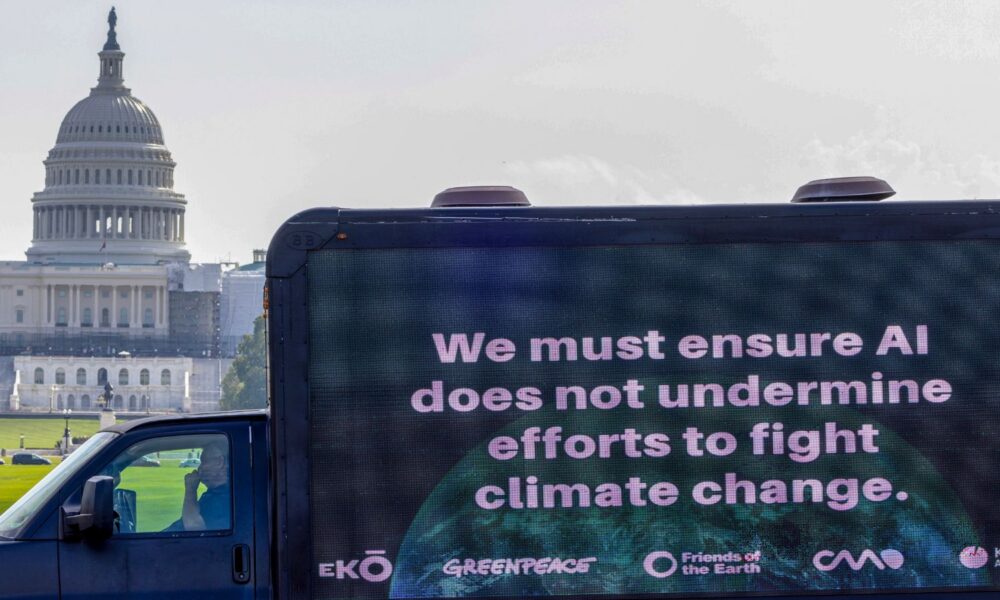

Artificial Intelligence (AI) feels inescapable. Individuals and businesses are looking for ways to leverage this new technology for profit or personal gain. Indeed, it took ChatGPT just five days to reach one million users after its release in late 2022. AI chatbots, like ChatGPT, are supported by massive data centers which consume tremendous amounts of water, electricity, chemicals, and rare earth metals and in return, generate heat, noise, pollution, and maybe a useful response to a user prompt. Not to mention the potential for individual consumers to bear the cascading costs from the associated infrastructure buildout, including that of new and updated electrical infrastructure.
Proponents of AI technology insist that AI will unlock solutions to a broad array of difficult, longstanding problems. In the specific case of climate change, the argument goes something like this: AI has the potential to accelerate global decarbonization, so we should focus resources on expanding data center capacity and enhancing model capability to unlock the decarbonization benefits it will bring. Bill Gates’ memo before COP30 cites AI as one of the key technologies for driving climate solutions. However, with mounting pressure from the US Department of Defense, a growing investment bubble, and warnings from AI companies themselves to not blindly accept the outputs from large language models (LLMs, the engine behind AI chatbots), we must ask ourselves: Is it prudent to depend on AI technology to solve one of our biggest challenges when it is creating and exacerbating so many others? What’s more, can AI even serve to “solve” it?
It is true that we’re past limiting warming to 1.5 degrees Celsius and that the current policies are insufficient to reach global emission reduction targets. But the problems leading to the gap between goals and outcomes are overwhelmingly ones that AI cannot fix. As a result, while AI may aid the development of new solutions, this blog post goes over some of the reasons why AI alone will not solve climate change and, most critically, why even if it could, we cannot afford to wait for hypothetical AI solutions to take climate action.
1. We already have the technology to solve climate change!
The causes of and solutions to climate change have been well understood for decades. Excess carbon dioxide (and other greenhouse gases) released into the atmosphere as a byproduct of our fossil fuel-based energy-hungry society traps heat, warming the planet.
The obvious solution to this problem is to replace our dependence on fossil-fuel energy with clean energy solutions. Fortunately, the falling costs of solar panels and wind turbines have made renewable energy one of the fastest growing energy sources in the world and, despite headwinds, clean energy projects still had a strong year in 2025.
Rather than a lack of technological solutions, climate progress has been primarily delayed by fossil fuel interests and a lack of political will, a dynamic which UCS documented extensively in our report Decades of Deceit.
Climate action also isn’t constrained by lack of information. There is no shortage of white papers or technical analyses. Policy change requires building coalitions, generating public support, and overcoming incumbency. Democracy requires harmonizing a cacophony of discordant voices through negotiation and patience.
On the other hand, relying on LLMs to design policies creates an authoritative illusion for decision-makers to hide behind while dismissing concerns from the public. They can summarize research and generate code, but these are primarily productivity tools, not breakthroughs.
Moreover, as AI systems grow more capable, questions about alignment between strict AI objectives and fuzzy human goals become increasingly important. Additionally, these systems are impenetrable black boxes. An AI system tasked with “solving” climate change would need to navigate delicate tradeoffs between cost, reliability, equity, and emissions: tradeoffs which reflect complex human values about justice and fairness–values that cannot be straightforwardly optimized.
History has shown that when governments commit to large-scale technical challenges, they can mobilize industry and overcome coordination barriers. Consider the Manhattan Project, which developed the first nuclear reactor just three years after fission was officially discovered. Or the Apollo program, which put a man on the moon within a decade of beginning. Or even the international cooperation that is healing the ozone layer. The clean energy transition could be no different—if only the commitment were there.
2. Delay is costly–and climate change is happening now
People are facing the effects of climate change now. Warmer oceans are driving more powerful storms, hotter temperatures and drier conditions are making wildfires worse and longer-lasting, a warmer atmosphere may destabilize the polar vortex leading to massive winter storms, and “danger season” is getting longer and more severe. All these effects cost billions of dollars in damages and thousands of avoidable deaths each year.
For you, dear reader, that means fewer summer days you can enjoy outside because of poor air quality and deadly heat, higher insurance premiums (if you’re fortunate enough to own a home), and higher electricity bills to cool your home. Even if LLMs or some new AI system unlock fusion energy in the next ten years, pollution that happens today guarantees additional warming in the future.
Cumulative carbon emissions drive long-term warming which means we have a limited carbon budget to avoid 1.5-2˚ C of warming. The figure below shows historical emissions from the United States since 1990 and two (out of many) possible futures. The area under the black curve gives the total emissions between 1990 and 2024. The blue and magenta curves show us possible future emissions. In one case, an “act now” scenario, we take immediate action to rapidly reduce emissions until we reach zero in 2050. In the other case, we delay substantial action until some future date, after which point we reduce emissions dramatically, such as the hypothetical where AI unlocks “something” that will accelerate decarbonization. Both cases eventually reduce emissions to zero, but even in that hypothetical silver-bullet future, acting later still leads to more than 4 times greater CO2 emissions!
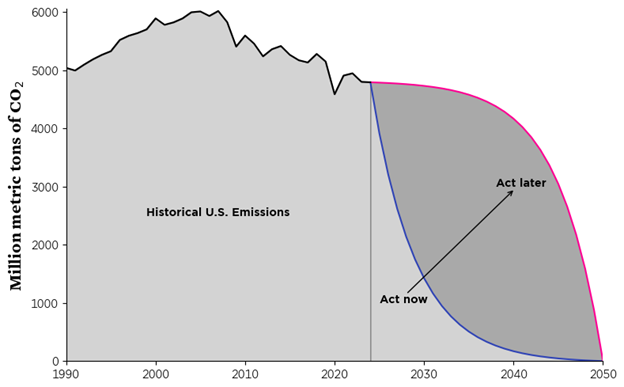
Of course, these are stylized scenarios, but the lesson is this: Taking immediate action on climate change and reducing emissions as quickly as possible gives us the best chance to minimize the damage caused by climate change. Acting later leads to more total emissions. Our goal must be to bend the curve downwards. This is why near‑term policies that lower the emissions curve, like clean energy standards, vehicle electrification, alternative fuels, lowering hurdles to deployment, and demand‑side efficiency, deliver outsized climate benefits relative to later innovations. Every year we delay increases the area under the emissions curve.
3. AI for Climate Science and LLMs are not the same thing
Artificial intelligence can aid climate change solutions in several important ways. This includes better understanding and predicting climate impacts—such as improved weather forecasting, enhancing extreme event detection and attribution, and downscaling climate models—as well as potentially supporting technological and process improvements on the solution side—such as facilitating molecular breakthroughs or accelerating complex engineering processes to expedite clean energy deployment. But while each of these types of contributions have real value, none address the fundamental problem at the heart of the issue: lack of political will, not lack of information or lack of solutions.
Moreover, new data center capacity is primarily driven by consumer-level LLM, not narrowly tailored applications focused on climate change. The AI-driven solutions I described above represent highly specialized applications and the total usage will only ever represent a small fraction of the computational energy demand from new hyperscale data centers, which are increasingly used for simple, everyday tasks—by hundreds of millions of people around the world.
Proponents of AI development often use the argument that “AI will help solve climate change” to justify a massive, emissions-heavy infrastructure buildout to support near-term AI ambitions—new fossil fuel-fired power plants, new gas pipelines, delayed coal plant retirements, the overwhelming share of which has absolutely nothing to do with climate change-relevant AI. The sharp difference in application, and their comparative compute requirements, matters for policy: We should not conflate pursuit of targeted scientific computing with an unchecked build‑out of LLM capacity.
4. AI adds tremendous pressure to the electricity system
LLMs require tremendous amounts of computing power for the training process, and even more to serve users. Excitement about the possible uses of LLMs, largely speculative hype driven by AI companies, made AI data centers the fastest growing source of energy demand in the United States in 2024, and this growth is only expected to accelerate in the near-term. Projections from LBNL show that, in the high case, data center demand could reach 600 terawatt-hours (TWh) by 2028–nearly 13% of total US electricity demand, and more than the entire state of Texas used in 2024.
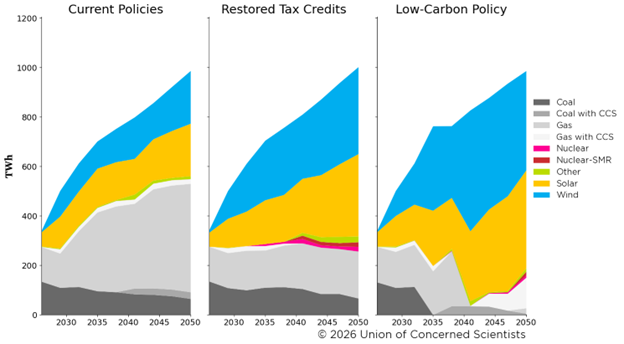
AI data center operators will look for any way they can to meet this new demand for electricity. As one recent UCS analysis shows, data center demand under current policies threatens to be primarily met by more natural gas generation—and indeed, that’s the scenario repeatedly playing out right now in fights across the country. This means that the choices regulators make now about how data centers are powered (as well as whether to power every data center that gets proposed) will reverberate into the future. Powering data centers with natural gas or coal will lock in further warming and worsen air quality leading to billions in public health costs.
UCS modeling further showed that even with high proposed levels of data center deployment, smart clean energy policies can result in most of this demand can be met with clean energy like solar and wind. The figure below shows the difference in electricity generation between a middling data center growth scenario and a no-growth reference scenario for three different policy cases.
In addition to exacerbating climate change and air pollution, data centers also consume a lot of water for cooling and are frequently built in already water-stressed locations. Data centers also generate noise and heat pollution for neighboring communities. Further, data centers often require new transmission and generating infrastructure which increase the cost of electricity. Rarely do data center owners and AI proponents bear these costs. Instead, they fall to the communities that are forced to share their resources and electric grid. When AI evangelists argue that the technology will someday pay for itself through climate benefits, these immediate, tangible harms must be included on their side of the ledger.
Looking to the future
We already know the causes of, and solutions to, the climate crisis—and the costs and harms of delaying action. Instead of relying on a hypothetical future AI “solution,” we need to focus on overcoming the real hurdles stalling climate progress.
Namely, we need policymakers to commit to climate action, commit to polluter accountability, and commit to overcoming vested interests. Not holding out for some hypothetical silver bullet, but committing now to doing the real work, the hard work, the grunt work: mobilizing action, and sustaining progress.
Moreover, we must now also ensure policymakers are taking action to prevent AI from being part of the problem. On speculative demand; on offloading of environmental, health, and economic risks and costs; on active pursuit of fossil fuels; on promise and perils—on all of these, tech companies must be challenged and must be held to account.
Unfortunately, implementing these solutions requires hard work and a level of commitment that has been lacking. Prioritizing time and money spent on AI, rather than contributing to known solutions, is at best a distraction, and at worst exacerbates the problem. We need to stop kidding ourselves—AI is a tool, and while it may be useful, the most effective tools we have for solving climate change are policies, not algorithms.