
Modeling our electricity system is essential for planning for our energy future, but energy models require detailed information about electricity demand: the amount of electricity consumed by people, industry, data centers, etc., and the location and timing of where and when the demand is needed are key to building these electricity models. Unfortunately, there is a critical lack of data around the number, size and location of data centers and how they use energy. This lack of transparency is compounded by the fact that data center proposals are often confidential and speculative, with some owners concealing the locations of planned data centers for “security reasons and/or for competitive advantage.”
There is also a general lack of transparency by the industry as a whole; Google, Amazon, Microsoft and other tech companies often work through subsidiaries to build data centers, “masking their presence and revealing little about the resources that the facilities consume.” There is no central database providing information for the numbers of data centers currently in operation, under construction, or in the planning stages. And there is no accountability for data center developers and utilities who may see the current landscape as an opportunity for profit.
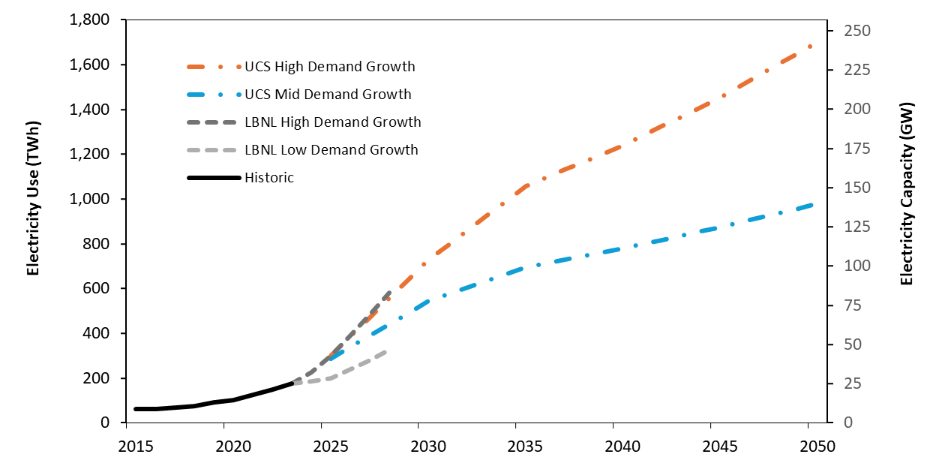
For our own data center analysis, UCS used electricity demand projections developed by Evolved Energy Research (which itself draws from a database of existing data centers from Baxtel), and we supplemented this data with news reports about announced projects and utility filings from both public sources and private databases. Private (read, costly) databases such as S&P Global and BloombergNEF have information about individual projects, but these databases are not complete.
We additionally made assumptions about which proposals might be built using data from an Independent System Operator (ISO) and from data purchased from S&P Global. This was not a straightforward process and was in the end both time consuming and costly. Ultimately the electricity demand projections were in the range of other bottom-up projections from national labs and industry studies. And after all of this effort, our projections quickly became outdated as the data center market is rapidly evolving, underscoring the need for both dedicated and transparent reporting by data center developers.
Without access to precise information on where data centers may be built and how they are operated, utility planners, grid operators, federal, regional, state and local agencies and researchers end up using their best guess at approximations and projections of how much electricity is required at specific places and times, which could lead to inaccurate conclusions, and risks saddling ratepayers and utilities with unneeded costly fossil fuel plants – not what you want when you are making investment decisions that could last for 30 years or more.
Inaccurate data about electricity demand leads to poor planning of infrastructure expansion. Over-building leads to higher short-term costs and heat-trapping emissions, while under-building leads to reliability issues. Long-term, both lead to even more costs when the problems must inevitably be fixed.
Developers are rushing to build data centers and are asking utilities to keep up with their proposed increased power requirements. This is a particular problem in many parts of the country; in states that UCS studied like Illinois, Michigan, Wisconsin, Louisiana, and California, state planning for utilities can have additional challenges (such as having no state Integrated Resource Planning (IRP) process, interstate electricity trading that could lead to even more fossil electricity generation, or states that fast tracked electricity infrastructure for data centers with minimal planning).
The lack of transparency and accountability around data centers in these states and others compounds potential problems with poor planning: utilities can over-build infrastructure, delay coal plant retirements, and can unnecessarily invest in fossil gas capacity. This is costly to consumers, increases pollution, and negatively impacts the health of communities. Communities are often either not provided with information on data center energy use, water consumption, and pollution produced or are straight up given misinformation about data center impacts. Some data centers are proposed in communities that already experience high levels of pollution from energy generation, potentially exacerbating already existing problems. But the possibility of billion dollar investments by data center operators in communities and the lack of planning can cause local decisionmakers to overlook very real risks.
These policies across many states and at the federal level risk setting us up for a future dependent on fossil fuels. Often, states see data centers as a way to promote local economic growth, spur job creation and increase local tax revenues. State and local governments have been offering data center developers tax discounts and other incentives. These tax breaks have led to massive data center growth in states with larger incentives.
But some states are now beginning to pause (or having the appearance of pausing) and rethink data center-related policies. Texas is seeing a huge loss in state revenue: the Texas governor announced a pause on new data centers for the state Public Utility Commission (PUC) and ERCOT to conduct an audit of projects to be approved, but has allowed the giant Meta $10 billion 1 GW, enough to power 750,000 average US households, data center project to move forward. Minnesota rolled back its data center tax incentives, removing the data center electricity exemption from the state sales tax. Wisconsin removed some data center financing incentives from two municipalities. And New York is the first state to impose a temporary moratorium (through July 2027) on building new data centers of 50 MW or larger until the state has had a chance to evaluate the potential impacts.
It’s encouraging that these states are slowing down data center development to listen to the concerns of communities, but we also need to do more to ensure a clean, affordable, and healthy electricity system for the electricity load that is imminent. Our recent analysis has shown that the US can meet increased demand from data centers primarily with clean energy while simultaneously phasing down fossil fuels. But we need strong policies to support and accelerate a clean energy transition. And we also need best practices and policy and regulatory changes at the federal, state and regional levels to ensure accountability and smart planning around data centers.
Increase data center transparency and accountability
State and federal policymakers need to require that data center developers and utilities be transparent in their contract negotiations and eliminate non-disclosure agreements. There should be public proceedings (with enough notice for communities to make informed decisions) for power purchase agreements and grid interconnections between data centers and utilities. Data centers need to publicly report and be held accountable for their electricity needs, water use, land use, onsite and induced emissions, and other data. Data centers need to be held accountable for any hazardous reliability, environmental, or public health impacts.
There are some moves at the national level to try to improve data center reporting. The North American Electric Reliability Corporation (NERC) is moving to require that data centers become registered entities and is currently drafting reliability standards for data centers.
NERC has the opportunity to enact rigorous standards that protect the grid and communities that rely on it everyday — submit your public comment here in support of strong reliability standards for data centers.
The NERC draft standards are to establish modeling data requirements, verification, and reporting procedures by data center owners, to ensure that grid operators and utility planners have the site data and information they need from data center owners to “plan, monitor, and assess the reliable operation” of the power system, and to have “adequate data available” from data center owners to ensure reliability and resource adequacy. These NERC standards are a good first step, but the information the data center owners are providing to meet these standards are confidential to NERC and are only focused on grid reliability. The Energy Information Administration (EIA) is also working to collect energy usage data from data centers. At the state and local level, there are efforts to prohibit lawmakers from signing NDAs and some state public utility commissions/public service commissions are working to not allow (as happened in Michigan) utilities to connect data centers through ex parte processes. These efforts should be widely adopted and become standard practice for all data center proposals.
Require utilities to conduct transparent long-term planning to include data centers
States need to require utilities to create long-term integrated resource plans (IRPs) that include transparent reporting of electricity demand from data centers, including any projected demand increases (this should cover any projected increases in load including data centers, population changes, changes due to electrification, etc.). Currently only 27 states are considering legislation to regulate data centers. It is important to conduct detailed modeling and analysis to make investment decisions for electricity generation to meet both electricity demand and any state climate and clean energy policies.
These plans, and the assumptions that went into the analysis for the IRPs, need to be made public. State regulators need to demonstrate to their communities that investments made in electricity generation are well planned, to minimize the risk of over- or underbuilding the electricity system. Data center developers need to be held accountable for the additional costs to the electricity system due to their increased load. There should be requirements around new data center loads to eliminate speculation so that rate payers are not stuck with the costs of over-building.
There is a lot of uncertainty if the increase in electricity demand due to data centers is going to continue, or if the AI bubble is going to “pop”. Investments in data centers and AI infrastructure has greatly exceeded data center revenue, which is worrying investors. When the AI bubble bursts we will be stuck with way more electricity generating capacity and other data center infrastructure than we need: investments that are “stranded” and beg the question of who pays the bill. As these IRPs are being developed, utilities should be cautious and need to place more emphasis on near-term projects that have already made significant financial commitments.
The data center boom is currently outpacing our electricity system’s ability to respond, already driving up electricity rates. Our federal, state and local governments need time to evaluate our complex electricity system, with its aging and polluting infrastructure and increasing electricity demand. We need accurate data enforced through standardized reporting requirements to make informed investment decisions for the size and type of new electricity generating capacity to build, where and when to meet this new demand, to keep electricity costs affordable and to limit the impacts of climate change.
This degree of data transparency must also be extended to water use and other environmental impact reporting. We need good data to develop policies to encourage investments in renewable energy and keep electricity costs affordable. Accurate data is essential for developing smart plans and making informed decisions to provide all consumers with clean affordable power. The first step to ensuring clean and affordable energy for consumers is an informed group of decision-makers that keep AI and utilities accountable for their impacts and investments to our grid.
Urge NERC to establish strong standards governing data centers today! Use the form here to submit your comment calling on NERC to comprehensively address the nature of the risk that computational loads such as data centers pose, ensure the proposed requirements are robust and fully vetted by stakeholders, ensure that all AI data centers are held to the same robust standards, and ensure that the process is transparent for the public and developers alike.