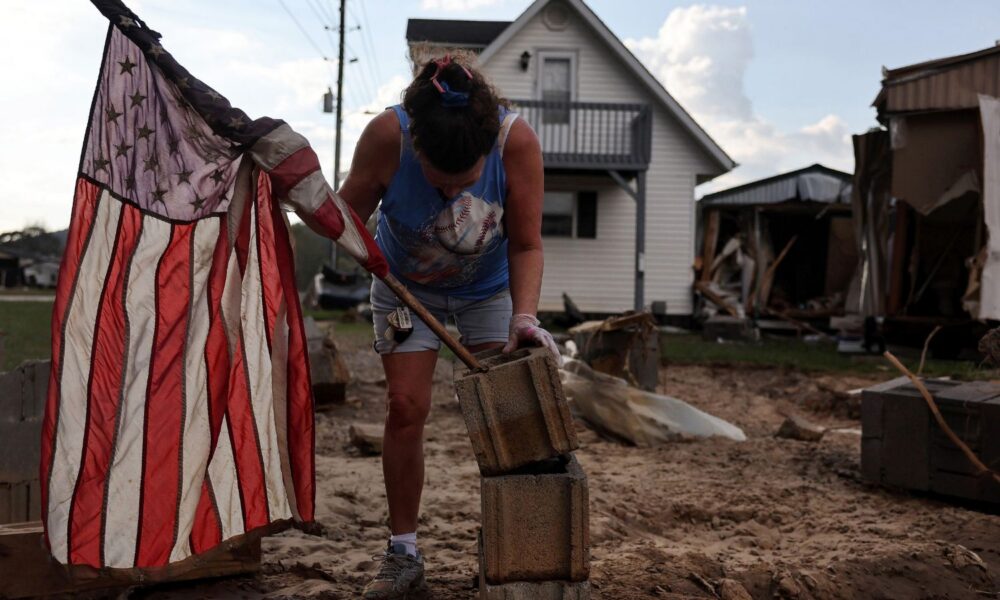

The Federal Emergency Management Agency (FEMA) is designed to help communities prepare for, cope with, and recover from extreme weather and climate-driven disasters. But over the last year and a half, the Trump administration has been taking an axe to the agency and implementing actions to shirk federal responsibility and place the burden of disaster response and recovery onto state, local, Tribal, and territorial governments.
On top of that, the Trump administration’s actions have set off an affordability crisis that further shrinks people’s ability to prepare for, cope with, and recover from disasters. With the North Atlantic hurricane season starting today (June 1 through November 30), we should all be demanding our policymakers do better to protect people and the economy.
2026: the “Triple Danger” of the unchecked Trump administration
Danger Season is the time of year between May and October when extreme weather in North America becomes most intense and frequent, with heat, flooding, wildfires, drought, and hurricanes posing the highest risks. 2026 is feeling different from the past. This year, we’re experiencing the triple crises of climate change, the reckless authoritarian Trump administration, and economic insecurity becoming overwhelming. My colleague Erika Spanger speaks to how these crises begin to collide in her recent post, noting that as the Trump administration delays and attempts to cancel critical programs like FEMA’s preparedness grants, it weakens the ability of local communities to prepare for, cope with and recover from climate impacts—the same communities that are feeling stress from higher gas and food prices and need support the most. The people who will experience Danger Season most acutely are those who can least afford to cope.
And while NOAA predicts a below normal 2026 Atlantic hurricane season, the forecast is for between 8 to 14 named storms, three to six hurricanes and the potential for one to three major hurricanes. On top of the considerable cost of air conditioning in deadly heat, many people lack the wherewithal to prepare for and recover from even one major hurricane.
The current state of FEMA
It’s been an emotional and turbulent whirlwind for FEMA staff under President Trump’s second term, which has reverberated throughout the nation’s communities.
In October of 2025 I wrote about the state of FEMA and its lack of readiness to respond to disasters. There have been changes since then, but the main goal of President Trump’s actions remains the same: to weaken the agency. This is evident as the administration fires experienced staff indiscriminately, politicizes disaster aid, and pushes the burden of disaster response and recovery onto state, local, Tribal and territorial governments.
The new DHS Secretary Markwayne Mullin has reversed some of the dismantling conducted during the disastrous term of prior Secretary Kristi Noem, no doubt due to pressure from Congress but also under federal court orders. Secretary Mullin may just be convincing the administration that we need the trainings, grants, and people that they ended, cancelled, and fired. Here are some of the recent reversals to FEMA-related attacks under Trump’s administration.
- DHS Secretary Mullin told members of Congress during his confirmation hearing that he’d do away with former DHS Secretary Noem’s $100,000 expenditure review requirement and that he’d speed up disaster assistance; he’s done the first and made steps in the right direction on the second.
- After two Federal court orders, FEMA finally issued a notice of funding for $1 billion for the Building Resilient Infrastructure and Communities (BRIC) program. But this is still far below the $4.6 billion appropriated by Congress via the Infrastructure Investment and Jobs Act and from FEMA’s Disaster Relief Fund (DRF) set-aside.
- On May 13, 2026, FEMA released $600 million in Flood Mitigation Assistance (FMA) grant funding after it had retracted it on February 14, 2025. This grant notice makes funds available for capability and capacity building, individual flood risk reduction projects and individual flood mitigation projects available for communities participating in the National Flood Insurance Program (NFIP).
- On April 30, 2026, FEMA rehired 14 staff that Secretary Noem fired for signing the Katrina Declaration. The declaration warned Congress of the Trump administration’s dismantling cuts and devastating attacks on FEMA’s programs and missions and urged them to act.
- On April 30, 2026, the Washington Post reported that FEMA would be rehiring 100 of its 300 Cadre of On-Call Response and Recovery (CORE) employees that FEMA had not rehired in January as part of Secretary Noem’s plan to cut FEMA’s workforce by 50%. However, the actual number is questionable as some CORE employees declined reinstatement and some had retired so were not eligible for reinstatement. FEMA’s CORE employees are hired for two-to-four-year contracts and deployed to disaster sites where they work within one of the 23 “cadres”—operational or programmatic groups. They make up the largest part of FEMA’s workforce at 39% (8,802) employees, followed by surge capacity who come from other agencies at 35%, permanent employees at 22% and other at 5%.
While these reversals are good news, quadruple stressors at the agency are going to challenge FEMA’s ability to respond to simultaneous disasters and include: 1) unqualified leadership; 2) brain drain—that is, the departure of longtime staff with institutional knowledge—and other staffing losses; 3) grant delays and uncertainty; and 4) radical policy shifts.
Unqualified leadership
Given the very low bar that Secretary Noem set, Secretary Mullin is a step up. But as I wrote in my March blog, he is unqualified to lead DHS, as he is a climate denier, backed extreme immigration policies, spread misinformation about FEMA, and voted against certifying the 2020 elections, among other issues. Former DHS official Miles Taylor, in an NPR interview, recently spoke to how the DHS secretary position is “the hardest job in Washington, I mean, hands down, this is absolutely the hardest job in Washington. And what you don’t want is someone going into that job who doesn’t ask questions, someone who doesn’t speak truth to power.”
After a year and a half in office and three unqualified acting FEMA administrators (Cameron Hamilton, David Richardson, and Karen Evans) President Trump nominated Cameron Hamilton on May 11 (yes, the same man he fired for testifying that FEMA should exist) to lead FEMA. Hamilton admitted to sharing misinformation about the agency on social media, lacks the required qualifications and the 5 years of experience required under law (the Post Katrina Emergency Management Reform Act (PKEMRA) of 2006), and should not be confirmed by the Senate (but he most likely will be).
Roughly half of FEMA’s leadership, 18 out of 38 of top-level positions have yet to be filled as of today, at the start of the Atlantic hurricane season. Empty positions include: FEMA Deputy Administrator, Chief of Staff, Deputy Chief of Staff, Associate Administrator for National Continuity Programs, both positions for Policy and Program Analysis, Deputy Associate Administrator for Mission Support, both positions for Resilience, Deputy Administrator for US Fire Administration and nine Regional Administrators.
Let’s hope Cameron Hamilton fills these essential leadership roles and other critical staff as soon as possible. But the reality is that it can take six months to a year to recruit and onboard a senior executive and a year to hire full-time staff, according to former FEMA chief of staff Michael Coen. Additionally, the Trump administration still has a hiring freeze in place, and FEMA has only been authorized to hire 300 high-priority staff.
And then there’s Gregg Phillips, the Associate Administrator of the Office of Response and Recovery, arguably the second or third most important role at FEMA. He’s also uniquely unqualified for the role. He’s a conspiracy theorist, known for violent rhetoric and has become infamous for his claims of having teleported to Waffle House.
Brain drain and staffing losses
FEMA has lost roughly one-third of its workforce since the beginning of the second Trump administration due to terminations, buyouts, and early retirements. The Government Accountability Office (GAO) reported that last year FEMA started the hurricane season with just 12% of its incident management workforce available. These numbers are staggering when we think back to the 2023 GAO report that noted FEMA already had a 35% staffing gap at that time. Members of Congress were also alarmed and passed a resolution entitled: “Condemning Federal workforce reductions that undermine preparedness, response, and recovery, and expressing concern regarding proposed future staffing cuts to the Federal Emergency Management Agency.”
But it’s not just the numbers, it’s about the talent that was behind them. Many people who have left had extensive experience in their fields and will be very hard to replace. There are two major lawsuits against the Trump administration involving unfair employment termination. A group of unions as well as local governments and nonprofits brought a lawsuit against a group of US government defendants including President Trump, DOGE, DHS and FEMA for firing CORE employees without the approval of Congress as required under law (you can read the fascinating lawsuit). A second class action lawsuit was filed in federal court on behalf of federal workers claiming the Trump administration unlawfully fired them for working on Diversity, Equity and Inclusion (DEI) initiatives.
Grant delays and uncertainty
The Trump administration’s attacks on FEMA grant programs have been so broad, state and local governments and their partners have been pushed to using the a tool President Trump knows a lot about: litigation. There are roughly five state and local government lawsuits against FEMA/DHS for placing restrictions on, reallocating, withholding, freezing or terminating preparedness and disaster assistance grant funding.
The Executive Director of the Association of State Floodplain Managers Chad Berginnis provided testimony to Congress on the need for FEMA to be “adequately funded and operationally functional.” Berginnis underscored how local and state partners have “experienced significant operational and funding disruptions,” which can only make it more difficult for them to prepare for hurricane season and be ready to take on more response and recovery when a major disaster does hit.
Thankfully, as mentioned above, many of the grant cancellations or restrictions on funding have recently been reversed. However, President Trump continues to play politics with disaster assistance, delaying and denying disaster declarations especially for blue states. Currently 27 disaster declaration requests remain open. The first of these is from Arizona for storm and flood damage and is dated October 24, 2025. The president has also been denying Hazard Mitigation Grant Program (HMGP) funding to states since March 18, 2025, the first President to do so in 27 years. Typically, Presidents award HMGP along with public and individual assistance once they’ve declared a disaster.
Radical policy shift
On January 24, the same day President Trump visited parts of North Carolina destroyed by Hurricane Helene, he signed an executive order establishing the FEMA Review Council. The President’s FEMA Review Council held their last meeting on May 7, when the council members discussed and voted to approve the final report that largely aligns with Project 2025. Most of the policy changes proposed require Congressional actions or new regulations (see table on page 15 at the link), and others would need to be implemented in a phased approach over two to three years. If implemented, the ten major recommendations would: force state, local, Tribal and territorial governments to continue to take on more and more of the burden of disaster response and recovery; push to privatize the National Flood Insurance Program; completely ignore pre-disaster mitigation, leaving communities less prepared for climate-fueled disasters; and reform individual assistance in a way that would leave many people behind and less safe after a disaster, among other reckless policies. Comments are due June 8, 2026, and UCS will be weighing in.
Which FEMA will show up this Atlantic hurricane season?
FEMA has been at the crosshairs of the Trump administration since day one. And as the threats and risks mount this Atlantic hurricane season, with the added risks of extreme weather turbocharged by climate change, we all have to wonder, which FEMA will show up? Will it be the same FEMA as last year that implemented DHS Secretary Noem’s draconian funding rule, causing extreme dysfunction in its response to the tragic Texas flash flooding—when acting FEMA administrator David Richardson was unreachable for over 24 hours, phone calls went unanswered, and funding requests went unpaid? Or could it be a degraded but more stabilized FEMA under the new DHS Secretary Mullin and the nominated FEMA administrator Cameron Hamilton?
My hope is that it’ll be the latter. The current FEMA acting administrator is FEMA Region IX administrator Bob Fenton: his third time in this role, he comes to the position with decades of experience at FEMA. However, on May 14, 2026, Representatives Bennie Thompson and Timothy Kennedy sent a sharply worded letter to Secretary Mullin and acting administrator Fenton to express their “serious and growing alarm over FEMA’s deteriorating readiness to protect the American people.”
Whichever FEMA shows up, we all need to prepare for the 2026 hurricane season
With the incredible destructive force of hurricanes, it only takes one to cause total devastation for a region. As NOAA says, “early preparation is essential to staying safe all season.” Here are some practical ideas to get ready for hurricane season that go beyond the usual important of advice of 1) make sure you have an evacuation plan; 2) have an emergency kit (Build a Kit); and 3) listen to local officials. Thinking ahead and taking small affordable but sensible steps to be prepared and able to cope in a crisis is something we all need to do— especially under an administration that seems to care little for the safety and wellbeing of everyday people. The veteran-led Team Rubicon does care and has this “7 No-Cost and Low-Cost Ways to Prepare for a Hurricane” checklist—check it out!
Call on Congress to demand FEMA readiness and oversight
We need to keep the pressure on the Trump administration to fill FEMA leadership positions with qualified staff, continue to release funding in a timely way, and ensure communities get the help they need to get back on their feet after disasters. This means we also need to keep up the pressure on members of Congress to ensure FEMA is properly funded and to provide accountability and oversight. Please: Tell Congress: Stop Trump’s Dismantling of FEMA and Disaster Relief.