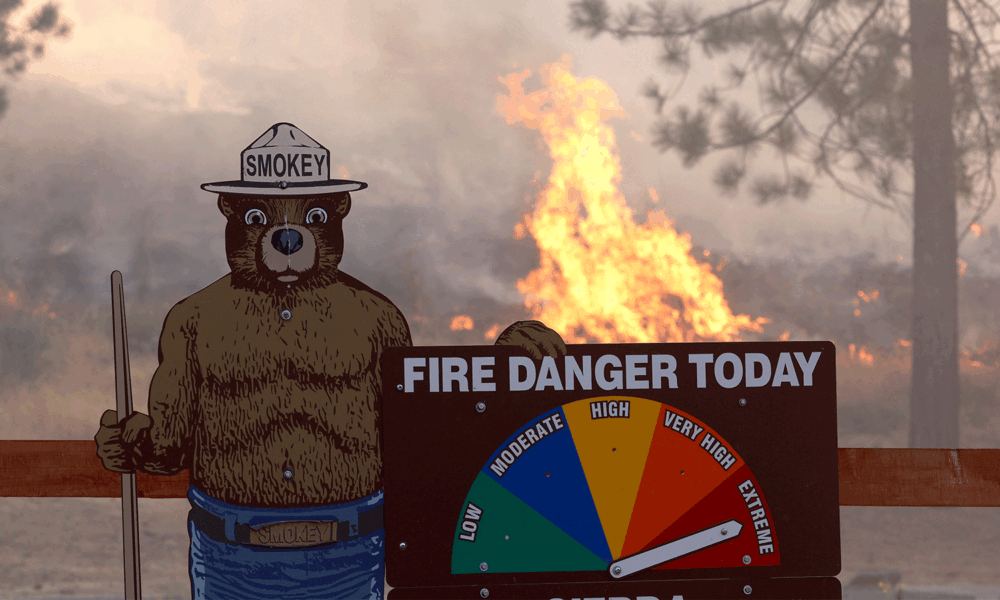

Smokey Bear isn’t just a symbol. He’s a reminder that protecting against wildfires relies on all of us, including supporting wildfire science, which is being taken from us. And President Trump’s plan to diminish our knowledge about wildfires—especially going into a super El Niño year with significant drought risk—isn’t smart.
In a recent post, I wrote about how the Trump administration’s efforts to reorganize the US Department of Agriculture (USDA) Forest Service and shutter 57 of its 77 research and development (R&D) facilities isn’t really about efficiency—it’s about hollowing out another science agency whose mission is to protect people, places, and livelihoods.
The Forest Service has since updated its website to qualify that these R&D closures are “possible” but not a foregone conclusion. Yet, as details of the restructuring emerge, they make one thing painfully clear: this plan would dismantle the world’s premier—and largest—wildfire research agency when wildfire risk, climate impacts, and economic losses are accelerating. Given future drier and hotter conditions and increasing severity of wildfires, losing this research would diminish our understanding of effectively managing forests under climate change.
Our much-beloved mascot Smokey Bear knows that President Trump’s plans to end climate studies, allowing forest fuel loads to build and diseases to spread, leaves our hands tied as we try to prevent wildfires without the benefit of evidence-based science.
So let’s get clear on what will be lost if the Trump administration moves this plan forward.
Research that helps people evacuate safely—gone
Take the Pacific Wildland Fire Sciences Laboratory in Seattle, which is slated for closure under the reorganization. Scientists there conduct fire impacts research on human health, ecosystem function, and wildlife habitat. Current projects include updating maps of fire threats to rural communities and research in support of land managers and wildland fire fighters to identify the best times for prescribed burns that reduce fire hazards and restore forest resilience.
Specifically, the lab produces the Fire and Smoke Map, used by millions of people every year to track fire activity and smoke exposure, with major implications for public health and local economies. The lab also conducts fire and smoke modeling research, fire behavior, and air quality impacts of wildlife. This research directly informs fire evacuation decisions—the kind that determine whether families have minutes or hours to get out safely.
Shuttering the lab wouldn’t just slow down research; it would hamper a real-time safety tool that communities already rely on.
Generations of science investments—lost
Long‑term research studies are important because they reveal patterns, causes, and consequences that simply can’t be seen over short time frames. This is especially true for complex systems like forests. For example, understanding how fuel treatments affect wildfire behavior or how repeated drought affects forest health requires years of observation and comparison. That’s what makes the Forest Service’s experimental forests, some over 100 years old, so special and valuable. These forests provide long-term data that’s irreplaceable if this administration takes a (literal) chainsaw to it.
In Montana
At Hungry Horse, closures would disrupt research tied to the nearby Coram Experimental Forest, where Forest Service scientists have spent decades studying western larch regeneration, silviculture, forest recovery after fire, and climate‑informed management, producing datasets and management guidance that depend on continuous on‑site monitoring and cannot simply be moved elsewhere. Specifically, western larch forests are diverse, productive, and valuable for timber production. Moreover, western larch regenerates well in exposed soil and sunny conditions, making it an important species for reforestation efforts, especially in a changing climate.
The Rocky Mountain Research Station in Bozeman, MT—also slated for closure—supports the Forest Inventory and Analysis (FIA) program. FIA provides long-term data on forest condition and resources across the US. The Coram Experimental Forest helps support FIA through better understanding specific species, like the western larch. Diminishing support for this important long-term research undermines needed forestry science especially in Montana.
In the White Mountains of New Hampshire
At Hubbard Brook Experimental Forest located in the White Mountains of New Hampshire,more than 60,000 samples of water, soil, plants, and physical cores have been collected over multiple decades. These samples are carefully stored and archived in environmentally-controlled facilities, yet the recent Forest Service reorganization puts these samples at risk when facilities are shut down.
Former USDA Forest Service senior policy analyst Anthony Veltri succinctly raises both the importance and serious risk of losing these critical long-term ecological data:
“Hubbard Brook’s real value is not just what it tells us today. It is the fact that it preserves reality in a form future scientists can still interrogate. The long-term environmental record at Hubbard Brook represents profound option value: the ability to ask future questions of past reality. Nobody collecting water samples in 1963 was thinking about PFAS [“forever chemicals”]. The instrument outlasted the question it was built to answer and became the foundation for questions nobody had thought to ask yet. That argument applies equally to PFAS baseline contamination tracking, acid rain attribution, watershed chemistry, and climate monitoring continuity.”
In the US South
The Southern Institute of Forest Genetics in Saucier, MS is a core hub for forest genetics and long-term tree improvement research in the US South. It is also a location slated for closure, leaving at risk the Harrison Experimental Forest and their work on how Southern forests are grown, restored, and adapted to threats such as pests, disease, and climate stress. This research site maintains decades‑old genetic field trials and experimental plantings that track tree growth, pest and disease resistance, and climate responses over time—research that cannot be replicated or relocated once abandoned and that directly informs tree improvement programs used across the South.
Beyond their scientific values, many of these Southern forests are home to iconic landscapes that are directly tied to cultural identities, including coastal cypress swamps and longleaf pine savannas. In addition, southern communities derive a portion of their drinking water from these forested ecosystems.
For example, water from state and private forest lands serve more than 16.7 million people in Texas alone. Southern forests are not just for research, but also for keeping rural economies strong and prosperous. Southern forestry contributes more than $250 billion in economic output and employs over 1.3 million people. Southern forests’ health, productivity, and ecological services sustain communities, and the research that happens in and on these biological treasures is worth saving.
In the Pacific Islands
Then there’s the Institute of Pacific Islands Forestry (IPIF) in Hilo, Hawaii, also slated for closure, which is the Forest Service R&D’s only facility in the Pacific. Researchers here have spent decades studying how diseases and invasive species threaten unique tropical plants. R&D scientists also study tropical forest conservation, drought, and wildfire risk—issues that are intensifying across Hawaii and other Pacific islands under climate change.
Closing the Hawai’i forestry station could result in Big Island forests disappearing within the next 20 years. Forest Service researchers are trying to better understand rapid ʻōhiʻa death, or ROD, a fungal disease that has killed 1 million to 2 million native trees that are the “backbone of Hawai’i’s tropical forests.” According to an extension forester with the University of Hawai’i, the Forest Service IPIF facility conducts about 75% of ROD research.
Long-term drought research in Hawai’i helped show how drought increases wildfire risk during El Niño years, providing historical context that’s essential for understanding and preparing for what’s expected to be a super El Niño this year, as well as future climate threats. In addition, this analysis uncovered $80 million in agricultural relief payments tied to drought events since 1996. I contributed to this multi-agency research, and it pains me to see less of this critical climate change research. Land managers will not have the information at hand to adapt and mitigate expected climate threats in the near future.
Climate adaptation tools foresters actually use—eliminated
In Michigan, a state where forests cover 56% of the landscape, four Forest Service R&D facilities are slated for closure. This will directly affect East Lansing and Wellston communities, as well as Upper Peninsula communities of Houghton and L’Anse. Local and state partnerships are at risk, since many Forest Service R&D staff work directly with the Michigan Department of Natural Resources and universities. For example, the Northern Institute for Applied Climate Science (NIACS), housed in the Northern Research Station Forestry Sciences Lab located in Houghton, MI, may be relocated and consolidated to “nearby” labs including in Madison, WI. Another challenge with moving lab staff to other facilities includes storage of research equipment and scientific records and physical space for staff.
Among the tools created and hosted by NIACS is a robust set of adaptation menus that help guide natural resource management and planning under climate change. These include adaptation strategies, approaches, and tactics for forested ecosystems, carbon management in forests, urban forests and human health, wildlife, and fire management. The underlying research and personnel behind these adaptation menus and related future could be discontinued amid this chaotic reorganization.
This isn’t academic theory. These tools are used by people making real decisions about fuel reduction, forest restoration, and community fire resilience—often in rural areas with limited capacity to recover from disasters. Taking these resources away in the name of “efficiency” leaves local managers flying blind.
A blow to local communities and local knowledge
The Trump administration’s plan to relocate staff doesn’t just disrupt the research—it disrupts the communities that support and depend on critical forestry research.
Research doesn’t just happen in isolation. Because many Forest Service labs are deeply embedded in local communities and universities, gutting these research projects also erodes the local knowledge, hard-earned trust, and community engagement built over decades that makes the science effective.
For example, Forest Service R&D scientists work on research projects to serve natural resource managers and land managers, partner with university faculty to leverage their data and findings, and mentor the next generation of scientists by serving on their research committees. As reported in the Bulletin of the Atomic Scientists, students and faculty at the University of Nevada Reno are losing access to long-term forested sites, endangering critical research on post-fire recovery of seedlings.
You don’t replace decades of localized knowledge by moving people to a central office thousands of miles away.
Smokey’s verdict
Smokey Bear’s message, “Only you can prevent wildfires,” has always been simple. It is about taking actions and supporting people on the ground.
This reorganization does the opposite. It disperses scientists from their local communities, shuts down irreplaceable research, and weakens our ability to respond to wildfires, climate change, and economic risk at precisely the wrong moment.
This is just another attack on federal science and scientists. The lack of regard for science as a public good will not only set the American scientific enterprise behind global rivals but also leave communities less safe and less healthy.
If this plan moves forward, the loss won’t be abstract. It cuts off generations’ worth of research at the knees, ending data collection that would be critical for solving current and future problems. Relocating research facilities jeopardizes clean drinking water and critical fire safety tools today, and our ability to recover from drought and wildfires in the future.
Smokey knows better. We should too.