
When devastating weather events make headlines, a question increasingly follows: Did climate change play a role? Where did the emissions driving that risk come from? And what harms result when those risks materialize?
This isn’t just casual curiosity. Communities facing floods, families displaced by wildfires, and governments planning infrastructure need accurate information about how a warming climate affects the risks and impacts we all face.
Attribution science has emerged over the past few decades to answer precisely these questions. And like any scientific field, it deserves thoughtful examination of its methods, limitations, and contributions.
Today, attribution work spans interconnected dimensions. Event attribution asks whether climate change made a specific weather event more likely or severe. Source attribution traces contributions back to specific emitters and sectors. Impact attribution connects climate-driven changes to real-world damages: lost lives, destroyed homes, disrupted livelihoods, and strained public systems. Together, attribution science can help to form a more complete chain of understanding.
Attribution quantifies the contribution of climate change to extreme events
The connection between climate change and extreme weather is well established. In their most recent report, the Intergovernmental Panel on Climate Change (IPCC) concluded that “Human-caused climate change is already affecting many weather and climate extremes in every region across the globe.”
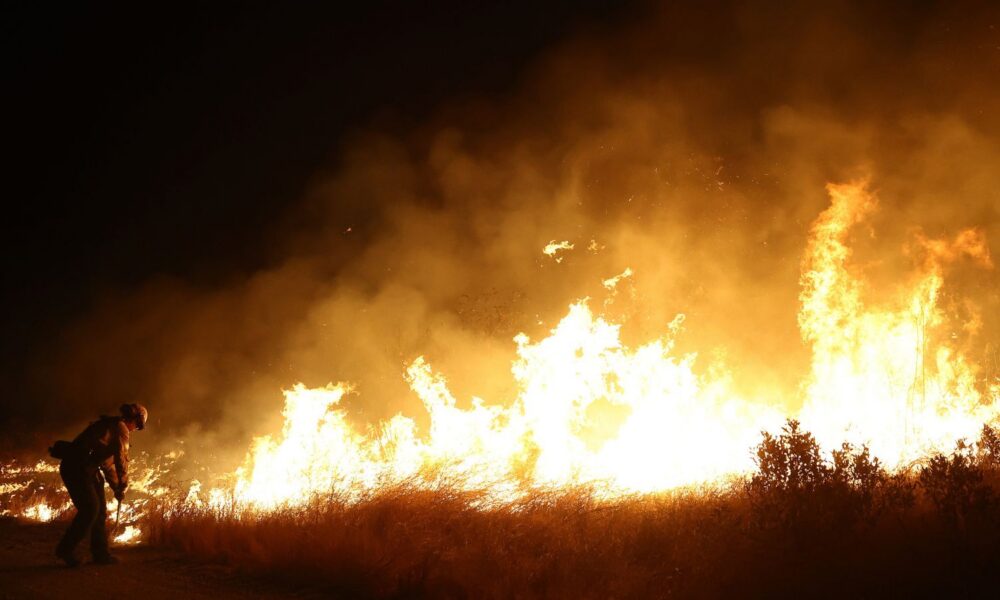
Think of climate change like adding fuel to a fire: The spark might have existed anyway, but the fuel makes it burn hotter and spread further. Weather would exist regardless of emissions from human activities; however, the weather we all experience is changing. Attribution research follows that fuel—from the fire’s intensity, to who poured it on, to what burned because of it.
Put more scientifically, attribution research investigates these changes in weather, asking whether climate change has made an event more likely, more severe, or both. It can also help us to understand how emissions from specific sectors have altered climate events and show us the contribution of climate change to impacts from such events.
Counterfactuals make attribution studies possible
Attribution methodology compares the actual event against modelled scenarios of what might have occurred in a world without human-induced warming. By running simulations with and without anthropogenic emissions, researchers quantify how the probability or intensity has shifted. This counterfactual approach is standard across many scientific disciplines, from epidemiology to economics, and is at the heart of all attribution science.
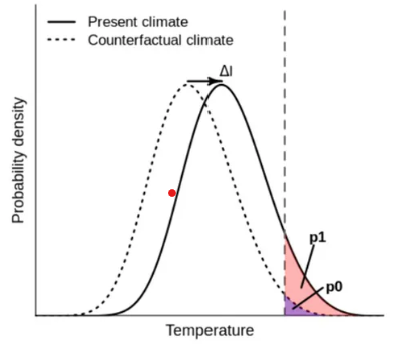
Here is an example of what a counterfactual might actually look like (figure 1 below). This figure from Perkins-Kirkpatrick et al 2024 shows how climate change shifts the odds of extreme heat. The dashed curve represents a counterfactual world without human-caused warming, while the solid curve shows a world with today’s warmer climate. Because the temperature distribution has shifted to the right, very hot days are now much more likely. The shaded areas illustrate this change in risk: an extreme temperature that was rare in the past (p0) becomes significantly more common today (p1).
In order to set a counterfactual, the researcher needs to define what version of the world they are comparing against, and the biggest decision point here is which time frame to use. This choice is based on the specific research question being asked. A study examining long-term climate trends might compare today’s conditions to pre-industrial times, while one focused on policy impacts might use a more recent baseline. In attribution studies examining the fossil fuel industry’s role in climate change, counterfactuals become especially salient given the industry’s decades of documented disinformation campaigns that delayed climate action. By modeling what climatic conditions might have been but for the industry’s actions—such as had they disclosed internal research or ceased obstructive practices at key moments—scientists can quantify not only how much warming occurred, but how much could have been avoided.
Attribution science is a mature scientific discipline
The first peer-reviewed event attribution study appeared in Nature in 2004, examining the 2003 European heatwave that killed tens of thousands of people. This research emerged from academic researchers at University of Reading and University of Oxford in the UK. Until this study was published, scientists had used attribution methodologies to attribute trends in global average surface temperature to climate change, but had never before linked an individual event to climate change, making this study a huge scientific and methodological achievement in the field.
Since then, the field has developed substantial methodological infrastructure to support continued research and development. The National Academies of Sciences published a comprehensive review in 2016, establishing frameworks to assess event attribution research quality and confidence levels. The IPCC has systematically evaluated event attribution literature across multiple assessment cycles, increasing confidence statements as methods improved and evidence accumulated.
Today, attribution studies appear in prominent scientific journals including Nature, Science, Environmental Research Letters, and PNAS. These studies undergo peer review—a standard scientific process—by independent experts who evaluate methodology, data quality, and the author’s characterization of uncertainty. In order to be responsive and help ensure science is available to inform decisions makers, the research group World Weather Attribution has pioneered rapid event attribution assessments. Using peer-reviewed methods, this group of experts produces near-real-time analysis to help inform the public about the role of climate change in specific events.
While there are well accepted methods, this is also a growing field that’s learning and advancing. We are also seeing improvements as computational power increases, observational data expands, and understanding deepens. In journal articles and at conferences, scientists engage in the practice of science by actively debating best practices for baseline selection, model ensemble construction, and uncertainty quantification. This internal critique is healthy science at work.
Evaluating and communicating uncertainty
All rigorous science includes an evaluation and communication of uncertainty, and attribution research is no different. Climate modeling experts are always balancing complexities: countless variables interacting in a changing climate system. That’s why attribution papers routinely report confidence intervals, probability ranges, and explicit statements about methodological limitations.
But not all event types carry the same uncertainty.
For heatwaves, confidence is relatively high because the physics are straightforward (more trapped heat = hotter temperature). For other event types like hurricanes or floods, confidence is lower because multiple factors influence outcomes and models have greater limitations. The IPCC’s Sixth Assessment Report reflects this nuance, expressing high confidence for heatwave attribution while noting lower confidence for tropical cyclones and some precipitation events.
This variability in confidence between event types isn’t a weakness—it’s the manifestation of standard scientific practice. Researchers are careful to match their claims to what the evidence supports. When media headlines simplify these nuances, that’s a communication challenge, not a scientific failure.
How attribution science is used
Attribution research serves multiple purposes across different sectors—none more important than the others, but each drawing on the science in distinct ways.
For communities and planners, attribution science informs practical decisions about infrastructure, insurance, and emergency preparedness. A city designing flood defenses needs to know whether historical rainfall records still represent future risk. An agricultural region needs to understand changing drought probabilities. A utility company planning grid resilience needs to anticipate heatwave frequency. Attribution science can be used as one tool to help shape budgets, building codes, and local planning.
For researchers, attribution science advances fundamental climate understanding. By examining how specific events unfold in different climate scenarios, scientists test and refine climate models. This can improve projections for future conditions, strengthening the foundation for climate science.
For policymakers and legislators, attribution findings help quantify climate risks that inform emissions targets, adaptation funding, and regulatory standards. When laws require climate risk disclosure or mandate resilience planning, attribution science provides the evidentiary backbone.
For litigators and their clients, attribution research helps establish connections between emissions, climate change, and specific harms—evidence for courts to weigh in the context of legal standards that vary by jurisdiction and claim type.
Attribution science is robust, growing, and more important than ever
The path forward requires continued investment in attribution research, improved observational networks, better climate models, and clearer communication of what studies can and cannot conclude. It also requires recognizing that scientific uncertainty isn’t ignorance—we often know enough to make informed decisions even while continuing to refine understanding.
Attribution science has matured into a valuable tool for understanding climate change impacts. Like all science, it has limitations that researchers openly acknowledge. But its core findings that human-caused climate change is affecting weather events in measurable ways rest on solid methodological foundations and contribute meaningfully to both scientific understanding and practical decision-making.
Communities facing climate risks and impacts deserve nothing less than rigorous, transparent science. Attribution research, conducted through peer-reviewed channels with appropriate uncertainty communication, delivers exactly that.