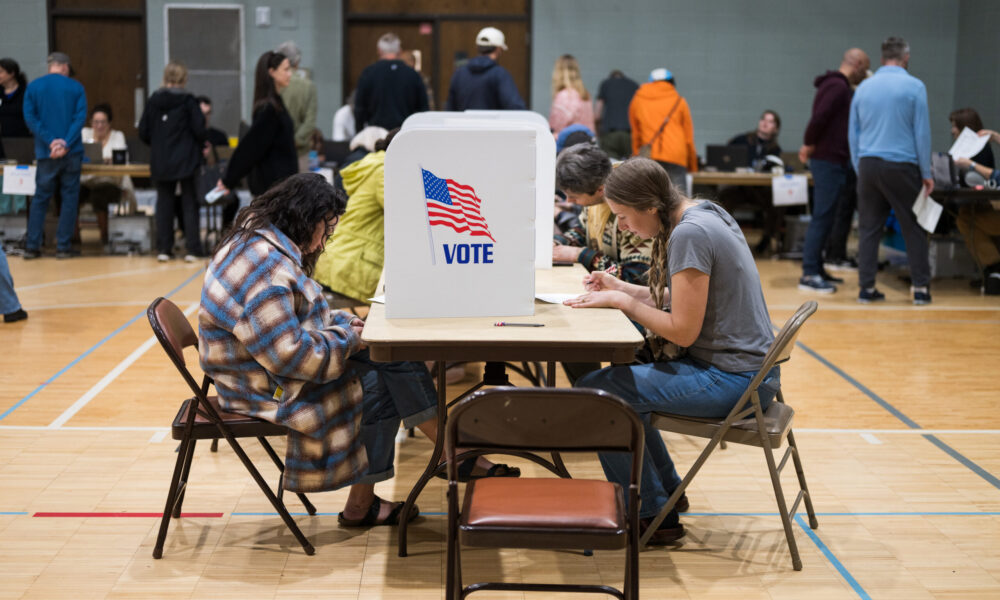

It’s one of the most consistent patterns in American politics: the president’s party, independent of party, loses seats in the election cycle in the middle of a presidential term. Political scientists call this phenomenon the “referendum model”, where widespread public discontent with the status quo guides an electoral backlash against the President’s party, reducing that party’s power on Capitol Hill—and increasing scrutiny of that President—for the final two years of presidential term. This model repeats over the last century of midterm elections, under both Democratic and Republican administrations, with the incumbent party losing House seats in 22 of the last 25 midterm elections and 17 of 25 in the Senate.
This pattern introduces accountability to American politics, and that’s why this president and his allies—afraid of losing power— are trying to limit the ability of voters to in this year’s election.
Consistent with the historical pattern that authoritarian actors seek to undermine accountability by obstructing free and fair elections, there are three main ways the Trump administration and its allies are trying to stifle democracy ahead of this year’s elections. Two of these tactics take place before Election Day: gerrymandering of Congressional maps and efforts to disenfranchise voters from casting ballots. Another tactic worth monitoring happens after the polls close on Election Day: potential challenges to certifying elections that would produce turnover in which party is in the majority on Capitol Hill. Regardless of when they fall these tactics attempt to thwart a free and fair election. We can monitor and challenge these tactics, but in the longer term, the reform provided by proportional representation can strengthen democracy and mitigate the efforts of authoritarians to prevent discontent from discontent to electoral turnover.
Before the Vote: Gerrymandering and Disenfranchisement Tactics
As his poll numbers began to decline in the summer of 2025, President Trump called on the state legislature in Texas to engage in an aggressive gerrymandering, explicitly aiming to increase the number of safe Republican seats in the state to protect the Republican majority on Capitol Hill. Following the successful effort by the Texas legislature to redraw their congressional maps—intended to net a forecasted five or more seats at the expense of Democratic incumbents—the California state legislature responded by successfully proposing a voter initiative to bypass the state’s independent redistricting commission and redraw the state’s congressional districts, aimed at shifting five Republican-held seats to Democratic control. The opening salvos by Texas and California triggered a redistricting war between both national parties across the respective states in which they control the redistricting process. States such as North Carolina, Ohio, and Missouri redrew their districts towards the benefit of one political party. (Missouri’s remapping was reversed this year.)
In their quest to blunt the prospect of electoral accountability through the gerrymandering of districts, supporters of gerrymandering were also aided by the recent Louisiana vs. Callais Supreme Court decision, which narrowed the scope of Section 2 of the Voting Rights Act. The Callais decision made it harder to challenge racially-discriminatory district maps, protecting the right to gerrymander for political reasons and making it harder to undo these maps in the absence of direct evidence of intentional discrimination. Callais effectively ended protections for majority-minority districts formed across the South following the passage of the 1965 Voting Rights Act, which aimed at addressing the dilution of African American electorates through gerrymandering. With the Supreme Court’s implicit blessing, southern legislatures had a new opening, and rushed to gerrymander their states even further. These efforts, over the objections of national Civil Rights groups and voting rights activists, resulted in safe Republican seats being drawn at the expense of former majority-minority districts in Alabama, Tennessee, and Louisiana.
President Trump’s demands for his political allies to draw new maps, aimed at blunting the typical midterm backlash to an incumbent president, t sparked a series of mid-decade gerrymandering decisions that are unprecedented in modern American politics, though the ultimate outcome is unclear. Given the unpopularity of the administration, experts expect the redistricting wars to net President Trump’s congressional allies only a few seats, an advantage that a large enough Democratic wave could erase or even reverse. But the potential for this plan to backfire in the short term shouldn’t make us disregard the clear intention to limit electoral accountability and protect the Trump administration from the accountability that typically results from the “referendum model” of midterm elections.
In addition to pushing allies in the states to re-draw their maps, the administration has taken its own efforts to insulate itself from electoral accountability, targeting voters’ ability to participate and citing myths and fabrications, including the absolutely false concept that voter fraud is widespread and pivotal in deciding elections, as justification. President Trump pursued various authoritarian actions to undermine the access to the right to vote. A March executive order sought to make the U.S. Postal Service the gatekeeper of mail ballots, though the Supreme Court declined to let its postal rule take effect for 2026. In September, the Supreme Court did allow an expanded federal citizenship database built on Social Security data, despite documented errors that flag eligible citizens as noncitizens. Meanwhile, the Justice Department has sued roughly 30 states for their voter files; the FBI seized Fulton County’s 2020 ballots; and the Pentagon removed an option for overseas citizens who have never lived in the United States from federal absentee voting forms. The President has also refused to rule out sending immigration agents to polling places or invoking the Insurrection Act around the election. And for the first time since 2002, the administration declined to invite international observers to monitor a federal election.
Suppression During and After the Vote
Taken together, these efforts at the national level by the administration represents a systematic effort that uses the myth of systematic fraud to place obstacles in front of citizens exercising their constitutional right to vote, while laying the groundwork to delegitimize the outcome of a free and fair election. While many of these efforts have been struck down by judicial decisions, we are closely watching how the administration is trying to shape the electorate and distort the results.
Currently, there are ongoing efforts by politicians at the state level to systematically place barriers between voters and the early voting process. In North Carolina, to give just one example, the State Board of Elections (placed under Republican control by a 2024 lame-duck law) approved a Guilford County plan with no early voting on the campuses of North Carolina A&T University, a historically Black university, or UNC Greensboro, despite both campuses hosting early voting sites in 2024. The board also voted along party lines to drop Sunday early voting in ten counties. And, while federal law bars systematic purges of voter rolls ninety days before Election Day, challenges still exist to individual voters’ eligibility and require careful watching through the November election.
The danger isn’t over once votes are cast: once polls close, states need to count and certify the results, and we’re watching this process closely. In some states, the processing of mail ballots cannot begin until Election Day, potentially delaying results of narrowly-decided contests by a few days, or even longer in cases involving a recount, which are required by some state laws in the event of a very narrow margin.
And, of course, the peaceful transfer of power and the democratic norms of legitimate elections require the losing candidate to concede defeat to the winning candidate. As political science research shows, the number of candidates claiming fraud and refusing to accept the outcome of an election is markedly on the rise, following President Trump’s refusal to accept the outcome of the 2020 election. As of this writing, President Trump still has not conceded the 2020 election or publicly acknowledged defeat in a free and fair election. Indeed, the administration is using falsehoods about the 2020 election to justify their efforts to restrict the vote.
Already, we can see the administration laying the groundwork to challenge or refuse to accept the outcomes of the 2026 elections. In just one example, the Department of Justice, at the behest of President Trump, preemptively filed a lawsuit that would block certification of the Alaska U.S. Senate race if the President’s endorsed candidate does not win re-election. The DOJ has also made unconstitutional demands of states, such as their efforts to get California to set aside mail ballots based on dubious allegations of non-citizen voting. We’ll be watching for candidates who potentially undermine confidence in our democratic institutions by falsely claiming a lack of free and fair elections, and state officials who shirk their mandatory duty to certify election outcomes. Indeed, in recent cycles, courts have enforced this responsibility of certifying election results against officials who sought to invoke discretion (that does not exist) to simply refuse to certify election outcomes they disagreed with. This commitment by the courts to compel state officials to fulfill their statutory responsibility to certify the results of a free and fair election is particularly important during a period where about a quarter of Americans express low trust in the electoral process.
Lastly, we will watch closely the final milestone ratifying the results of the 2026 elections: the seating of a new Congress on January 3, 2027. The House is not a continuing body under the 20th amendment, and every member’s term, including the Speaker’s, ends on noon of that day. As a result, the outgoing Speaker has no power to refuse to seat the new Congress. Operationally, this means that the House Clerk calls the roll of members-elect based on the election certificates the states submit, and those new members elect their own Speaker, a precondition of the formal swearing-in of the members-elect. While the Speaker cannot refuse to seat a duly elected member-elect, we are watching for the narrower risk lying in disputes over individual seats, whether through contested certificates or challenges under Article I, Section 5, which makes the entire body of the House the judge of its members’ elections. This is why certification matters towards the orderly transition of power following a free and fair election.
It’s a vital test of electoral accountability in a democracy: does the incoming House reflect the outcome of a free and fair election? As political scientists and election forecasters note, all objective signs point to a classic midterm election resulting from the “referendum model,” where out-party voters are more mobilized than in-party voters and thus sweep their party into power for the final two years of a presidential term, a pattern overwhelmingly consistent in over a century of election outcomes. Absent a proportional representation system that would constrain gerrymandering as strategy of blunt voter accountability, we note that the concentrated efforts we’ve seen to systematically gerrymander congressional districts are an attempt to stifle the “referendum model” outcome. A change in Congressional power could prove both a challenge to the legislative agenda of the Trump administration and open the administration to scrutiny as a new Congress exercises its oversight and investigatory power. We know why the Trump administration is trying to prevent this, and we can see the array of tactics they’re using. We remain vigilant but calm, in hopes for a truly free and fair election. Fortunately, courts have generally struck down efforts to disenfranchise voters and block certification of results. Despite a bitterly contested and polarized electoral landscape, with diligence, we can participate in the electoral process and act to defend free and fair elections for all.